Results by title
62 books match the query 'Ghosts' and 4 start with a
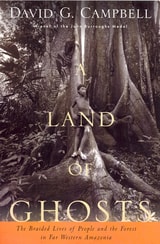
A Land of Ghosts
The Braided Lives of People and the Forest in Far Western AmazoniaCampbell, David G
Rutgers University Press, 2007
For thirty years David G. Campbell has explored the Amazon, an enchanting terrain of forest and river that is home to the greatest diversity of plants and animals to have ever existed, anywhere at any time, during the four-billion-year history of life on Earth.
With great artistic flair, Campbell describes a journey up the Rio Moa, a remote tributary of the Amazon River, 2,800 miles from its mouth. Here he joins three old friends: Arito, a caiman hunter turned paleontologist; Tarzan, a street urchin brought up in a bordello; and Pimentel, a master canoe pilot. They travel together deep into the rainforest and set up camp in order to survey every woody plant on a two-hectare plot of land with about as many tree species as in all of North America.
Campbell introduces us to two remarkable women, Dona Cabocla, a widow who raised six children on that lonely frontier, and Dona Ausira, a Nokini Native American who is the last speaker of her tribe's ages-old language. These pioneers live in a land whose original inhabitants were wiped out by centuries of disease, slavery, and genocide, taking their traditions and languages with them. He explores the intimate relationship between the extinction of native language and the extirpation of biological diversity. "It's hard for a people to love a place that is not defined in words and thus cannot be understood. And it's easy to give away something for which there are no words, something you never knew existed."
In elegant prose that enchants and entrances, Campbell has written an elegy for the Amazon forest and its peoples-for what has become a land of ghosts.
Alas Poor Ghost
Gillian Bennett
Utah State University Press, 1999
In the rational modern world, belief in the supernatural seemingly has been consigned to the worlds of entertainment and fantasy. Yet belief in other worldly phenomena, from poltergeists to telepathy, remains strong, as Gillian Bennett's research shows. Especially common is belief in continuing contact with, or the continuing presence of, dead family members. Bennett interviewed women in Manchester, England, asking them questions about ghosts and other aspects of the supernatural. (Her discussion of how her research methods and interview techniques evolved is in itself valuable.) She first published the results of the study in the well-received Traditions of Belief: Women and the Supernatural, which has been widely used in folklore and women's studies courses. "Alas, Poor Ghost!" extensively revises and expands that work. In addition to a fuller presentation and analysis of the original field research and other added material, the author, assisted by Kate Bennett, a gerontological psychologist, presents and discusses new research with a group of women in Leicester, England.
Bennett is interested in more than measuring the extent of belief in other worldly manifestations. Her work explores the relationship between narrative and belief. She anticipated that her questions would elicit from her interviewees not just yes or no replies but stories about their experiences that confirmed or denied notions of the supernatural. The more controversial the subject matter, the more likely individuals were to tell stories, especially if their answers to questions of belief were positive. These were most commonly individualized narratives of personal experience, but they contained many of the traditional motifs and other content, including belief in the supernatural, of legends. Bennett calls them memorates and discusses the cultural processes, including ideas of what is a "proper" experience of the supernatural and a "proper" telling of the story, that make them communal as well as individual. These memorates provide direct and vivid examples of what the storytellers actually believe and disbelieve. In a final section, Bennett places her work in historical context through a discussion of case studies in the history of supernatural belief.

American Pronghorn
Social Adaptations and the Ghosts of Predators PastJohn A. Byers
University of Chicago Press, 1997
In this elegantly written book, John A. Byers argues that these mystifying behaviors evolved in response to the dangerous predators with whom pronghorn shared their grassland home for nearly four million years: among them fleet hyenas, lions, and cheetahs. Although these predators died out ten thousand years ago, pronghorn still behave as if they were present—as if they were living with the ghosts of predators past.
Byers's provocative hypothesis will stimulate behavioral ecologists and mammalogists to consider whether other species' adaptations are also haunted by selective pressures from predators past. The book will also find a ready audience among evolutionary biologists and paleontologists.
Arkansas in Ink
Gunslingers, Ghosts, and Other Graphic TalesGuy Lancaster
Butler Center for Arkansas Studies, 2014