Results by title
6 books match the query 'Gibbons, J. Whitfield'
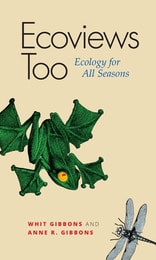
Ecoviews Too
Ecology for All SeasonsWhit Gibbons and Anne R. Gibbons
University of Alabama Press, 2017
Discover the wonders of ecology through the changing seasons of the natural world.
Whit Gibbons and Anne R. Gibbons’s Ecoviews Too: Ecology for All Seasons is based on the popular weekly column “Ecoviews,” published by numerous newspapers for more than thirty years. A follow-up to Ecoviews: Snakes, Snails and Environmental Tales, this lively and entertaining book provides a fascinating and thought-provoking look at the ecology of animals, plants, and their habitats, and promotes awareness of pressing environmental issues.
Because nature, in all its myriad and amazing manifestations, can be enjoyed all year round, this collection is conveniently divided into four sections paralleling the seasons and tracking the adaptations and responses of wildlife to the relentless changes that occur at any location over time. The ecological vignettes focus on seasonal happenings in the cycle of life. The authors not only draw parallels between the natural world and human activities but also highlight unique behaviors of various plant and animal species. They often use humor to get across their message regarding the need to protect our native species and the habitats they depend on for survival.
An intriguing and captivating publication, Ecoviews Too is comprised of fifty informative essays that address ecological topics such as camouflage and mimicry, hibernation and estivation, the human need to encounter scary animals, the mysteries of plant dormancy in winter, the comeback of the wild turkey coinciding with the decline of bobwhites, the chemistry behind the color change in fall leaves, and the top ten environmental problems facing the world today. Educating, entertaining, and delighting a general audience, especially those with an interest in nature, Ecoviews Too provides a useful resource for students and scientists alike.
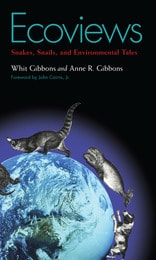
Ecoviews
Snakes, Snails, and Environmental TalesWhit Gibbons and Anne R. Gibbons
University of Alabama Press, 1998
Discover the wonder of nature through stories that connect science, wildlife, and everyday life.
This lively and entertaining book provides a fascinating and thought-provoking look at the ecology of animals, plants, and their habitats and promotes awareness of pressing environmental issues. The eight informative chapters deliver effective environmental messages and supply compelling insight into the natural world and the ecologists who investigate its many mysteries.
From a concerned ecological stance, the authors show that human relationship with other organisms and the environment is always complex and can be exhilarating, inspiring, humorous, and irritating, depending on perspectives and circumstances. Writing truly to inform and delight, they give a captivating variety of examples from the natural world in hopes of making readers of all ages more compassionate, more tolerant, and more sensitive to other living organisms and their interrelationships. The book celebrates the intrinsic worth of all plants and animals in order to motivate people in a unified effort to preserve the Earth's rich array of life forms. The preservation of the integrity of our planet's biodiversity is, the authors illustrate, critical to our own survival.
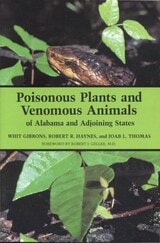
Poisonous Plants and Venomous Animals of Alabama and Adjoining States
Whit Gibbons, Robert R. Haynes, and Joab L. Thomas
University of Alabama Press, 1989
The essential guide to identifying and understanding the Southeast's toxic plants and venomous wildlife.
Wisteria, mistletoe, oleander, milkweed, narcissus, yellow Jessamine, wild hydrangea, trillium, all are plants easily recognized by most people. But these and more that 200 other plants in Alabama and the Southeast can cause systemic poisoning if ingested by human beings and livestock. This book describes these poisonous plants, including various mushrooms, and discusses the toxic properties, symptoms of poisoning, habitat occurrence, and geographic distribution. One chapter describes plants that cause dermatitis or other allergic reactions-plants including poison ivy, poison sumac, ragweed, clematis, and red maple.
Other chapters of the book discuss venous animals-not only the six venomous snakes of the Southeast but also certain jellyfishes, centipedes, spiders, scorpions, stinging caterpillars, wasps, hornets, bees, catfishes, stingrays, and others- that might be encountered by people during recreation or work. The authors describe habitat occurrence, geographic distribution, and general life history and behavior for these animals. Numerous color photographs and drawings of both plants and animals are included for identification, as well as hundreds of range maps.
The authors encourage an appreciation for the protective mechanisms hat help plants and animals defend themselves against predators or other threats. Although people must be able to recognize a poisonous plant or venomous animal in order to avoid suffering unwary contact, the book reassures the reader that Alabama’s flora and fauna gives us little cause to worry on a relative scale. The information provided increases our understanding of and admiration for these species and their environments.
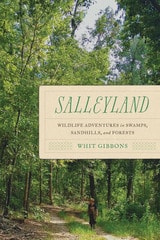
Salleyland
Wildlife Adventures in Swamps, Sandhills, and ForestsWhit Gibbons
University of Alabama Press, 2023
WINNER OF THE SOUTH CAROLINA OUTDOOR PRESS ASSOCIATION'S EXCELLENCE IN CRAFT FOR THE BEST OUTDOOR BOOK AWARD
Adventures and misadventures exploring nature on a patch of “worthless” abandoned farmland
Following his retirement from academic life, renowned naturalist and writer Whit Gibbons and his family purchased a tract of abandoned farmland where the South Carolina piedmont meets the coastal plain. Described as backcountry scrubland, it was originally envisioned as a family retreat, but soon the property became Gibbons’s outdoor learning laboratory where he was often aided by his four grandchildren, along with a host of enthusiastic visitors.
Inspired by nature’s power to excite, educate, and provide a sense of place in the world, Gibbons invites readers to learn about their surrounding environments by describing his latest adventures and sharing expert advice for exploring the world in which we live. Peppered throughout with colorful personal anecdotes and told with Gibbons’s affable style and wit, Salleyland: Wildlife Adventures in Swamps, Sandhills, and Forests is more than a personal memoir or a record of place. Rather, it is an exercise in learning about a patch of nature, thereby reminding us to open our eyes to the complexity and wonder of the natural world.
Starting with the simple advice of following your own curiosity, Gibbons discusses different opportunities and methods for exploring one’s surroundings, introduces key ecological concepts, offers advice for cultivating habitat, explains the value of and different approaches to keeping lists and field journals, and celebrates the advances that cell phone photography and wildlife cameras offer naturalists of all levels. With Gibbons’s guidance and encouragement, readers will learn to embrace their inner scientists, equipped with the knowledge and encouragement to venture beyond their own front doors, ready to discover the secrets of their habitat, regardless of where they live.
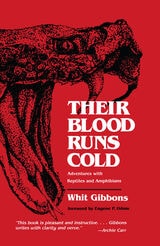
Their Blood Runs Cold
Adventures with Reptiles and AmphibiansWhit Gibbons
University of Alabama Press, 1983
Their Blood Runs Cold
Adventures with Reptiles and AmphibiansWhit Gibbons
University of Alabama Press, 2013
Enter the fascinating world of reptiles and amphibians through the eyes of a pioneering field scientist.
Their Blood Runs Cold is entertaining, informative reading that not only enhances our understanding of a unique group of animals, but also provides genuine insight into the mind and character of a research scientist.
Whit Gibbons possesses the rare talent of conveying the challenge and excitement of scientific inquiry. A research ecologist who specializes in the study of reptiles and amphibians, he gives accounts of work in the field that are as readable as good short stories.
From the dangers of being chased by an angry rattlesnake to the exhilaration of discovering a previously undescribed species, Gibbons brings to life the everyday experiences of the herpetologist as he chases down lizards, turtles, snakes, alligators, salamanders, and frogs in their natural habitats. With essays like “Turtles May Be Slow but They’re 200 Million Years Ahead of Us” and “How to Catch an Alligator in One Uneasy Lesson,” Their Blood Runs Cold both entertains and informs.
The thirtieth anniversary edition of Their Blood Runs Cold features a new prologue and epilogue, additions that address changes in the taxonomy and study of reptiles and amphibians that have occurred since the publication of the original edition and offer suggestions for further reading that highlight the explosion of interest in the topic.