Results by title
6 books match the query 'Gila River Valley (N.M. and Ariz.)'
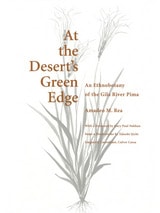
At the Desert's Green Edge
An Ethnobotany of the Gila River PimaAmadeo M. Rea; With a Foreword by Gary Paul Nabhan; Sumi-e Illustrations by Takashi Ijichi; Linguistic Consultant Culver Cassa
University of Arizona Press, 1997
The Akimel O'odham, or Pima Indians, of the northern Sonoran Desert continue to make their home along Arizona's Gila River despite the alarming degradation of their habitat that has occurred over the past century. The oldest living Pimas can recall a lush riparian ecosystem and still recite more than two hundred names for plants in their environment, but they are the last generation who grew up subsisting on cultivated native crops or wild-foraged plants. Ethnobiologist Amadeo M. Rea has written the first complete ethnobotany of the Gila River Pima and has done so from the perspective of the Pimas themselves.
At the Desert's Green Edge weaves the Pima view of the plants found in their environment with memories of their own history and culture, creating a monumental testament to their traditions and way of life. Rea first discusses the Piman people, environment, and language, then proceeds to share their botanical knowledge in entries for 240 plants that systematically cover information on economic botany, folk taxonomy, and linguistics. The entries are organized according to Pima life-form categories such as plants growing in water, eaten greens, and planted fruit trees. All are anecdotal, conveying the author's long personal involvement with the Pimas, whether teaching in their schools or learning from them in conversations and interviews.
At the Desert's Green Edge is an archive of otherwise unavailable plant lore that will become a benchmark for botanists and anthropologists. Enhanced by more than one hundred brush paintings of plants, it is written to be equally useful to nonspecialists so that the Pimas themselves can turn to it as a resource regarding their former lifeways. More than an encyclopedia of facts, it is the Pimas' own story, a witness to a changing way of life in the Sonoran Desert.
[more]
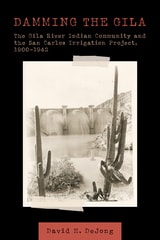
Damming the Gila
The Gila River Indian Community and the San Carlos Irrigation Project, 1900–1942David H. DeJong
University of Arizona Press, 2024
Unraveling a complex web of tension, distrust, and political maneuvering, Damming the Gila continues the story of the Gila River Indian Community’s struggle for the restoration of its water rights.
This volume continues to chronicle the history of water rights and activities on the Gila River Indian Reservation. Centered on the San Carlos Irrigation Project and Coolidge Dam, it details the history and development of the project, including the Gila Decree and the Winters Doctrine. Embedded in the narrative is the underlying tension between tribal growers on the Gila River Indian Reservation and upstream users. Told in seven chapters, the story underscores the idea that the Gila River Indian Community believed the San Carlos Irrigation Project was first and foremost for their benefit and how the project and the Gila Decree fell short of restoring their water and agricultural economy.
Damming the Gila is the third in a trio of important documentary works, beginning with DeJong’s Stealing the Gila and followed by Diverting the Gila. It continues the story of the Gila River Indian Community’s fight to regain access to their water.
[more]
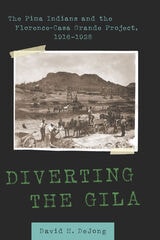
Diverting the Gila
The Pima Indians and the Florence-Casa Grande Project, 1916–1928David H. DeJong
University of Arizona Press, 2021
In the late nineteenth and early twentieth centuries, Americans assumed the land and water resources of the West were endless. Water was as vital to newcomers to Arizona’s Florence and Casa Grande valleys as it had always been to the Pima Indians, who had been successfully growing crops along the Gila River for generations when the white settlers moved in.
Diverting the Gila explores the complex web of tension, distrust, and political maneuvering to divide and divert the scarce waters of the Gila River. Residents of Florence, Casa Grande, and the Pima Reservation fought for vital access to water rights. Into this political foray stepped Arizona’s freshman congressman Carl Hayden, who not only united the farming communities but also used Pima water deprivation to the advantage of Florence-Casa Grande and Upper Gila Valley growers. The result was the federal Florence-Casa Grande Project that, as legislated, was intended to benefit Pima growers on the Gila River Indian Reservation first and foremost. As was often the case in the West, well-heeled, nontribal political interests manipulated the laws at the expense of the Indigenous community.
Diverting the Gila is the sequel to David H. DeJong’s 2009 Stealing the Gila, and it continues to tell the story of the forerunner to the San Carlos Irrigation Project and the Gila River Indian Community’s struggle to regain access to their water.
[more]
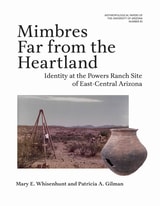
Mimbres Far from the Heartland
Identity at the Powers Ranch Site of East-Central ArizonaMary E. Whisenhunt and Patricia A. Gilman
University of Arizona Press, 2025
This new work offers a unique investigation into the complexities of Mimbres identity and social dynamics beyond the traditional Mimbres Valley heartland. Situated at the western edge of the Mimbres region, the Powers Ranch site represents a professionally excavated Classic period settlement in Arizona’s Gila River Valley. Through excavation and analysis of architecture and a rich array of artifacts, including ceramic sherds, projectile points, and shell artifacts, the authors provide a detailed look at the lives of Mimbres people on the periphery.
This work compares findings from Powers Ranch with those from neighboring sites in the Gila River Valley and further east in the Mimbres Valley, unraveling patterns of identity and affiliation that challenge previous understandings. The study is guided by three key research questions: the extent of affiliation between the community at the Powers Ranch site and Mimbres communities to the east, patterns that suggest Powers Ranch was a habitation and not a limited activity site, and whether the site was unique in comparison with Mimbres occupations situated to the south in the Gila River Valley. Contributions from scholars M. Steven Shackley, Martin H. Welker, and Arthur W. Vokes further enrich this volume, ensuring a comprehensive and authoritative exploration of the Powers Ranch site.
Mimbres Far from the Heartland is an invaluable addition to Southwest archaeology, shedding light on how people constructed unique identities in edge communities and how these identities were expressed through material culture and social networks. Whisenhunt and Gilman’s work significantly advances our understanding of Mimbres communities, offering new insights into the social resilience and cultural affiliations of people living far from their cultural heartland.
[more]
Once a River
Bird Life and Habitat Changes on the Middle GilaAmadeo M. Rea
University of Arizona Press, 1983
Like many rivers of the arid Southwest, the Gila is for much of its length a dry bed except after seasonal rains. Yet a mere century ago it hosted a thriving biological community, and two centuries ago American Indians fished from its banks.
It is no mystery how the desert swallowed up the Gila. Beaver trapping, overgrazing, and woodcutting first ruined natural watersheds, then damming confined the last drops of its surface flow. Historical sources and archaeological data inform us of the Gila's past, but its bird life further testifies to the changes.
Amadeo Rea traces the decline of bird life on the Middle Gila in a book that addresses the broader issue of habitat deterioration. Bird lovers will find it a storehouse of data on avian migration patterns and on ornithological classification based on skeletal structure. Anthropologists can draw on its Piman ethnoclassification of birds, which links the Gila River tribe with various other Uto-Aztecan peoples of Mexico's west coast.
But for all concerned with protecting our environment, Once a River offers evidence of change that might be apprehended elsewhere. It is a case history of a loss that perhaps need never have occurred.
[more]
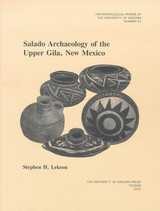
Salado Archaeology of the Upper Gila, New Mexico
Stephen H. Lekson
University of Arizona Press, 2002
Salado is an enigma of the past. One of the most spectacular cultures of the ancient Southwest, its brilliant polychrome pottery has been subjected to varied interpretations, from religious cult to artistic horizon. Stephen Lekson now uses data from two Salado sites—a large pueblo and a small farmstead—to clarify long-standing misconceptions about this culture. By combining analysis of the large whole-vessel collection at Dutch Ruin with the scientific excavation of Villareal II, a picture of Salado emerges that enables Lekson to evaluate previous competing theories and propose that Salado represents a major fourteenth-century migration of Pueblo peoples into the Chihuahuan deserts. Lekson demonstrates that late, short-lived Salado farmsteads—difficult to identify archaeologically in areas with larger Mimbres concentrations—coexisted with larger Salado towns, and he argues that Salado in the Upper Gila region appears as a substantial in-migration of Mogollon Uplands populations into what was a vacant river valley. Throughout the fourteenth century, Salado communities in the Upper Gila were integrated into the larger Salado horizon and were closely connected to Casas Grandes, as indicated by the export of serpentine to the city of Paquimé and the occurrence of Casas Grandes pottery at Upper Gila Salado sites. The book includes illustrations of 71 vessels from Dutch Ruin plus a full-color frontispiece. Through analysis of these two sites, Lekson has taken a large step toward clearing up the mystery of Salado. His work will be welcomed by all who study the movements of peoples in the prehispanic Southwest.
[more]