Results by title
3 books match the query 'Gilliland, Betsy'
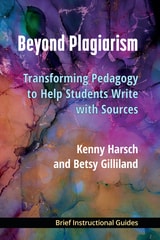
Beyond Plagiarism
Transforming Pedagogy to Help Students Write with SourcesKenny Harsch and Betsy Gilliland
University of Michigan Press, 2025
Starting with an overview of the complexities underlying plagiarism and source use, the book offers practical tools that teachers can integrate in their classes. These tools include examples of modifications to syllabi; integrating processes into assignment design, classroom support, and feedback and grading; meta-texts to guide student reflection on their use of sources; explanations of why source use is important in academic writing; guiding students through learning how to read for writing, analyze genres to better understand expectations, and practice paraphrasing, summarizing, and quoting in their own assignments; approaching AI tools strategically; and modeling successful strategies for each step of the scholarly process. By taking a pedagogical approach, expert members of the academic community can help students understand how academic writing builds on and incorporates sources, provide support for students to learn to do these things through a process approach, and respond to situations of plagiarism with nuance, compassion, and a growth mindset.
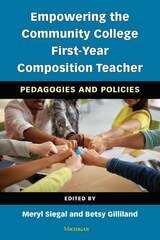
Empowering the Community College First-Year Composition Teacher
Pedagogies and PoliciesMeryl Siegal and Betsy Gilliland
University of Michigan Press, 2021
This volume is an inquiry into community college first-year pedagogy and policy at a time when change has not only been called for but also mandated by state lawmakers who financially control public education. It also acknowledges new policies that are eliminating developmental and remedial writing courses while keeping mind that, for most community college students, first-year composition serves as the last course they will take in the English department toward their associate’s degree.
Chapters focusing on pedagogy and policy are integrated within cohesively themed parts: (1) refining pedagogy; (2) teaching toward acceleration; (3) considering programmatic change; and (4) exploring curriculum through research and policy. The volume concludes with the editors’ reflections regarding future work; a glossary and reflection questions are included.
This volume also serves as a call to action to change the way community colleges attend to faculty concerns. Only by listening to teachers can the concerns discussed in the volume be addressed; it is the teachers who see how societal changes intersect with campus policies and students’ lives on a daily basis.

Responding to Writing
A Practical Sourcebook for InstructorsDana R. Ferris, Grant Eckstein, and Betsy Gilliland
University of Michigan Press, 2027
Responding to Writing brings together practical, cutting-edge ideas from teachers who spend their days working with student writers and trying to make feedback genuinely useful. The book shares classroom approaches that have been tested in real courses, from high school settings to college and graduate programs. It shows how teachers, peers, and students themselves can make feedback a more collaborative and manageable part of writing instruction.
Each chapter presents a student‑centered approach that helps writers feel supported and more in control of their own writing and revision process. In addition to a summary of the approach with light background and context, readers will find straightforward examples, tools, and routines they can adapt to their own classrooms, including ways to use technology, build reflection into assignments, and support writers with varied backgrounds and needs. This book offers working instructors a set of dependable methods for helping students improve as writers while keeping feedback purposeful and humane.