Results by title
8 books match the query 'Girard, René'

Anorexia and Mimetic Desire
René Girard
Michigan State University Press, 2008
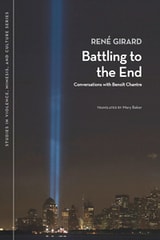
Battling to the End
Conversations with Benoit ChantreRené Girard
Michigan State University Press, 2010
Carl von Clausewitz (1780–1831), the Prussian military theoretician who wrote On War, is known above all for his famous dictum: “War is the continuation of politics by other means.” In René Girard’s view, however, the strategist’s treatise offers up a more disturbing truth to the reader willing to extrapolate from its most daring observations: with modern warfare comes the insanity of tit-for-tat escalation, which political institutions have lost their ability to contain. Having witnessed the Napoleonic Wars firsthand, Girard argues, Clausewitz intuited that unbridled “reciprocal action” could eventually lead foes to total mutual annihilation. Haunted by the Franco-German conflict that was to ravage Europe, in Girard’s account Clausewitz is a prescient witness to the terrifying acceleration of history. Battling to the End issues a warning about the apocalyptic threats hanging over our planet and delivers an authoritative lesson on the mimetic laws of violence.

Be Not Conformed
Rene Girard at the Nexus of Athens, Jerusalem, and Silicon ValleyLuke Burgis
Catholic University of America Press, 2026
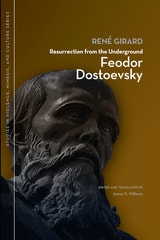
Resurrection from the Underground
Feodor DostoevskyRené Girard
Michigan State University Press, 2012
In a fascinating analysis of critical themes in Feodor Dostoevsky’s work, René Girard explores the implications of the Russian author’s “underground,” a site of isolation, alienation, and resentment. Brilliantly translated, this book is a testament to Girard’s remarkable engagement with Dostoevsky’s work, through which he discusses numerous aspects of the human condition, including desire, which Girard argues is “triangular” or “mimetic”—copied from models or mediators whose objects of desire become our own. Girard’s interdisciplinary approach allows him to shed new light on religion, spirituality, and redemption in Dostoevsky’s writing, culminating in a revelatory discussion of the author’s spiritual understanding and personal integration. Resurrection is an essential and thought-provoking companion to Dostoevsky’s Notes from the Underground.
Sacrifice
René Girard
Michigan State University Press, 2011
In Sacrifice, René Girard interrogates the Brahmanas of Vedic India, exploring coincidences with mimetic theory that are too numerous and striking to be accidental. Even that which appears to be dissimilar fails to contradict mimetic theory, but instead corresponds to the minimum of illusion without which sacrifice becomes impossible.
The Bible reveals collective violence, similar to that which generates sacrifice everywhere, but instead of making victims guilty, the Bible and the Gospels reveal the persecutors of a single victim. Instead of elaborating myths, they tell the truth absolutely contrary to the archaic sense. Once exposed, the single victim mechanism can no longer function as the model for would-be sacrificers.
Recognizing that the Vedic tradition also converges on a revelation that discredits sacrifice, mimetic theory locates within sacrifice itself a paradoxical power of quiet reflection that leads, in the long run, to the eclipse of this institution which is violent but nevertheless fundamental to the development of human culture. Far from unduly privileging the Western tradition and awarding it a monopoly on the knowledge and repudiation of blood sacrifice, mimetic analysis recognizes comparable, but never truly identical, traits in the Vedic tradition.

The One by Whom Scandal Comes
René Girard (Translated by M. B. DeBevoise)
Michigan State University Press, 2014

Violence, the Sacred, and Things Hidden
A Discussion with René Girard at Esprit (1973)René Girard
Michigan State University Press, 2022
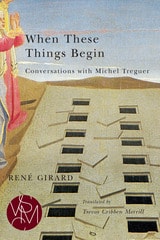
When These Things Begin
Conversations with Michel TreguerRené Girard (Translated by Trevor Cribben Merrill)
Michigan State University Press, 2014