Results by title
3 books match the query 'Glad, John'
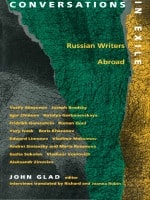
Conversations in Exile
Russian Writers AbroadJohn Glad, ed.
Duke University Press, 1993
Glad's introduction situates the three distinct waves of westward emigration in their historical and political framework. Organized by genre, the book begins with discussions with the older generation of writers and then moves on to more recent arrivals: the makers of fantasy and humor, the aesthetes, the moralists, and the realists. Each voice is compelling for its invaluable testimony--some reveal startling insights into the persecution of dissidents under Soviet rule while others address the relationship between creativity, writing, and conditions of exile. Taken together these interviews reveal the range of modern Russian writing and document the personalities and positions that have made Russian writers in emigration so diverse, experimental, and controversial.
The Writers: Vasily Aksyonov, Joseph Brodsky, Igor Chinnov, Natalya Goranevskaya, Frifrikh Gorensetin, Roman Goul, Yury Ivask, Boris Khazanov, Edward Liminov, Vladimir Makisimov, Andrei Siniavsky and Maria Rozanova, Sasha Sokolov, Vladimir Voinovich, Aleksandr Zinoviev
Excerpt
John Glad: You're a Russian poet but an American essayist. Does that bring on any measure of split personality? Do you think you are becoming less and less Russian?
Joseph Brodsky (recipient of 1987 Nobel Prize for Literature): That's not for me to say. As far as I'm concerned, in my inner self, inside, it feels quite natural. I think being a Russian poet and an American essayist is an ideal situation. It's all a matter of whether you have (a) the heart and (b) the brains to be able to do both. Sometimes I think I do. Sometimes I think I don't. Sometimes I think that one interferes with the other.
Literature in Exile
John Glad, ed.
Duke University Press, 1990
The volume includes writers whose origins lie in Central Europe, South Africa, Israel, Cuba, Chile, Somalia, and Turkey. Through their testimony of the creative process in exile, we gain insight into the forces which affect the creative process as a whole.
Contributors. William Gass, Yury Miloslavsky, Jan Vladislav, Jiri Grusa, Guillermo Cabrera Infante, Horst Bienek, Edward Limonov, Nedim Gursel, Nuruddin Farah, Jaroslav Vejvoda, Anton Shammas, Joseph Brodsky, Wojciech Karpinski, Thomas Venclova, Yuri Druzhnikov
Twentieth-Century Russian Poetry
John Glad
University of Iowa Press, 1992
This celebrated anthology, first published in 1978 as Russian Poetry: The Modern Period, provides a much-needed panoramic overview of Russian poetry since the Bolshevik Revolution of 1917.
Major features of this collection include a new and expanded introduction, a substantial new section of glasnost-era poetry, a generous sampling of postrevolutionary poetry in Russia, full representation of poets of the first and second post-World War II generations, and poetry of the successive emigrations, flights, or expulsions from Russia.
Twentieth-Century Russian Poetry makes an important contribution to our continuing understanding of a changing world order. This anthology should be read by all those who wish to know more about the poetry of Russia, those interested in international cultural and literary history, and all Slavicists.