Results by title
2 books match the query 'Glasgow (Scotland)'

Mackintosh's Masterwork
The Glassgow School of ArtEdited by William Buchanan
Rutgers University Press, 2004
Of the many practitioners of art nouveau in Great Britain, Charles Rennie Mackintosh (1868–1928) has outlasted them all. His work bridged the more ornate style of the later nineteenth century and the forms of international modernism that followed. Like Frank Lloyd Wright, with whom he is frequently compared, he is known for so thoroughly integrating art and decoration that the two became inseparable. His work has been honored by a major exhibition at the Metropolitan Museum of Art, and his designs have proliferated to such an extent that they can be found reproduced in posters, prints, jewelry, and even new buildings. His most important project was the Glasgow School of Art, which still functions as a highly prestigious art school. This glorious building is visited each year by thousands of tourists from around the world. Built over a dozen years, beginning in 1897, the Glasgow School of Art is Mackintosh’s greatest and most influential legacy.
This completely redesigned and heavily illustrated edition of Mackintosh’s Masterwork has been greatly expanded and contains newly discovered material about both the early life of the architect and the formative years in which his plans for the School of Art were executed.
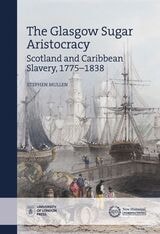
The Glasgow Sugar Aristocracy
Scotland and Caribbean Slavery, 1775–1838Stephen Mullen
University of London Press, 2020
This important book assesses the size and nature of Caribbean slavery’s economic impact on British society. The Glasgow Sugar Aristocracy, a grouping of West India merchants and planters, became active before the emancipation of chattel slavery in the British West Indies in 1834. Many acquired nationally significant fortunes, and their investments percolated into the Scottish economy and wider society. At its core, the book traces the development of merchant capital and poses several interrelated questions during an era of rapid transformation, namely, what impact the private investments of West India merchants and colonial adventurers had on metropolitan society and the economy, as well as the wider effects of such commerce on industrial and agricultural development.
The book also examines the fortunes of temporary Scottish economic migrants who traveled to some of the wealthiest of the Caribbean islands, presenting the first large-scale survey of repatriated slavery fortunes via case studies of Scots in Jamaica, Grenada, and Trinidad before emancipation in 1834. It, therefore, takes a new approach to illuminate the world of individuals who acquired West Indian fortunes and ultimately explores, in an Atlantic frame, the interconnections between the colonies and metropole in the late eighteenth and early nineteenth centuries.