Results by title
10 books match the query 'Global Age'
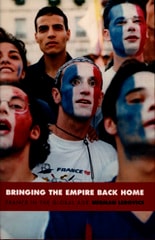
Bringing the Empire Back Home
France in the Global AgeHerman Lebovics
Duke University Press, 2004
In Bringing the Empire Back Home, the inventive cultural historian Herman Lebovics provides a riveting account of how intense disputes about what it means to be French have played out over the past half-century, redefining Paris, the regions, and the former colonies in relation to one another and the world at large. In a narrative populated with peasants, people from the former colonies, museum curators, former colonial administrators, left Christians, archaeologists, anthropologists, soccer players and their teenage fans, and, yes, leading government officials, Lebovics reveals contemporary French society and cultures as perhaps the West’s most important testing grounds of pluralism and assimilation. A lively cultural history, Bringing the Empire Back Home highlights not only the political significance of France’s efforts to synthesize the regional, national, European, ethnic postcolonial, and global but also the chaotic beauty of the endeavor.
Complex Deterrence
Strategy in the Global AgeEdited by T. V. Paul, Patrick M. Morgan, and James J. Wirtz
University of Chicago Press, 2009
As the costs of a preemptive foreign policy in Iraq have become clear, strategies such as containment and deterrence have been gaining currency among policy makers. This comprehensive book offers an agenda for the contemporary practice of deterrence—especially as it applies to nuclear weapons—in an increasingly heterogeneous global and political setting.
Moving beyond the precepts of traditional deterrence theory, this groundbreaking volume offers insights for the use of deterrence in the modern world, where policy makers may encounter irrational actors, failed states, religious zeal, ambiguous power relationships, and other situations where the traditional rules of statecraft do not apply. A distinguished group of contributors here examines issues such as deterrence among the Great Powers; the problems of regional and nonstate actors; and actors armed with chemical, biological, and nuclear weapons. Complex Deterrence will be a valuable resource for anyone facing the considerable challenge of fostering security and peace in the twenty-first century.
German Colonialism in a Global Age
Bradley Naranch and Geoff Eley, eds.
Duke University Press, 2015
Contributors. Dirk Bönker, Jeff Bowersox, David Ciarlo, Sebastian Conrad, Christian S. Davis, Geoff Eley, Jennifer Jenkins, Birthe Kundus, Klaus Mühlhahn, Bradley Naranch, Deborah Neill, Heike Schmidt, J. P. Short, George Steinmetz, Dennis Sweeney, Brett M. Van Hoesen, Andrew Zimmerman

Holocaust And Memory In The Global Age
Daniel Levy
Temple University Press, 2005
Originally published in Germany, The Holocaust and Memory in the Global Age examines the nature of collective memory in a globalized world, and how the memory of one particular event—the Holocaust—helped give rise to an emerging global consensus on human rights.
Daniel Levy and Natan Sznaider show how memories of the Holocaust have been de-contextualized from the original event and offer a framework for interpreting contemporary acts of injustice such as ethnic cleansing and genocide. Representations of mass atrocities in Bosnia and Kosovo during the 1990s resonated with iconographies of the Holocaust and played a significant role in the political and military interventions in the Balkans. Subsequently, these representations have had a crucial impact on the consolidation of international human rights and related issues of transitional justice, reparations, and restitution.
Knowledge Flows in a Global Age
A Transnational ApproachEdited by John Krige
University of Chicago Press, 2022
The contributors to this collection focus on what happens to knowledge and know-how at national borders. Rather than treating it as flowing like currents across them, or diffusing out from center to periphery, they stress the human intervention that shapes how knowledge is processed, mobilized, and repurposed in transnational transactions to serve diverse interests, constraints, and environments. The chapters consider both what knowledge travels and how it travels across borders of varying permeability that impede or facilitate its movement. They look closely at a variety of platforms and objects of knowledge, from tangible commodities—like hybrid wheat seeds, penicillin, Robusta coffee, naval weaponry, seed banks, satellites and high-performance computers—to the more conceptual apparatuses of plant phenotype data and statistics. Moreover, this volume decenters the Global North, tracking how knowledge moves along multiple paths across the borders of Mexico, India, Portugal, Guinea-Bissau, the Soviet Union, China, Angola, Palestine and the West Bank, as well as the United States and the United Kingdom. An important new work of transnational history, this collection recasts the way we understand and analyze knowledge circulation.
Mobile Urbanism
Cities and Policymaking in the Global AgeEugene McCann
University of Minnesota Press, 2010
The essays in this volume argue for a theorizing of both urban policymaking and place-making that understands them as groups of territorial and relational geographies. It broadens our comprehension of agents of transference, reconceiving how policies are made mobile, and acknowledging the importance of interlocal policy mobility. Through the richness of its empirical examples from Europe, North America, South America, Africa, Asia, and Australia, contributors bring to light the significant methodological challenges that researchers face in the study of an urban–global, territorial–relational conceptualization of cities and suggest productive new approaches to understanding urbanism in a networked world.
Contributors: S. Harris Ali, York U, Toronto; Allan Cochrane, Open U; Roger Keil , York U, Toronto; Doreen Massey, Open U; Donald McNeill, U of Western Sydney; Jamie Peck, U of British Columbia; Jennifer Robinson, University College London.
Outsider Within
Reworking Anthropology in the Global AgeFaye Harrison
University of Illinois Press, 2007
Outsider Within presents an approach to critically reconstructing the anthropology discipline to better encompass issues of gender and race. Among the nine key changes to the field that Faye V. Harrison advocates are researching in an ethically and politically responsible manner, promoting greater diversity in the discipline, rethinking theory, and committing to a genuine multicultural dialogue. In drawing from materials developed during her distinguished twenty-five year career in Caribbean and African American studies, Harrison analyzes anthropology’s limits and possibilities from an African American woman’s perspective, while also recognizing similarities between peoples, despite social, cultural, and political differences. In seeking to productively engage anthropologists of diverse geographical, cultural, and national origins, Harrison challenges them to work together to transcend stark gender, racial, and national hierarchies.
Patriotic Education in a Global Age
Randall Curren and Charles Dorn
University of Chicago Press, 2018
In Patriotic Education in a Global Age, philosopher Randall Curren and historian Charles Dorn address these questions as they seek to understand what role patriotism might legitimately play in schools as an aspect of civic education. They trace the aims and rationales that have guided the inculcation of patriotism in American schools over the years, the methods by which schools have sought to cultivate patriotism, and the conceptions of patriotism at work in those aims, rationales, and methods. They then examine what those conceptions mean for justice, education, and human flourishing. Though the history of attempts to cultivate patriotism in schools offers both positive and cautionary lessons, Curren and Dorn ultimately argue that a civic education organized around three components of civic virtue—intelligence, friendship, and competence—and an inclusive and enabling school community can contribute to the development of a virtuous form of patriotism that is compatible with equal citizenship, reasoned dissent, global justice, and devotion to the health of democratic institutions and the natural environment. Patriotic Education in a Global Age mounts a spirited defense of democratic institutions as it situates an understanding of patriotism in the context of nationalist, populist, and authoritarian movements in the United States and Europe, and will be of interest to anyone concerned about polarization in public life and the future of democracy.
Poetry in a Global Age
Jahan Ramazani
University of Chicago Press, 2020
Poetry in a Global Age builds on Ramazani’s award-winning A Transnational Poetics, a book that had a catalytic effect on literary studies. Ramazani broadens his lens to discuss modern and contemporary poems not only in relation to world literature, war, and questions of orientalism but also in light of current debates over ecocriticism, translation studies, tourism, and cultural geography. He offers brilliant readings of postcolonial poets like Agha Shahid Ali, Lorna Goodison, and Daljit Nagra, as well as canonical modernists such as W. B. Yeats, Wallace Stevens, T. S. Eliot, and Marianne Moore. Ramazani shows that even when poetry seems locally rooted, its long memory of forms and words, its connections across centuries, continents, and languages, make it a powerful imaginative resource for a global age. This book makes a strong case for poetry in the future development of world literature and global studies.
The Deliverance of Others
Reading Literature in a Global AgeDavid Palumbo-Liu
Duke University Press, 2012
The influential literary critic David Palumbo-Liu suggests that we can arrive at a sense of responsibility toward others by reconsidering the discourses of sameness that deliver those unlike ourselves to us. Through virtuoso readings of novels by J. M. Coetzee, Nadine Gordimer, Kazuo Ishiguro, and Ruth Ozeki, he shows how notions that would seem to offer some basis for commensurability between ourselves and others—ideas of rationality, the family, the body, and affect—become less stable as they try to accommodate more radical types of otherness. For Palumbo-Liu, the reading of literature is an ethical act, a way of thinking through our relations to others.