Results by title
5 books match the query 'Global Context'

LGBTQ+ Public Opinion
The United States in Global ContextEdited by Mandi Bates Bailey, Steven P. Nawara, Andrew R. Flores
University of Michigan Press, 2027
Rather than focusing on public opinion around the LGBTQ+ community within a single nation or region, LGBTQ+ Public Opinion brings a comparative global perspective. The collection first considers the development of individual attitudes before turning to cultural influences and the role(s) of political elites. Contributors utilize varied methodological approaches from experimental and survey design to case studies and personal interviews. With different lenses, they analyze topics such as same-sex marriage, stigma, transgender youth participation in sports, group empathy, trust in government, media use and consumption, the role of courts, economic growth, and “born this way.” While the editors discuss trends and parallels, they are careful to avoid prescriptive assessment or mistakenly analogizing. Notably, this collection is exceedingly timely given trends in queer-phobic rhetoric and authoritarian pleas by public officials in the United States and worldwide. With contributions from established and emerging scholars, this book offers a unique framework to consider the development of attitudes that will apply to studies of minority groups more broadly.
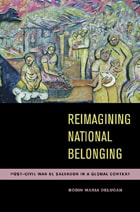
Reimagining National Belonging
Post-Civil War El Salvador in a Global ContextRobin Maria DeLugan
University of Arizona Press, 2012
Examining events that unfolded between 1992 and 2011, DeLugan both illustrates the idiosyncrasies of state and society in El Salvador and opens a larger portal into conditions of constructing a state in the present day around the globe—particularly the process of democratization in an age of neoliberalism. She demonstrates how academics, culture experts, popular media, and the United Nations and other international agencies have all helped shape ideas about national belonging in El Salvador. She also reveals the efforts that have been made to include populations that might have been overlooked, including indigenous people and faraway citizens not living inside the country’s borders. And she describes how history and memory projects have begun to recall the nation’s violent past with the goal of creating a more just and equitable nation.
This illuminating case study fills a gap in the scholarship about culture and society in contemporary El Salvador, while offering an “ethnography of the state” that situates El Salvador in a global context.
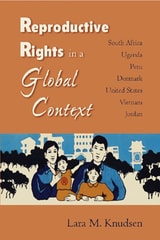
Reproductive Rights in a Global Context
South Africa, Uganda, Peru, Denmark, United States, Vietnam, JordanLara M. Knudsen
Vanderbilt University Press, 2006
Traveling alone when she was between 17 and 22, with no institutional affiliation and no financial assistance, the author visited five developing countries and two developed ones on five continents. Her goal was to extend her own experience in an abortion clinic in Portland, Oregon. Lara Knudsen interviewed over 90 women's rights activists, health professionals, NGO workers, and government officials, gaining a sense of both official policies and the actual delivery of services in local clinics. The book places the experiences of women within the global context of how international population control agendas have influenced women's reproductive rights in the past, and how the changing international discourse on reproductive health continues to influence those rights today.
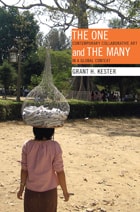
The One and the Many
Contemporary Collaborative Art in a Global ContextGrant H. Kester
Duke University Press, 2011
Transcultural Bodies
Female Genital Cutting in Global ContextHernlund, Ylva K
Rutgers University Press, 2007
Female "circumcision" or, more precisely, female genital cutting (FGC), remains an important cultural practice in many African countries, often serving as a coming-of-age ritual. It is also a practice that has generated international dispute and continues to be at the center of debates over women's rights, the limits of cultural pluralism, the balance of power between local cultures, international human rights, and feminist activism. In our increasingly globalized world, these practices have also begun immigrating to other nations, where transnational complexities vex debates about how to resolve the issue.
Bringing together thirteen essays, Transcultural Bodies provides an ethnographically rich exploration of FGC among African diasporas in the United Kingdom, Europe, and Australia. Contributors analyze changes in ideologies of gender and sexuality in immigrant communities, the frequent marginalization of African women's voices in debates over FGC, and controversies over legislation restricting the practice in immigrant populations.