Results by title
8 books match the query 'Global Era'
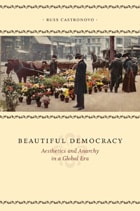
Beautiful Democracy
Aesthetics and Anarchy in a Global EraRuss Castronovo
University of Chicago Press, 2007
Foreign Policy Rhetorics in a Global Era
Concepts and Case StudiesAllison M. Prasch
Michigan State University Press, 2024
Among the cases researched in this collection are foreign policy rhetoric from Cold War foreign policy in Latin America, the rhetoric of Vladimir Putin’s Ukraine war messages, and the development challenges of the Ford Foundation and the Kenya Women Finance Trust, among many others.
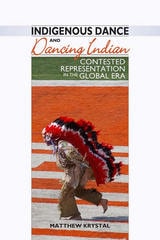
Indigenous Dance and Dancing Indian
Contested Representation in the Global EraMatthew Krystal
University Press of Colorado, 2020
Considering four genres of dance in which indigenous people are represented--K'iche Maya traditional dance, powwow, folkloric dance, and dancing sports mascots--the book addresses both the ideational and behavioral dimensions of identity. Each dance is examined as a unique cultural expression in individual chapters, and then all are compared in the conclusion, where striking parallels and important divergences are revealed. Ultimately, Krystal describes how dancers and audiences work to construct and consume satisfying and meaningful identities through dance by either challenging social inequality or reinforcing the present social order.
Detailed ethnographic work, thorough case studies, and an insightful narrative voice make Indigenous Dance and Dancing Indian a substantial addition to scholarly literature on dance in the Americas. It will be of interest to scholars of Native American studies, social sciences, and performing arts.
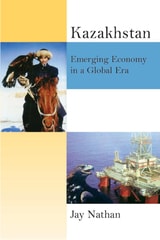
Kazakhstan's New Economy
Post-Soviet, Central Asian Industries in a Global EraJay Nathan
University of Scranton Press, 2013
“An excellent resource on major industries in Kazakhstan.”—Byrganym Aitimova, Minister of Education and Science, the Republic of Kazakhstan
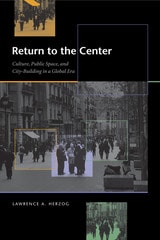
Return to the Center
Culture, Public Space, and City Building in a Global EraBy Lawrence A. Herzog
University of Texas Press, 2006
The redesign and revitalization of traditional urban centers is the cutting edge of contemporary urban planning, as evidenced by the intense public and professional attention to the rebuilding of city cores from Berlin to New York City's "Ground Zero." Spanish and Latin American cities have never received the recognition they deserve in the urban revitalization debate, yet they offer a very relevant model for this "return to the center." These cultures have consistently embraced the notion of a city whose identity is grounded in its organic public spaces: plazas, promenades, commercial streets, and parks that invite pedestrian traffic and support a rich civic life. This groundbreaking book explores Spanish, Mexican, and Mexican-American border cities to learn what these urban areas can teach us about effectively using central public spaces to foster civic interaction, neighborhood identity, and a sense of place.
Herzog weaves the book around case studies of Madrid and Barcelona, Spain; Mexico City and Querétaro, Mexico; and the Tijuana-San Diego border metropolis. He examines how each of these urban areas was formed and grew through time, with attention to the design lessons of key public spaces. The book offers original and incisive discussions that challenge current urban thinking about politics and public space, globalization, and the future of privatized communities, from gated suburbs to cyberspace. Herzog argues that well-designed, human-scaled city centers are still vitally necessary for maintaining community and civic life. Applicable to urban renewal projects around the globe, Herzog's book will be important reading for planners, architects, designers, and all citizens interested in creating more livable cities.
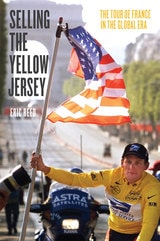
Selling the Yellow Jersey
The Tour de France in the Global EraEric Reed
University of Chicago Press, 2014
In Selling the Yellow Jersey, Eric Reed examines the Tour’s development in France as well as the event’s global athletic, cultural, and commercial influences. The race is the crown jewel of French cycling, and at first the newspapers that owned the Tour were loath to open up their monopoly on coverage to state-owned television. However, the opportunity for huge payoffs prevailed, and France tapped into global networks of spectatorship, media, business, athletes, and exchanges of expertise and personnel. In the process, the Tour helped endow world cycling with a particularly French character, culture, and structure, while providing proof that globalization was not merely a form of Americanization, imposed on a victimized world. Selling the Yellow Jersey explores the behind-the-scenes growth of the Tour, while simultaneously chronicling France’s role as a dynamic force in the global arena.
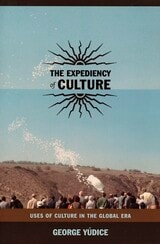
The Expediency of Culture
Uses of Culture in the Global EraGeorge Yúdice
Duke University Press, 2003
Yúdice contends that a new international division of cultural labor has emerged, combining local difference with transnational administration and investment. This does not mean that today’s increasingly transnational culture—exemplified by the entertainment industries and the so-called global civil society of nongovernmental organizations—is necessarily homogenized. He demonstrates that national and regional differences are still functional, shaping the meaning of phenomena from pop songs to antiracist activism. Yúdice considers a range of sites where identity politics and cultural agency are negotiated in the face of powerful transnational forces. He analyzes appropriations of American funk music as well as a citizen action initiative in Rio de Janeiro to show how global notions such as cultural difference are deployed within specific social fields. He provides a political and cultural economy of a vast and increasingly influential art event— insite a triennial festival extending from San Diego to Tijuana. He also reflects on the city of Miami as one of a number of transnational “cultural corridors” and on the uses of culture in an unstable world where censorship and terrorist acts interrupt the usual channels of capitalist and artistic flows.
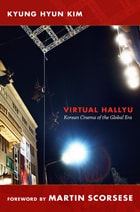
Virtual Hallyu
Korean Cinema of the Global EraKyung Hyun Kim
Duke University Press, 2011
In the late 1990s, South Korean film and other cultural products, broadly known as hallyu (Korean wave), gained unprecedented international popularity. Korean films earned an all-time high of $60.3 million in Japan in 2005, and they outperformed their Hollywood competitors at Korean box offices. In Virtual Hallyu, Kyung Hyun Kim reflects on the precariousness of Korean cinema’s success over the past decade. Arguing that state film policies and socioeconomic factors cannot fully explain cinema’s true potentiality, Kim draws on Deleuze’s concept of the virtual—according to which past and present and truth and falsehood coexist—to analyze the temporal anxieties and cinematic ironies embedded in screen figures such as a made-in-the-USA aquatic monster (The Host), a postmodern Chosun-era wizard (Jeon Woo-chi), a schizo man-child (Oasis), a weepy North Korean terrorist (Typhoon), a salary man turned vengeful fighting machine (Oldboy), and a sick nationalist (the repatriated colonial-era film Spring of Korean Peninsula). Kim maintains that the full significance of hallyu can only be understood by exposing the implicit and explicit ideologies of protonationalism and capitalism that, along with Korea’s ambiguous post-democratization and neoliberalism, are etched against the celluloid surfaces.