Results by title

4 books match the query 'Global temperature changes'
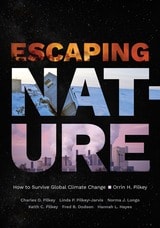
cover of Escaping Nature: How to Survive Global Climate Change

Escaping Nature

How to Survive Global Climate Change

Orrin H. Pilkey, Charles O. Pilkey, Linda P. Pilkey-Jarvis, Norma J. Longo, Keith C. Pilkey, Fred B. Dodson, and Hannah L. Hayes

Duke University Press, 2024
Industrial and agricultural greenhouse gas emissions are rapidly warming Earth’s climate, unleashing rising seas, ocean acidification, melting permafrost, powerful storms, wildfires, floods, deadly heat waves, droughts, tsunamis, food shortages, and armed conflict over shrinking water supplies while reducing nutritional levels in crops. Billions of people will become climate refugees. Hotter temperatures will allow tropical diseases to spread into temperate regions. Higher levels of CO2, allergens, dust, and other particulate matter will impair our physical and mental health and even reduce our cognitive abilities. Climate change disproportionately affects the world’s poor. It also harms Nature, and could ultimately trigger a sixth mass extinction. In Escaping Nature, Orrin H. Pilkey and his coauthors offer concrete suggestions for how to respond to the threats posed by global climate change. They argue that while we wait for the world’s governments to get serious about mitigating climate change we can adapt to a hotter world through technological innovations, behavioral changes, nature-based solutions, political changes, and education.
[more]
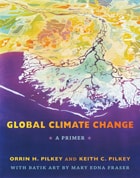
cover of Global Climate Change: A Primer

Global Climate Change

A Primer

Orrin H. Pilkey and Keith C. Pilkey

Duke University Press, 2011

An internationally recognized expert on the geology of barrier islands, Orrin H. Pilkey is one of the rare academics who engages in public advocacy about science-related issues. He has written dozens of books and articles explaining coastal processes to lay readers, and he is a frequent and outspoken interviewee in the mainstream media. Here, the colorful scientist takes on climate change deniers in an outstanding and much-needed primer on the science of global change and its effects.

After explaining the greenhouse effect, Pilkey, writing with son Keith, turns to the damage it is causing: sea level rise, ocean acidification, glacier and sea ice melting, changing habitats, desertification, and the threats to animals, humans, coral reefs, marshes, and mangroves. These explanations are accompanied by Mary Edna Fraser’s stunning batiks depicting the large-scale arenas in which climate change plays out.

The Pilkeys directly confront and rebut arguments typically advanced by global change deniers. Particularly valuable are their discussions of “Climategate,” a manufactured scandal that undermined respect for the scientific community, and the denial campaigns by the fossil fuel industry, which they compare to the tactics used by the tobacco companies a generation ago to obfuscate findings on the harm caused by cigarettes.
[more]
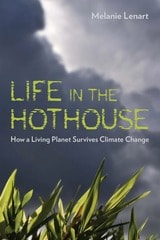
cover of Life in the Hothouse: How a Living Planet Survives Climate Change

Life in the Hothouse

How a Living Planet Survives Climate Change

Melanie Lenart

University of Arizona Press, 2010

In this insightful, compelling, and highly readable work, Melanie Lenart, an award-winning journalist and science writer who holds a PhD in Natural Resources and Global Change, examines global warming with the trained eye of a professional scientist. And she presents the science in a clear, straightforward manner. Why does the planet’s warming produce stronger hurricanes, rising seas, and larger floods? Simple, says Lenart. The Earth is just doing what comes naturally. Just as humans produce sweat to cool off on a hot day, the planet produces hurricanes, floods, wetlands, and forests to cool itself off.

Life in the Hothouse incorporates Lenart’s extensive knowledge of climate science—including the latest research in climate change—and the most current scientific theories, including Gaia theory, which holds that the Earth has some degree of climate control “built in.” As Lenart points out, scientists have been documenting stronger hurricanes and larger floods for many years. There is a good reason for this, she notes. Hurricanes help cool the ocean surface and clear the air of carbon dioxide, the main greenhouse gas responsible for global warming. From the perspective of Gaia theory, these responses are helping to slow the ongoing global warming and Lenart expounds upon this in a clear and understandable fashion.

There is hope, Lenart writes. If we help sustain Earth's natural defense systems, including wetlands and forests, perhaps Mother Earth will no longer need to rely as much on the cooling effects of what we call "natural disasters"—many of which carry a human fingerprint. At a minimum, she argues, these systems can help us survive the heat.

[more]
cover of Media Hot and Cold

Media Hot and Cold

Nicole Starosielski

Duke University Press, 2021

In Media Hot and Cold Nicole Starosielski examines the cultural dimensions of temperature to theorize the ways heat and cold can be used as a means of communication, subjugation, and control. Diving into the history of thermal media, from infrared cameras to thermostats to torture sweatboxes, Starosielski explores the many meanings and messages of temperature. During the twentieth century, heat and cold were broadcast through mass thermal media. Today, digital thermal media such as bodily air conditioners offer personalized forms of thermal communication and comfort. Although these new media promise to help mitigate the uneven effects of climate change, Starosielski shows how they can operate as a form of biopower by determining who has the ability to control their own thermal environment. In this way, thermal media can enact thermal violence in ways that reinforce racialized, colonial, gendered, and sexualized hierarchies. By outlining how the control of temperature reveals power relations, Starosielski offers a framework to better understand the dramatic transformations of hot and cold media in the twenty-first century.
[more]