Results by title
10 books match the query 'Glossaries, vocabularies, etc'
A Key into the Language of America
The Tomaquag Museum EditionRoger Williams
Westholme Publishing, 2019
Roger Williams’s Key into the Language of America, first published in 1643, is one of the most important artifacts of early Indigenous American culture. In it, Williams recorded the day-to-day experience of the Narragansett people of Rhode Island in their own words, the first documentation of an American Indian language in English. Williams’s Key can be read at many levels because of its historical, literary, political, and religious significance. Its greatest value, though, is its intimate portrait of the Narragansett and their linguistic neighbors in the early years of European colonial settlement, before disease, dislocation, warfare—in particular, King Philip’s War—and colonial interference had diminished their population and power in the region. An extraordinary achievement, Williams’s Key gives us a contemporary account of Narragansett family life, of their sociability and skill in business, their dress, foodways, and the farming, fishing, and hunting that formed the basis of their sustenance practices.
This new Tomaquag Museum edition includes for the first time cultural commentary provided by the Narragansett Tribe as well as modern linguistic information provided by a leading authority in the study of American Indian languages.
The Tomaquag Museum, located in Exeter, Rhode Island, is an Indigenous nonprofit organization dedicated to sharing the culture, arts, and history of the Narragansett and other tribal communities of southern New England.
Building Your Biblical Hebrew Vocabulary
Learning Words by Frequency and CognateGeorge M. Landes
SBL Press, 2001
A classic resource for beginning Hebrew students
First published over thirty years ago under the title A Student's Vocabulary of Biblical Hebrew, this classic work has been completely revised, updated, and expanded by the author to assist a new generation of students in naturally developing a basic Biblical Hebrew vocabulary. Designed to help beginning Hebrew readers acquire vocabulary quickly, this valuable teaching tool focuses on words that occur most frequently in the Hebrew Bible, while arranging them by roots and cognates allowing students to naturally expand their working vocabulary. Vocabulary lists have been kept to a manageable size; extensive cross-references document when words appear frequently with different meanings, and an index allows rapid location of every word encountered. As a result, students who master this volume will remember words more easily, consult a lexicon less frequently but more intelligently, and translate the Hebrew Bible at sight more readily and enjoyably.
Features
- Vocabulary groupings based on frequency, roots, and cognates
- Separate listing for nouns without verbal roots in the Hebrew Bible
- Appendices including proper names and the forms and meanings of pronominal suffixes
Cree Legends and Narratives from the West Coast of James Bay
Simeon Scott
University of Manitoba Press, 1995
Insiders' French
Beyond the DictionaryEleanor Levieux and Michel Levieux
University of Chicago Press, 1999
This "new France" is a country poised to experience the European single currency but uncertain about being part of Europe. It is hooked on fast food but ambivalent about the country where it originated. France today has record unemployment and an increasingly controversial immigrant population. Clearly, given the rapidly changing conditions and lifestyles, conventional French dictionaries alone cannot completely inform readers and visitors. Insiders' French offers a solution to the incomprehension, a unique handbook in which you'll find the language of European union, the space program, abortion and women's rights, high-tech industries, and health care, among other topics. Entries proceed by association of ideas and related terms, with extensive cross-referencing, while still being alphabetized for easy reference like a standard dictionary. Cartoons from major French journals add to your understanding and enjoyment.
Insiders' French opens up the secret territory of French politics and culture that is often not understood by visitors or students, and it does so with wit and verve—qualities that remain in the French language despite its recent changes.
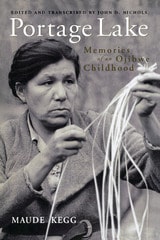
Portage Lake
Memories of an Ojibwe ChildhoodMaude Kegg
University of Minnesota Press, 1993
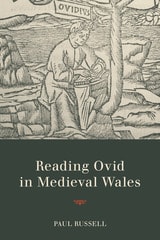
Reading Ovid in Medieval Wales
Paul Russell
The Ohio State University Press, 2017
Russell argues that this annotated version of the Ars amatoria arose out of the teaching traditions of the Carolingian world and that the annotation, as we have it, was the product of a cumulative process of glossing and commenting on the text. He then surveys other glossed Ovid manuscripts to demonstrate how that accumulation was built up. Russell also explores the fascinating issue of why Ovid’s love poetry should be used to teach Latin verse in monastic contexts. Finally, he discusses the connection between this manuscript and the numerous references to Ovid in later Welsh poetry, suggesting that the Ovidian references should perhaps be taken to refer to love poetry more generically.
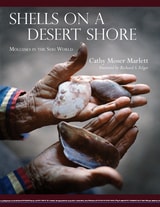
Shells on a Desert Shore
Mollusks in the Seri WorldCathy Moser Marlett; Foreword by Richard S. Felger
University of Arizona Press, 2014
Shells on a Desert Shore describes the Seri knowledge of mollusks and includes names, folklore, history, uses, and much more. Cathy Moser Marlett’s research of several decades, conducted in the Seri language, builds on work begun in 1951 by her parents, Edward and Becky Moser. The language, spoken by fewer than a thousand people today, is considered endangered. Marlett presents what she has learned from Seri consultants over recent decades and also draws from her own childhood experiences while living in a Seri village. The information from the people who had lived as hunter-gatherers provides a window into a lifestyle no longer recalled from personal experience by most Seris today—and perhaps a window into the lives of other peoples who made the Gulf’s shores their home.
The book offers a wealth of information about Seri history, as well as species accounts of more than 150 mollusks from the Seri area on the central Gulf coast. Chapters describe how the people ate mollusks or used them medicinally, how the mollusks were named, and how their shells were used. The author provides several hundred detailed drawings and photographs, many of them archival.
Shells on a Desert Shore is a fresh, original presentation of a significant part of the Seri way of life. Unique because it is written from the perspective of a participant in the Seri culture, the book will stand as a definitive, irreplaceable work in ethnography, a time capsule of the Seri people and their connection to the sea.
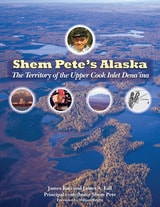
Shem Pete's Alaska
The Territory of the Upper Cook Inlet Dena'inaJames Kari and James A. Fall
University of Alaska Press, 2003
This expanded edition of Shem Pete's Alaska presents 973 named places in 16 drainage-based chapters. The names form a reconstructed network from the vantage points of the life experiences of Shem Pete and other Dena'ina and Ahtna speakers. It is annotated with comments and stories by Shem Pete and more than 50 other contributors, plus historic references, vignettes, copious photographs, historic maps, and shaded-relief placename maps. The authors provide perspective on Dena'ina language and culture, as well as a summary of Dena'ina geographic knowledge and placename research methodology.
This beautifully produced edition is a treasure for all Alaskans and for anyone interested in the "personal connectedness to a beautiful land" voiced by Dena'ina elders.
From the foreword by William Bright: "Shem Pete's experience and wisdom as an elder of the Dena'ina Athabascan Indians shine through this work like the sun—as do the skill and devotion of James Kari, James Fall, and the other Dena'ina, Ahtna, Alaska Native, and Anglo-American people who contributed to making the book a reality. . . . We have a volume that offers a vivid picture of Native Alaskan culture, history, geography, and language, with added glimpses of oral literature and music. . . . All Native American Peoples, indeed, all traditional communities in the world would be fortunate and proud to have this kind of record of their life and culture."
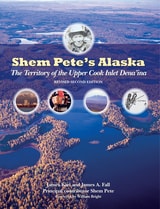
Shem Pete's Alaska
The Territory of the Upper Cook Inlet Dena'inaJames Kari and James A. Fall
University of Alaska Press, 2016
The first two editions of Shem Pete’s Alaska contributed much to Dena’ina cultural identity and public appreciation of the Dena’ina place names network in Upper Cook Inlet. This new edition adds nearly thirty new place names to its already extensive source material from Shem Pete and more than fifty other contributors, along with many revisions and new annotations. The authors provide synopses of Dena’ina language and culture and summaries of Dena’ina geographic knowledge, and they also discuss their methodology for place name research.
Exhaustively refined over more than three decades, Shem Pete’s Alaska will remain the essential reference work on the landscape of the Dena’ina people of Upper Cook Inlet. As a book of ethnogeography, Native language materials, and linguistic scholarship, the extent of its range and influence is unlikely to be surpassed.
The Dog's Children
Anishinaabe Texts told by Angeline WilliamsLeonard Bloomfield
University of Manitoba Press, 1991