Results by title
4 books match the query 'Glover, Kaiama L.'

A Regarded Self
Caribbean Womanhood and the Ethics of Disorderly BeingKaiama L. Glover
Duke University Press, 2021
In A Regarded Self Kaiama L. Glover champions unruly female protagonists who adamantly refuse the constraints of coercive communities. Reading novels by Marie Chauvet, Maryse Condé, René Depestre, Marlon James, and Jamaica Kincaid, Glover shows how these authors' women characters enact practices of freedom that privilege the self in ways unmediated and unrestricted by group affiliation. The women of these texts offend, disturb, and reorder the world around them. They challenge the primacy of the community over the individual and propose provocative forms of subjecthood. Highlighting the style and the stakes of these women's radical ethics of self-regard, Glover reframes Caribbean literary studies in ways that critique the moral principles, politicized perspectives, and established critical frameworks that so often govern contemporary reading practices. She asks readers and critics of postcolonial literature to question their own gendered expectations and to embrace less constrictive modes of theorization.
[more]
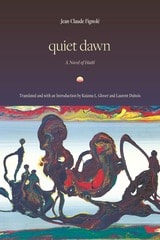
Quiet Dawn
Jean-Claude Fignolé. Translated and with an Introduction by Kaiama L. Glover and Laurent Dubois.
Duke University Press, 2025
Jean-Claude Fignolé’s Quiet Dawn tells an enthralling story of Haiti’s transition from French colony to independent Black republic. The swirling, multilayered novel provides intimate portraits of an eighteenth-century slaveholder, his wife, and their enslaved laborers set against the devastating backdrop of enslavement and revolution. Into this Gothic colonial tale Fignolé interweaves a series of tragic events involving a present-day French nun doing penance for the sins of her ancestors. One of the few contemporary Haitian novels to explicitly grapple with Haiti’s revolution, Quiet Dawn foregrounds issues of race, power, the continuing legacy of historical trauma, and the unresolved tensions between the past and present. Published in French in 1990 and appearing here in English for the first time, Quiet Dawn forcefully pushes against the silencing of Haiti’s past, belying its title to depict a clamorous Atlantic world that comprises Europe, Africa, and the vast expanse of the Americas.
[more]

The Haiti Reader
History, Culture, PoliticsLaurent Dubois, Kaiama L. Glover, Nadève Ménard, Millery Polyné, and Chantalle F. Verna, editors
Duke University Press, 2020
While Haiti established the second independent nation in the Western Hemisphere and was the first black country to gain independence from European colonizers, its history is not well known in the Anglophone world. The Haiti Reader introduces readers to Haiti's dynamic history and culture from the viewpoint of Haitians from all walks of life. Its dozens of selections—most of which appear here in English for the first time—are representative of Haiti's scholarly, literary, religious, visual, musical, and political cultures, and range from poems, novels, and political tracts to essays, legislation, songs, and folk tales. Spanning the centuries between precontact indigenous Haiti and the aftermath of the 2010 earthquake, the Reader covers widely known episodes in Haiti's history, such as the U.S. military occupation and the Duvalier dictatorship, as well as overlooked periods such as the decades immediately following Haiti's “second independence” in 1934. Whether examining issues of political upheaval, the environment, or modernization, The Haiti Reader provides an unparalleled look at Haiti's history, culture, and politics.
[more]

The Wombs of Women
Race, Capital, FeminismFrançoise Vergès
Duke University Press, 2020
In the 1960s thousands of poor women of color on the (post)colonial French island of Reunion had their pregnancies forcefully terminated by white doctors; the doctors operated under the pretext of performing benign surgeries, for which they sought government compensation. When the scandal broke in 1970, the doctors claimed to have been encouraged to perform these abortions by French politicians who sought to curtail reproduction on the island, even though abortion was illegal in France. In The Wombs of Women—first published in French and appearing here in English for the first time—Françoise Vergès traces the long history of colonial state intervention in black women’s wombs during the slave trade and postslavery imperialism as well as in current birth control politics. She examines the women’s liberation movement in France in the 1960s and 1970s, showing that by choosing to ignore the history of the racialization of women’s wombs, French feminists inevitably ended up defending the rights of white women at the expense of women of color. Ultimately, Vergès demonstrates how the forced abortions on Reunion were manifestations of the legacies of the racialized violence of slavery and colonialism.
[more]