Results by title
8 books match the query 'Gnosticism'
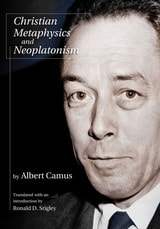
Christian Metaphysics and Neoplatonism
Albert Camus, Translated & Intro by Ronald D. Srigley
University of Missouri Press, 2007
Contemporary scholarship tends to view Albert Camus as a modern, but he himself was conscious of the past and called the transition from Hellenism to Christianity “the true and only turning point in history.” For Camus, modernity was not fully comprehensible without an examination of the aspirations that were first articulated in antiquity and that later received their clearest expression in Christianity. These aspirations amounted to a fundamental reorientation of human life in politics, religion, science, and philosophy.
Understanding the nature and achievement of that reorientation became the central task of Christian Metaphysics and Neoplatonism. Primarily known through its inclusion in a French omnibus edition, ithas remained one of Camus’ least-read works, yet it marks his first attempt to understand the relationship between Greek philosophy and Christianity as he charted the movement from the Gospels through Gnosticism and Plotinus to what he calls Augustine’s “second revelation” of the Christian faith.
Ronald Srigley’s translation of this seminal document helps illuminate these aspects of Camus’ work. His freestanding English edition exposes readers to an important part of Camus’ thought that is often overlooked by those concerned primarily with the book’s literary value and supersedes the extant McBride translation by retaining a greater degree of literalness.
Srigley has fully annotated Christian Metaphysics to include nearly all of Camus’ original citations and has tracked down many poorly identified sources. When Camus cites an ancient primary source, whether in French translation or in the original language, Srigley substitutes a standard English translation in the interest of making his edition accessible to a wider range of readers. His introduction places the text in the context of Camus’ better-known later work, explicating its relationship to those mature writings and exploring how its themes were reworked in subsequent books.
Arguing that Camus was one of the great critics of modernity through his attempt to disentangle the Greeks from the Christians, Srigley clearly demonstrates the place of Christian Metaphysics in Camus’ oeuvre. As the only stand-alone English version of this important work—and a long-overdue critical edition—his fluent translation is an essential benchmark in our understanding of Camus and his place in modern thought.
Evagrius's Kephalaia Gnostika
A New Translation of the Unreformed Text from the SyriacIlaria L.E. Ramelli
SBL Press, 2015
A new English translation for scholars and students of church history
Evagrius exerted a striking impact on the development of spirituality, of Origenism, and of the spiritual interpretation of the Bible in Greek, Syriac, and Latin Christianity. This English translation of the most complete Syriac version of Kephalaia Gnostika makes Evagrius Ponticus's thoughts concerning reality, God, protology, eschatology, anthropology, and allegorical exegesis of Scripture widely available.
Features:
- English translation of the longer Syriac version discovered by Antoine Guillaumont
- Commentary provides an integrated analysis of Evagrius's ascetic and philosophical writings
- Extensive introduction on the importance of Evagrius and the context of his writings
Modernity without Restraint (CW5)
Political Religions; The New Science of Politics; and Science, Politics and GnosticismEric Voegelin, Edited & Intro by Manfred Henningsen
University of Missouri Press, 2000
Published together for the first time in one volume are Eric Voegelin's Political Religions, The New Science of Politics, and Science, Politics, and Gnosticism.Political Religions was first published in 1938 in Vienna, the year of Voegelin's forced emigration from Austria to the United States. The New Science of Politics was written in 1952 and established Voegelin's reputation as a political philosopher in America. Science, Politics, and Gnosticism was Voegelin's Inaugural Lecture at the University of Munich in 1958 and introduced him to the West German intellectual public.
Although these books were written during remarkably different historical circumstances of Voegelin's life, all three present an analysis of modern Western civilization that has lost its spiritual foundations and is challenged by various ideological persuasions. Voegelin critiques in these texts a "modernity without restraint." It is a modernity with Hegelian, Marxian, Nietzschean, Heideggerian, positivist, Fascist, and other predominantly German characteristics. The author confronts this modernity with Western meaning as it emerged in ancient Greece, Rome, Israel, and Christianity and became transformed in the European Middle Ages, the Italian Renaissance, and the Anglo- American political formation.
This three-in-one volume delves into the intellectual and spiritual complications of modernity, tracing its evolution from the ancient civilizations to the twentieth century. In his substantial new introduction, Manfred Henningsen explores the experiential background that motivated Voegelin's theoretical analyses and the new relevance that his work has gained in recent years with the unexpected collapse of state socialism in East Germany, Eastern Europe, and the Soviet Union. Modernity without Restraint will be a valuable addition to intellectual history and Voegelin studies.
Refutation of All Heresies
M. David Litwa
SBL Press, 2016
A reliable, readable translation for scholars and students
The Refutation of All Heresies (ca. 225 CE) is a treasure-trove of ancient philosophy, astrology, medicine, magic, Gnostic thought, numerology, heresiography, ecclesial politics, and early Christian studies in general. Offered here for the first time in almost a century is a full English translation, along with a newly-edited Greek text, extensive notes, and a thorough introduction.
Features:
- A full English translation with extensive notes
- Newly edited Greek text that avoids the pitfalls of the most recent edition
- A thorough-going introduction that addresses the questions of authorship, date, and audience, as well as the purpose of the book, its organization, method, and importance for Gnostic studies
Stromateis, Books 1–3
Catholic University of America Press, 1991
The Ancient Martyrdom Accounts of Peter and Paul
David L. Eastman
SBL Press, 2015
New English translations based upon the most up-to-date critical editions
This book for the first time collects the various ancient accounts of the martydoms of Peter and Paul, which number more than a dozen, along with more than forty references to the martyrdoms from early Christian literature. At last a more complete picture of the traditions about the deaths of Peter and Paul is able to emerge.
Features:
- Greek, Latin, and Syriac accounts from antiquity translated into English
- Introductions and notes for each text
- Original texts are produced on facing pages for specialists

The Panarion of Epiphanius of Salamis
Book I (Sects 1–46)Frank Williams
SBL Press, 2016
Now in Paperback!
Epiphanius, monastic founder and bishop of Salamis on Cyprus for almost forty years of the fourth century, threw heart and soul into the controversies of the time and produced the Panario or Medicine Chest, a historical encyclopedia of sects and heresies and their refutations. Book I deals with material that is also found in Nag Hammadi, other Gnostic writings, and in such patristic authors as Irenaeus and Hippolytus. Students of Nag Hammadi and Gnosticism, patrologists, historians of religion, church historians, and Judaism have found this translation useful.
Features:
- Paperback format of an essential Brill reference set
- Coverage of Gnostic and Jewish Christian groups
- Documents not available elsewhere in paperback
The Serpent's Gift
Gnostic Reflections on the Study of ReligionJeffrey J. Kripal
University of Chicago Press, 2006
“Because thou hast done this, thou art cursed above all cattle, and above every beast of the field.” With those words in Genesis, God condemns the serpent for tempting Adam and Eve, and the serpent has shouldered the blame ever since. But how would the study of religion change if we looked at the Fall from the snake’s point of view? Would he appear as a bringer of wisdom, more generous than the God who wishes to keep his creation ignorant?
Inspired by the early Gnostics who took that startling view, Jeffrey J. Kripal uses the serpent as a starting point for a groundbreaking reconsideration of religious studies and its methods. In a series of related essays, he moves beyond both rational and faith-based approaches to religion, exploring the erotics of the gospels and the sexualities of Jesus, John, and Mary Magdalene. He considers Feuerbach’s Gnosticism, the untapped mystical potential of comparative religion, and even the modern mythology of the X-Men.
Ultimately, The Serpent’s Gift is a provocative call for a complete reorientation of religious studies, aimed at a larger understanding of the world, the self, and the divine.