Results by title

5 books match the query 'God (Judaism)'
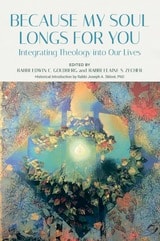
cover of Because My Soul Longs for You: Integrating Theology into Our Lives

Because My Soul Longs for You

Integrating Theology into Our Lives

Rabbi Edwin C. Goldberg and Rabbi Elaine S. Zecher

Central Conference of American Rabbis, 2021

Because My Soul Longs for You seeks to answer one of the most enduring human questions: Where can we find God in our lives? While Jewish theologians have long pondered the "God question" from ethical and philosophical perspectives, the last century has made space for a more experiential theology: God is present in our lived experiences. Radical amazement, to use Rabbi Abraham Joshua Heschel's phrase, can be found in everyday life. Contributors to this volume share how they welcome God's presence into their lives, as well as the theological language they use to think and speak about this presence. Chapters explore how we experience God through prayer, text study, poetry, food, music, service, movement, meditation, interpersonal connection, and much more.
 

[more]
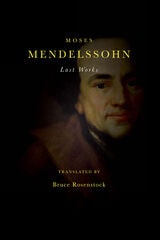
cover of Last Works

Last Works

Moses Mendelssohn. Translated by Bruce Rosenstock

University of Illinois Press, 2012
Moses Mendelssohn (1729–1786) was the central figure in the emancipation of European Jewry. His intellect, judgment, and tact won the admiration and friendship of contemporaries as illustrious as Johann Gottfried Herder, Gotthold Ephraim Lessing, and Immanuel Kant. His enormously influential Jerusalem (1783) made the case for religious tolerance, a cause he worked for all his life.
 
Last Works includes, for the first time complete and in a single volume, the English translation of Morning Hours: Lectures on the Existence of God (1785) and To the Friends of Lessing (1786). Bruce Rosenstock has also provided an historical introduction and an extensive philosophical commentary to both texts.
 
At the center of Mendelssohn's last works is his friendship with Lessing. Mendelssohn hoped to show that he, a Torah-observant Jew, and Lessing, Germany's leading dramatist, had forged a life-long friendship that held out the promise of a tolerant and enlightened culture in which religious strife would be a thing of the past.
 
Lessing's death in 1781 was a severe blow to Mendelssohn. Mendelssohn wrote his last two works to commemorate Lessing and to carry on the work to which they had dedicated much of their lives. Morning Hours treats a range of major philosophical topics: the nature of truth, the foundations of human knowledge, the basis of our moral and aesthetic powers of judgment, the reality of the external world, and the grounds for a rational faith in a providential deity. It is also a key text for Mendelssohn's readings of Spinoza. In To the Friends of Lessing, Mendelssohn attempts to unmask the individual whom he believes to be the real enemy of the enlightened state: the Schwärmer, the religious fanatic who rejects reason in favor of belief in suprarational revelation.
[more]
cover of Midrash and Theory: Ancient Jewish Exegesis and Contempory Literary Studies

Midrash and Theory

Ancient Jewish Exegesis and Contempory Literary Studies

David Stern

Northwestern University Press, 1998

In Midrash and Theory, David Stern presents an approach to midrashic literature through the prism of contemporary theory.

As midrash--the literature of classical Jewish Scriptural interpretation--has become the focus of new interest in contemporary literary circles, it has been invoked as a precursor of post-structuralist theory and criticism. At the same time, the midrashic imagination has undergone a revival in the larger Jewish community and shown itself capable of exercising a powerful influence and hold on a new type of contemporary Jewish writing. Stern examines this resurgence of fascination with ancient Jewish interpretation from the persepctive of the cultural relevance of midrash and its connection to its original historical and literary contexts.
[more]
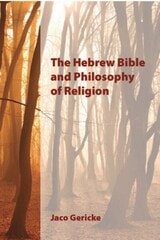
cover of The Hebrew Bible and Philosophy of Religion

The Hebrew Bible and Philosophy of Religion

Jaco Gericke

SBL Press, 2012
This study pioneers the use of philosophy of religion in the study of the Hebrew Bible. After identifying the need for a legitimate philosophical approach to Israelite religion, the volume traces the history of interdisciplinary relations and shows how descriptive varieties of philosophy of religion can aid the clarification of the Hebrew Bible’s own metaphysical, epistemological, and moral assumptions. Two new interpretative methodologies are developed and subsequently applied through an introduction to what the biblical texts took for granted about the nature of religious language, the concept of deity, the properties of Yhwh, the existence of gods, religious epistemology, and the relation between religion and morality.
[more]
cover of The Soul of the Stranger: Reading God and Torah from a Transgender Perspective

The Soul of the Stranger

Reading God and Torah from a Transgender Perspective

Joy Ladin

Brandeis University Press, 2018

Reading some of the best-known Torah stories through the lens of transgender experience, Joy Ladin explores fundamental questions about how religious texts, traditions, and the understanding of God can be enriched by transgender perspectives, and how the Torah and trans lives can illuminate one another. Drawing on her own experience and lifelong reading practice, Ladin shows how the Torah, a collection of ancient texts that assume human beings are either male or female, speaks both to practical transgender concerns, such as marginalization, and to the challenges of living without a body or social role that renders one intelligible to others—challenges that can help us understand a God who defies all human categories. These creative, evocative readings transform our understanding of the Torah’s portrayals of God, humanity, and relationships between them.
[more]