Results by title

4 books match the query 'Goddess'
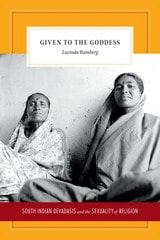
cover of Given to the Goddess: South Indian Devadasis and the Sexuality of Religion

Given to the Goddess

South Indian Devadasis and the Sexuality of Religion

Lucinda Ramberg

Duke University Press, 2014
Who and what are marriage and sex for? Whose practices and which ways of talking to god can count as religion? Lucinda Ramberg considers these questions based upon two years of ethnographic research on an ongoing South Indian practice of dedication in which girls, and sometimes boys, are married to a goddess. Called devadasis, or jogatis, those dedicated become female and male women who conduct the rites of the goddess outside the walls of her main temple and transact in sex outside the bounds of conjugal matrimony. Marriage to the goddess, as well as the rites that the dedication ceremony authorizes jogatis to perform, have long been seen as illegitimate and criminalized. Kinship with the goddess is productive for the families who dedicate their children, Ramberg argues, and yet it cannot conform to modern conceptions of gender, family, or religion. This nonconformity, she suggests, speaks to the limitations of modern categories, as well as to the possibilities of relations—between and among humans and deities—that exceed such categories.
[more]
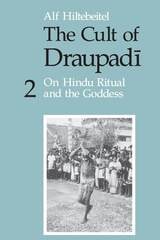
cover of The Cult of Draupadi, Volume 2: On Hindu Ritual and the Goddess

The Cult of Draupadi, Volume 2

On Hindu Ritual and the Goddess

Alf Hiltebeitel

University of Chicago Press, 1991

A groundbreaking work in the history of popular devotional Hinduism 
 
This is the second volume of a two-volume work on the little-known South Indian folk cult of the goddess Draupadi and on the classical epic, the Mahabharata, that the cult brings to life in mythic, ritual, and dramatic forms. Draupadi, the chief heroine of the Sanskrit Mahabharata, takes on many unexpected guises in her Tamil cult, but her dimensions as a folk goddess remain rooted in a rich interpretive vision of the great epic. By examining the ways that the cult of Draupadi commingles traditions about the goddess and the epic, Alf Hiltebeitel shows the cult to be singularly representative of the inner tensions and working dynamics of popular devotional Hinduism. 

Volume 2 looks at the cultic rituals and argues that these rituals cannot be interpreted independent of other Hindu traditions. Hiltebeitel draws upon his recent fieldwork to demonstrate the remarkable regional and local variations in the practice of the Draupadī cult rituals, from the core area around the ancient center of gingee to the thanjavur area just to the south. He brings to the forefront the differences between the complex rituals of cities, towns, and villages and discusses variations related to their proximity to the central temple in gingee and to the castes from which their customs are derived. using as its model the festival of the Tindivanam temple, Hiltebeitel’s study follows the order of the festival itself and investigates in turn the festival’s four interrelated arenas: the Draupadī temple, a drama stage, a ritual battlefield (paṭukaḷam), and a firewalking area. He explains how the Draupadī festival orchestrates movements back and forth between these arenas to produce a “ritual of battle” in which Draupadī emerges as the victorious goddess.
 

[more]
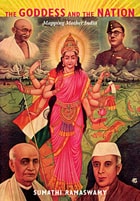
cover of The Goddess and the Nation: Mapping Mother India

The Goddess and the Nation

Mapping Mother India

Sumathi Ramaswamy

Duke University Press, 2010

Making the case for a new kind of visual history, The Goddess and the Nation charts the pictorial life and career of Bharat Mata, “Mother India,” the Indian nation imagined as mother/goddess, embodiment of national territory, and unifying symbol for the country’s diverse communities. Soon after Mother India’s emergence in the late nineteenth century, artists, both famous and amateur, began to picture her in various media, incorporating the map of India into her visual persona. The images they produced enabled patriotic men and women in a heterogeneous population to collectively visualize India, affectively identify with it, and even become willing to surrender their lives for it. Filled with illustrations, including 100 in color, The Goddess and the Nation draws on visual studies, gender studies, and the history of cartography to offer a rigorous analysis of Mother India’s appearance in painting, print, poster art, and pictures from the late nineteenth century to the present.

By exploring the mutual entanglement of the scientifically mapped image of India and a (Hindu) mother/goddess, Sumathi Ramaswamy reveals Mother India as a figure who relies on the British colonial mapped image of her dominion to distinguish her from the other goddesses of India, and to guarantee her novel status as embodiment, sign, and symbol of national territory. Providing an exemplary critique of ideologies of gender and the science of cartography, Ramaswamy demonstrates that images do not merely reflect history; they actively make it. In The Goddess and the Nation, she teaches us about pictorial ways of learning the form of the nation, of how to live with it—and ultimately to die for it.
[more]
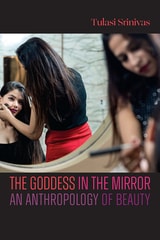
cover of The Goddess in the Mirror: An Anthropology of Beauty

The Goddess in the Mirror

An Anthropology of Beauty

Tulasi Srinivas

Duke University Press, 2025

In The Goddess in the Mirror, Tulasi Srinivas offers a pathbreaking ethnography of contemporary Indian beauty parlors in Bangalore. Exploring the gendered world of beauty in the intimate spaces of the salon, whose popularity has exploded amid an urban tech revolution, Srinivas invites readers to consider what beauty is and what it does. Visiting diverse salons that cater to various classes, castes, and queer sexualities, she tracks the relationships between clients and workers, revealing the beauty industry’s painful political, religious, and economic stakes. Embodiment, religion, and narrative intersect as clients and beauticians tell well-known stories of beautiful Hindu goddesses, heroines, queens, and apsaras, thereby weaving their own ethical subjectivities every day. Following the goddess’s allure, radiance, woundedness, fluidity, and fertility, Srinivas situates ideas of beauty within a larger moral and political context where beauty is both a fleeting pursuit and a rich resource for navigating a patriarchal present.
[more]