Results by title
11 books match the query 'Going'
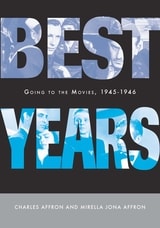
Best Years
Going to the Movies, 1945-1946Charles Affron and Mirella Jona Affron
Rutgers University Press, 2009
Best Years is a panoramic study, shining light on this critical juncture in American historyand the history of American cinemaùthe end of World War II (1945) and a year of unprecedented success in Hollywood's "Golden Age" (1946). This unique time, the last year of war and the first full year of peace, provides a rich blend of cinema genres and typesùfrom the battlefront to the home front, the peace film to the woman's film, psychological drama, and the period's provocative new style, film noir.
Best Years focuses on films that were famous, infamous, forgotten, and unforgettable. Big budget A-films, road shows, and familiar series share the spotlight. From Bergman and Grant in Notorious to Abbott and Costello in Lost in a Harem, Charles Affron and Mirella Jona Affron examine why the bond between screen and viewer was perhaps never tighter. Paying special attention to the movie-going public in key cities--Atlanta, New York, Boston, Honolulu, and Chicago--this ambitious work takes us on a cinematic journey to recapture a magical time.
Coming and Going
New and Selected PoemsJames McAuley
University of Arkansas Press, 1989
Going
Kevin Oderman
West Virginia University Press, 2006
In Granada, a boy in a dress begs in the white alleys of the old town. A vulnerable runaway, he turns to an American painter who is living in the city for protection, Madeleine James. The boy also meets Madeleine's new friend, poet Cy Jacobs. Although the two adults mean to help the boy, they unwittingly expose him to more peril. Soon, all the characters in the story have been scraped on the touchstone of hard realities and made to show their mettle, be it base or gold. This novel, at times somber and at times flaring with intensity, calls up indelibly the difficulties of making a good life—or a good death—in a world in which we are all, in one way or another, going.
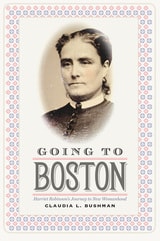
Going to Boston
Harriet Robinson's Journey to New WomanhoodClaudia L. Bushman
University Press of New England, 2017
Going to Cincinnati
A History of the Blues in the Queen CitySteven C. Tracy
University of Illinois Press, 2025
Going to Court to Change Japan
Social Movements and the Law in Contemporary JapanPatricia G. Steinhoff, Editor
University of Michigan Press, 2014
Going to War in Iraq
When Citizens and the Press MatterStanley Feldman, Leonie Huddy, and George E. Marcus
University of Chicago Press, 2015
Drawing on the most comprehensive survey of public reactions to the war, Stanley Feldman, Leonie Huddy, and George E. Marcus revisit this critical period and come back with a very different story. Polling data from that critical period shows that the Bush administration’s carefully orchestrated campaign not only failed to raise Republican support for the war but, surprisingly, led Democrats and political independents to increasingly oppose the war at odds with most prominent Democratic leaders. More importantly, the research shows that what constitutes the news matters. People who read the newspaper were more likely to reject the claims coming out of Washington because they were exposed to the sort of high-quality investigative journalism still being written at traditional newspapers. That was not the case for those who got their news from television. Making a case for the crucial role of a press that lives up to the best norms and practices of print journalism, the book lays bare what is at stake for the functioning of democracy—especially in times of crisis—as newspapers increasingly become an endangered species.
Going to the Countryside
The Rural in the Modern Chinese Cultural Imagination, 1915-1965Yu Zhang
University of Michigan Press, 2020
Since the beginning of the twentieth century, modern Chinese intellectuals, reformers, revolutionaries, leftist journalists, and idealistic youth had often crossed the increasing gap between the city and the countryside, which made the act of “going to the countryside” a distinctively modern experience and a continuous practice in China. Such a spatial crossing eventually culminated in the socialist state program of “down to the villages” movements during the 1960s and 1970s. What, then, was the special significance of “going to the countryside” before that era? Going to the Countryside deals with the cultural representations and practices of this practice between 1915 and 1965, focusing on individual homecoming, rural reconstruction, revolutionary journeys to Yan’an, the revolutionary “going down to the people” as well as going to the frontiers and rural hometowns for socialist construction. As part of the larger discourses of enlightenment, revolution, and socialist industrialization, “going to the countryside” entailed new ways of looking at the world and ordinary people, brought about new experiences of space and time, initiated new means of human communication and interaction, generated new forms of cultural production, revealed a fundamental epistemic shift in modern China, and ultimately created a new aesthetic, social, and political landscape.
As a critical response to the “urban turn” in the past few decades, this book brings the rural back to the central concern of Chinese cultural studies and aims to bridge the city and the countryside as two types of important geographical entities, which have often remained as disparate scholarly subjects of inquiry in the current state of China studies. Chinese modernity has been characterized by a dual process that created problems from the vast gap between the city and the countryside but simultaneously initiated constant efforts to cope with the gap personally, collectively, and institutionally. The process of “crossing” two distinct geographical spaces was often presented as continuous explorations of various ways of establishing the connectivity, interaction, and relationship of these two imagined geographical entities. Going to the Countryside argues that this new body of cultural productions did not merely turn the rural into a constantly changing representational space; most importantly, the rural has been constructed as a distinct modern experiential and aesthetic realm characterized by revolutionary changes in human conceptions and sentiments.
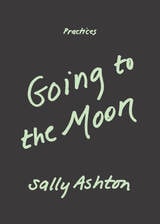
Going to the Moon
Sally Ashton
Duke University Press, 2026
In 2022, poet Sally Ashton learned that one of her poems would be included in a time capsule to be sent to the Moon via Astrobotic’s 2024 Griffin/VIPER as part of the Lunar Codex project. For her, this event seemed like the high point in a life spent chasing the Moon, from a childhood inspired by the space race of the 1960s to an adulthood spent in contemplation and conversation with the sky. In Going to the Moon, Ashton marvels at the Moon’s powerful influence since the dawn of humanity—how we have, in our own ways, gone to the Moon, and what we have found. Contemplating lunar settlement in the light of history, culture, the rise of the space industry, and geopolitical conflict, Ashton shares her sense of wonder at the simple beauty of our unchanged Moon and reveals what is at stake in our contemporary attempts to colonize it.
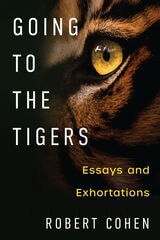
Going to the Tigers
Essays and ExhortationsRobert Cohen
University of Michigan Press, 2022
In this funny and perceptive collection, novelist and essayist Robert Cohen shares his thoughts on the writing process and then puts these prescriptions into practice—from how to rant effectively as an essayist and novelist (“The Piano Has Been Drinking”), how to achieve your own style, naming characters (and creating them), how one manages one’s own identity with being “a writer” in time and space, to the use of reference and allusion in one’s work. Cohen is a deft weaver of allusion himself. In lieu of telling the reader how to master the elements of writing fiction, he shows them through the work of the writers who most influenced his own development, including Roth, Ellison, Kafka, and Robinson. Rooted in his own experiences, this collection of essays shows readers how to use their influences and experiences to create bold, personal, and individual work. While the first part of the book teaches writing, the essays in the second part show how these elements come together.
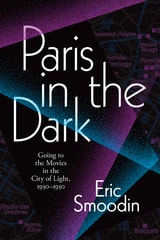
Paris in the Dark
Going to the Movies in the City of Light, 1930–1950Eric Smoodin
Duke University Press, 2020