Results by title
4 books match the query 'Going Public'
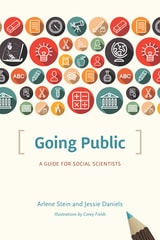
Going Public
A Guide for Social ScientistsArlene Stein and Jessie Daniels
University of Chicago Press, 2017
While there has been an increasing call for social scientists to engage more broadly with the public, concrete advice for starting the conversation has been in short supply. Arlene Stein and Jessie Daniels seek to change this with Going Public, the first guide that truly explains how to be a public scholar. They offer guidance on writing beyond the academy, including how to get started with op-eds and articles and later how to write books that appeal to general audiences. They then turn to the digital realm with strategies for successfully building an online presence, cultivating an audience, and navigating the unique challenges of digital world. They also address some of the challenges facing those who go public, including the pervasive view that anything less than scholarly writing isn’t serious and the stigma that one’s work might be dubbed “journalistic.”
Going Public shows that by connecting with experts, policymakers, journalists, and laypeople, social scientists can actually make their own work stronger. And by learning to effectively add their voices to the conversation, researchers can help make sure that their knowledge is truly heard above the digital din.
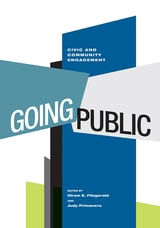
Going Public
Civic and Community EngagementHiram E. Fitzgerald
Michigan State University Press, 2013
The terms “civic engagement” and “community engagement” have various definitions, but they are united by the sense that individuals who are civically engaged not only are concerned about the quality of life in their communities but also take action to improve conditions for the common good. In the United States, to be civically engaged means to actively participate in a civil democratic society. Going Public examines programs related to civic engagement and the ways in which faculty and students participate in communities in order to improve them. Engagement scholarship is a scholarship of action, a scholarship of practice that takes place both in and with the community. Within the framework of this new scholarship, the mission of the academy does not begin and end with intellectual discovery and fact-finding. Rather, the academy joins forces with the community, and together they use their knowledge and resources to address pressing social, civic, economic, and moral problems. Each chapter in this book tells a unique story of community engagement and the scholarship of practice in a diverse range of settings, documenting successes and failures, the unintended consequences, and the questions yet to be answered.
Going Public
Creating Visibility in the Field of ArtEdited by Sigrid Adorf, Sønke Gau, and Basil Rogger
Diaphanes, 2022
There are many ways to go public in art. There’s exhibiting, publishing, or reviewing. It is only through making artworks public that they become accessible to audiences—a performative act that also involves a marketplace of money and attention. Yet reception is an essential aspect of production.
This book looks at why such reception should not be limited to the art public, positing that going public as an aesthetic and political strategy necessitates an emancipatory practice of public communication that allows, and aspires to, uncertainties, questions, and complexities.
Going Public
What Writing Programs Learn from EngagementShirley Rose
Utah State University Press, 2010
In Going Public, Rose and Weiser locate their discussion in the context of three current conversations in higher education: 1) the engagement movement, particularly as this movement serves to address and respond to calls for greater accountability to broader publics; 2) recent interest in public discourse/civic rhetoric among scholars of rhetorical history and contemporary rhetorical theory; 3) the service learning movement in higher education, especially the ways in which college and university writing programs have contributed to this movement.
While there have been a number of publications describing service-learning and community leadership programs, most of these focus on curricular elements and address administrative issues, if at all, primarily from a curricular perspective. The emphasis of the current book is on the ways that engagement-focused programs change conceptions of WPA identity. Going Public, then, is not only a significant contribution to the scholarly literature, but also supplies an important new resource for WPA preparation courses in rhetoric and composition PhD programs.