Results by title
3 books match the query 'Golden State'
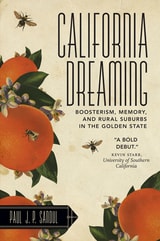
California Dreaming
Boosterism, Memory, and Rural Suburbs in the Golden StatePaul J. P. Sandul
West Virginia University Press, 2014
At the turn of the 20th century, the California dream was a suburban ideal where life on the farm was exceptional. Agrarian virtue existed alongside good roads, social clubs, cultural institutions, and business commerce. The California suburban dream was the ultimate symbol of progress and modernity.
California Dreaming: Boosterism, Memory, and Rural Suburbs in the Golden State analyzes the growth, promotion, and agricultural colonization that fed this dream during the early 1900s. Through this analysis, Paul J. P. Sandul introduces a newly identified rural-suburban type: the agriburb, a rural suburb deliberately planned, developed, and promoted for profit. Sandul reconceptualizes California’s growth during this time period, establishing the agriburb as a suburban phenomenon that occurred long before the booms of the 1920s and 1950s.
Sandul’s analysis contributes to a new suburban history that includes diverse constituencies and geographies and focuses on the production and construction of place and memory. Boosters purposefully “harvested” suburbs with an eye toward direct profit and metropolitan growth. State boosters boasted of unsurpassable idyllic communities while local boosters bragged of communities that represented the best of the best, both using narratives of place, class, race, lifestyle, and profit to avow images of the rural and suburban ideal.
This suburban dream attracted people who desired a family home, nature, health, culture, refinement, and rural virtue. In the agriburb, a family could live on a small home grove while enjoying the perks of a progressive city. A home located within the landscape of natural California with access to urban amenities provided a good place to live and a way to gain revenue through farming.
To uncover and dissect the agriburb, Sandul focuses on local histories from California’s Central Valley and the Inland Empire of Southern California, including Ontario near Los Angeles and Orangevale and Fair Oaks outside Sacramento. His analysis closely operates between the intersections of history, anthropology, geography, sociology, and the rural and urban, while examining a metanarrative that exposes much about the nature and lasting influence of cultural memory and public history upon agriburban communities.
[more]
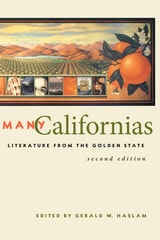
Many Californias
Literature from the Golden StateGerald W. Haslam
University of Nevada Press, 1999
Haslam divides the state into five regions, selecting prose and poetry from each that reflects their history, terrain, and culture. Many Califonias features sixty-seven authors ranging from Jack London to Maxine Hong Kingston, making it the most diverse general-interest anthology available.
[more]

The Way We Really Were
THE GOLDEN STATE IN THE SECOND GREAT WAREdited by Roger W. Lotchin
University of Illinois Press, 2000
The customary picture of the World War II era in California has been dominated by accounts of the Japanese American concentration camps, African Americans, and women on the home front.
The Way We Really Were substantially enlivens this view, addressing topics that have been neglected or incompletely treated in the past to create a more rounded picture of the wartime situation at home. Exploring the developments brought to fruition by the war and linking them to their roots in earlier decades, contributors address the diversity of the musical scene, which arose from a cross-pollination of styles brought by Okies, blacks, and Mexican migrants. They examine increased political involvement by women, Hollywood's response to the war, and the merging of business and labor interests in the Bay Area Council. They also reveal how wartime dynamics led to substantial environmental damage and lasting economic gains by industry.
The Way We Really Were examines significant wartime changes in the circumstances of immigrant groups that have been largely overlooked by historians. Among these are Italian Americans, heavily insular and pro-Fascist before the war and very pro-American and assimilationist after, and Chinese American men, who achieved new legitimacy and entitlement through military service. Also included is a look at cultural negotiation among multiple ethnic groups in the Golden State. A valuable addition to the literature on California history, The War We Really Were provides an entree into new areas of scholarship and a fresh look at familiar ones.
[more]