Results by title
2 books match the query 'González-Tennant, Edward'
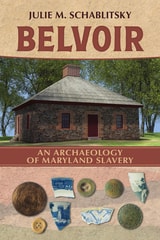
Belvoir
An Archaeology of Maryland SlaveryJulie M. Schablitsky
University of Alabama Press, 2025
Unearthed truths, buried lives: Belvoir reveals the pain, resilience, and reckoning found beneath the soil of a Maryland plantation.
Near Annapolis, Maryland, a former tobacco plantation dating to the 1730s holds centuries of untold history. In Belvoir: An Archaeology of Maryland Slavery, Julie M. Schablitsky leads readers on an archaeological narrative to unearth the lives and stories still buried there.The book begins with an introduction to the estate’s history, detailing its ownership by prominent families such as the Rosses, Scotts, Worthingtons, and Welshes. Schablitsky highlights the landscape of the estate, including the unique thirty-two-square-foot stone quarter built for enslaved people.
With sensitivity and scientific rigor, Schablitsky shifts focus to the enslaved people who lived and labored at Belvoir for more than eighty years. Through detailed excavation of the stone quarter and analysis of everyday artifacts—buttons, tobacco pipes, food remains, ceramics—she reconstructs the daily life, acts of resistance, and the cultural endurance of a community forced to navigate brutality.
Yet what makes Belvoir especially vital is its ethical compass. Schablitsky centers the voices of descendants, allowing their questions, memories, and presence to shape the narrative. The result is a groundbreaking archaeological case study and a blueprint for restorative justice at sites of enslavement. Scholars, archaeologists, and general readers alike will find Belvoir a deeply human, profoundly necessary book, one that confronts the past with clarity, care, and the hope of reconciliation.
Historical Archaeologies of the Caribbean
Contextualizing Sites through Colonialism, Capitalism, and Globalismedited by Todd M. Ahlman and Gerald F. Schroedl
University of Alabama Press, 2019
Historical Archaeologies of the Caribbean: Contextualizing Sites through Colonialism, Capitalism, and Globalism addresses issues in Caribbean history and historical archaeology such as freedom, frontiers, urbanism, postemancipation life, trade, plantation life, and new heritage. This collection moves beyond plantation archaeology by expanding the knowledge of the diverse Caribbean experiences from the late seventeenth through the mid-nineteenth centuries.
The essays in this volume are grounded in strong research programs and data analysis that incorporate humanistic narratives in their discussions of Amerindian, freedmen, plantation, institutional, military, and urban sites. Sites include a sample of the many different types found across the Caribbean from a variety of colonial contexts that are seldom reported in archaeological research, yet constitute components essential to understanding the full range and depth of Caribbean history.
Contributors examine urban contexts in Nevis and St. John and explore the economic connections between Europeans and enslaved Africans in urban and plantation settings in St. Eustatius. The volume contains a pioneering study of frontier exchange with Amerindians in Dominica and a synthesis of ceramic exchange networks among enslaved Africans in the Leeward Islands. Chapters on military forts in Nevis and St. Kitts call attention to this often-neglected aspect of the Caribbean colonial landscape. Contributors also directly address culture heritage issues relating to community participation and interpretation. On St. Kitts, the legacy of forced confinement of lepers ties into debates of current public health policy. Plantation site studies from Antigua and Martinique are especially relevant because they detail comparisons of French and British patterns of African enslavement and provide insights into how each addressed the social and economic changes that occurred with emancipation.
Contributors
Todd M. Ahlman / Douglas V. Armstrong / Samantha Rebovich Bardoe / Paul Farnsworth / Jeffrey R. Ferguson / R. Grant Gilmore III / Diana González-Tennant / Edward González-Tennant / Barbara J. Heath / Carter L. Hudgins Kenneth G. Kelly / Eric Klingelhofer / Roger H. Leech / Stephan Lenik / Gerald F. Schroedl / Diane Wallman / Christian Williamson