Results by title
3 books match the query 'González, Ray'
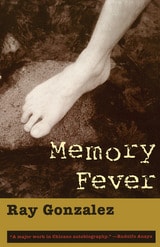
Memory Fever
Ray Gonzalez
University of Arizona Press, 1999
For poet Ray Gonzalez, growing up in El Paso during the 1960s was a time of loneliness and vulnerability. He encountered discrimination in high school not only for being Latino but also for being a non-athlete in a school where sports were important. Like many young people, he found diversion in music; unlike most, he found solace in the desert. In these vignettes, Gonzalez shares memories of boyhood that tell how he discovered the natural world and his creative spirit.
Through 29 storylike essays, Gonzalez takes readers into the heart of the desert and the soul of a developing poet. He introduces us to the people who shaped his life. We learn of his father's difficulties with running a pool hall and of his grandmother's steadfast religious faith. We meet sinister Texas Rangers, hallucinatory poets, illegal aliens, and racist high school jocks. His vivid recollections embrace lizard hunts and rattlesnake dreams, rock music and menudo making—all in stories that convey the pains and joys of growing up on the border. As Gonzalez leads us through his desert of hope and vision, we come to recognize the humor and sadness that permeate this special place.
Through 29 storylike essays, Gonzalez takes readers into the heart of the desert and the soul of a developing poet. He introduces us to the people who shaped his life. We learn of his father's difficulties with running a pool hall and of his grandmother's steadfast religious faith. We meet sinister Texas Rangers, hallucinatory poets, illegal aliens, and racist high school jocks. His vivid recollections embrace lizard hunts and rattlesnake dreams, rock music and menudo making—all in stories that convey the pains and joys of growing up on the border. As Gonzalez leads us through his desert of hope and vision, we come to recognize the humor and sadness that permeate this special place.
[more]
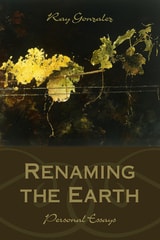
Renaming the Earth
Personal EssaysRay Gonzalez
University of Arizona Press, 2008
In his distinctive and spirited way, Ray Gonzalez, the well-known essayist, poet, fiction writer, and anthologist, reflects on the American Southwest—where he was raised and to which he still feels attached (even though he has lived much of his life elsewhere). It is a place that tugs at him, from its arid desert landscapes to its polyglot cities—part Mexican, part Anglo, part something in-between—always in the process of redefining themselves.
Nowhere does the process of redefinition hit Gonzalez quite as hard as in his native city of El Paso, Texas. There he finds the “segregated little town of my childhood” transformed into “a metropolis of fast Latino zip codes . . . a world where the cell phone, the quick beer, the rented apartment, and the low-paying job say you can be young and happy on the border.” Readers will wonder, along with the author, whether life along the “new border” is worth “the extermination of the old boundaries.”
But there is another side of the Southwest for this “son of the desert”—the world of dusty canyons, ponderosa pines, ocotillo, and mesquite. Here, he writes, “there is a shadow, and it is called ancient home—structures erased from their seed to grow elsewhere, vultured strings searching for a frame that stands atop history and renames the ground.”
Rooted in the desert sand and in the banks of the Rio Grande, the muddy river that forms the border between nations, these essays are by turns lyrical, mournful, warm to the ways of the land, and lukewarm to the ways of man.
[more]
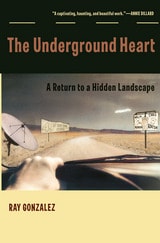
The Underground Heart
A Return to a Hidden LandscapeRay Gonzalez
University of Arizona Press, 2002
Returning home after a long absence is not always easy. For Ray Gonzalez, it is more than a visit; it is a journey to the underground heart. He has lived in other parts of the country for more than twenty years, but this award-winning poet now returns to the desert Southwest—a native son playing tourist—in order to unearth the hidden landscapes of family and race.
As Gonzalez drives the highways of New Mexico and west Texas, he shows us a border culture rejuvenated by tourist and trade dollars, one that will surprise readers for whom the border means only illegal immigration, NAFTA, and the drug trade. Played out against a soundtrack of the Allman Brothers and The Doors, The Underground Heart takes readers on a trip through a seemingly barren landscape that teems with life and stories. Gonzalez witnesses Minnesotans experiencing culture shock while attending a college football game in El Paso; he finds a proliferation of Pancho Villa death masks housed at different museums; he revisits Carlsbad Caverns, discovering unsuspected beauty beneath the desert's desolation; and he takes us shopping at El Mercado—where tourists can buy everything from black velvet paintings of Elvis (or Jesus, or JFK) to Mexican flag underwear.
From "nuclear tourism" in New Mexico to "heritage tourism" in the restored missions of San Antonio, Gonzalez goes behind the slogans of The Land of Enchantment and The Lone Star State to uncover a totally different Southwest. Here are tourist centers that give a distorted view of southwestern life to outsiders, who leave their dollars in museum gift shops and go home weighed down with pounds of Indian jewelry around their necks. Here border history is the story of one culture overlaid on another, re-forming itself into a whole new civilization on the banks of the Rio Grande.
The Underground Heart is a book brimming with subtle ironies and insights both quiet and complex—one which recognizes that sometimes one must go away and grow older to finally recognize home as a life-giving, spiritually sustaining place. As Gonzalez rediscovers the land of his past, he comes to understand the hyper, bilingual atmosphere of its future. And in the Southwest he describes, readers may catch a glimpse of their own hidden landscapes of home.
[more]