Results by title
2 books match the query 'Goods'
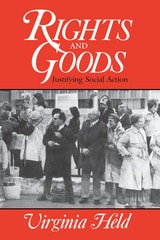
Rights and Goods
Justifying Social ActionVirginia Held
University of Chicago Press, 1989
Theories of justice, argues Virginia Held, are usually designed for a perfect, hypothetical world. They do not give us guidelines for living in an imperfect world in which the choices and decisions that we must make are seldom clear-cut.
Seeking a morality based on actual experience, Held offers a method of inquiry with which to deal with the specific moral problems encountered in daily life. She argues that the division between public and private morality is misleading and shows convincingly that moral judgment should be contextual. She maps out different approaches and positions for various types of issues, including membership in a state, legal decisions, political activities, economic transactions, interpersonal relations, diplomacy, journalism, and determining our obligation to future generations. Issues such as these provide the true test of moral theory, since its success is seen in the willingness of conscientious persons to commit themselves to it by acting on it in their daily lives.
Seeking a morality based on actual experience, Held offers a method of inquiry with which to deal with the specific moral problems encountered in daily life. She argues that the division between public and private morality is misleading and shows convincingly that moral judgment should be contextual. She maps out different approaches and positions for various types of issues, including membership in a state, legal decisions, political activities, economic transactions, interpersonal relations, diplomacy, journalism, and determining our obligation to future generations. Issues such as these provide the true test of moral theory, since its success is seen in the willingness of conscientious persons to commit themselves to it by acting on it in their daily lives.
[more]
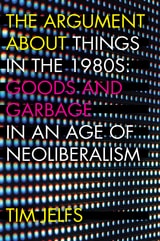
The Argument about Things in the 1980s
Goods and Garbage in an Age of NeoliberalismTim Jelfs
West Virginia University Press, 2018
In the late 1970s, a Jeff Koons art exhibit featured mounted vacuum cleaners lit by fluorescent tube lighting and identified by their product names: New Hoover Quik Broom, New Hoover Celebrity IV. Raymond Carver published short stories such as “Are These Actual Miles?” that cataloged the furniture, portable air conditioners, and children’s bicycles in a family home. Some years later the garbage barge Mobro 4000 turned into an international scandal as it spent months at sea, unable to dump its trash as it was refused by port after port.
Tim Jelfs’s The Argument about Things in the 1980s considers all this and more in a broad study of the literature and culture of the “long 1980s.” It contributes to of-the-moment scholarly debate about material culture, high finance, and ecological degradation, shedding new light on the complex relationship between neoliberalism and cultural life.
Tim Jelfs’s The Argument about Things in the 1980s considers all this and more in a broad study of the literature and culture of the “long 1980s.” It contributes to of-the-moment scholarly debate about material culture, high finance, and ecological degradation, shedding new light on the complex relationship between neoliberalism and cultural life.
[more]