Results by title
5 books match the query 'Goodwin, Craufurd D.'
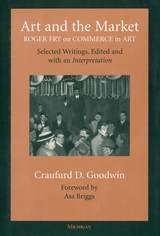
Art and the Market
Roger Fry on Commerce in Art, Selected Writings, Edited with an InterpretationCraufurd D. Goodwin
University of Michigan Press, 1998

Economic Engagements with Art, Volume 31
Craufurd D. W. Goodwin and Neil de Marchi, eds.
Duke University Press, 0
This volume, which deals mostly with painting, is divided into three sections that consider the interplay between art and economics from different perspectives. In the first section, Art and Economic Theory, economists clarify the need to construct a framework for understanding the roles of taste and fashion in art valuation. A historical view is considered in a piece about the teacher of Velasquez and artistic adviser to the Inquisition in Seville, who took into account not only market factors, like demand, but also the "truth" and the nobility of the artist’s profession and of the painting itself. Also in this section is an essay on Rousseau’s perspective on the worth of a painting based on its envy value in social circles; other contributions focus on William Stanley Jevons, a nineteenth century British political economist, whose problems with art stemmed from the uniqueness of each work, rendering definitive market and economic terms irrelevant. The second section of the book, Art and Economic Policy, looks at broader policy issues with regard to the historical role of art. Essays consider policy with respect to art exports and imports and federal patronage of the arts during theDepression; Lionel Robbins and the political economy of art; and the interplay among economy, architecture, and politics as shown in certain postwar Hilton hotels. In the final section, The Business of Art, a variety of perspectives are considered: the economics of art in early modern times, discussed in the context of both humanist and scholastic approaches; the pricing of pictures based on a study of the Smith-Reynolds connection; and the relationships between Otto Nuerath, graphic art, and the social order.
The first collaborative and historical treatment of the connection between art and economics, Economic Engagements with Art will appeal to people across, from history and economics to art history.
Contributors. Márcia Balisciano, William J. Barber, Neil de Marchi, Bertil Fridén, Crauford D. Goodwin, Guido Guerzoni, Robert J. Leonard, Harro Maas, Ernest Mathijs, Steven G. Medema, Bert Mosselmans, Zarinés Negrón, Marcia Pointon, Helen Rees, Toon van Houdt, Annabel Wharton, Sara Zablotney
Economic Engagements with Art, Volume 31
Craufurd D. W. Goodwin and Neil de Marchi, eds.
Duke University Press, 0
This volume, which deals mostly with painting, is divided into three sections that consider the interplay between art and economics from different perspectives. In the first section, Art and Economic Theory, economists clarify the need to construct a framework for understanding the roles of taste and fashion in art valuation. A historical view is considered in a piece about the teacher of Velasquez and artistic adviser to the Inquisition in Seville, who took into account not only market factors, like demand, but also the "truth" and the nobility of the artist’s profession and of the painting itself. Also in this section is an essay on Rousseau’s perspective on the worth of a painting based on its envy value in social circles; other contributions focus on William Stanley Jevons, a nineteenth century British political economist, whose problems with art stemmed from the uniqueness of each work, rendering definitive market and economic terms irrelevant. The second section of the book, Art and Economic Policy, looks at broader policy issues with regard to the historical role of art. Essays consider policy with respect to art exports and imports and federal patronage of the arts during theDepression; Lionel Robbins and the political economy of art; and the interplay among economy, architecture, and politics as shown in certain postwar Hilton hotels. In the final section, The Business of Art, a variety of perspectives are considered: the economics of art in early modern times, discussed in the context of both humanist and scholastic approaches; the pricing of pictures based on a study of the Smith-Reynolds connection; and the relationships between Otto Nuerath, graphic art, and the social order.
The first collaborative and historical treatment of the connection between art and economics, Economic Engagements with Art will appeal to people across, from history and economics to art history.
Contributors. Márcia Balisciano, William J. Barber, Neil de Marchi, Bertil Fridén, Crauford D. Goodwin, Guido Guerzoni, Robert J. Leonard, Harro Maas, Ernest Mathijs, Steven G. Medema, Bert Mosselmans, Zarinés Negrón, Marcia Pointon, Helen Rees, Toon van Houdt, Annabel Wharton, Sara Zablotney
Economics and National Security
A History of Their Interaction, Volume 23Craufurd D. W. Goodwin
Duke University Press, 1991
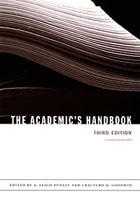
The Academic's Handbook
A. Leigh DeNeef and Craufurd D. Goodwin, eds.
Duke University Press, 2006
Faculty members, administrators, and professionals with experience at all levels of higher education offer candid, practical advice to help beginning academics understand matters including:
— The different kinds of institutions of higher learning and expectations of faculty at each.
— The advantages and disadvantages of teaching at four-year colleges instead of research universities.
— The ins and outs of the job market.
— Alternatives to tenure-track, research-oriented positions.
— Salary and benefits.
— The tenure system.
— Pedagogy in both large lecture courses and small, discussion-based seminars.
— The difficulties facing women and minorities within academia.
— Corporations, foundations, and the federal government as potential sources of research funds.
— The challenges of faculty mentoring.
— The impact of technology on contemporary teaching and learning.
— Different types of publishers and the publishing process at university presses.
— The modern research library.
— The structure of university governance.
— The role of departments within the university.
With the inclusion of eight new chapters, this edition of The Academic’s Handbook is designed to ease the transition from graduate school to a well-rounded and rewarding career.
Contributors. Judith K. Argon, Louis J. Budd, Ronald R. Butters, Norman L. Christensen, Joel Colton, Paul L. Conway, John G. Cross, Fred E. Crossland, Cathy N. Davidson, A. Leigh DeNeef, Beth A. Eastlick, Matthew W. Finkin, Jerry G. Gaff, Edie N. Goldenberg, Craufurd D. Goodwin, Stanley M. Hauerwas, Deborah L. Jakubs, L. Gregory Jones, Nellie Y. McKay, Patrick M. Murphy, Elizabeth Studley Nathans, A. Kenneth Pye, Zachary B. Robbins, Anne Firor Scott, Sudhir Shetty, Samuel Schuman, Philip Stewart, Boyd R. Strain, Emily Toth, P. Aarne Vesilind, Judith S. White, Henry M. Wilbur, Ken Wissoker