Results by title
7 books match the query 'Goscilo, Helena'
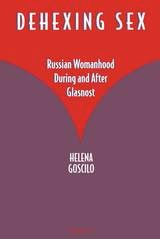
Dehexing Sex
Russian Womanhood During and After GlasnostHelena Goscilo
University of Michigan Press, 1996
Glasnost and the collapse of the Soviet Union revolutionized Russian society. What effects, however, did they have on the status, role, and image of women in Russian culture? Examining the past turbulent decade of transition to "democracy" and a market economy, Dehexing Sex traces the ways in which Russia's concept of womanhood both changed and remained the same, taking into account dominant ideologies and social philosophies, sociopolitical organizations, women's writings, literary criticism, film, and popular cultural forms such as pornography. The lively, engaging chapters of this book examine texts by contemporary women writers in the context of the political, social, economic, biological, psychological, and aesthetic transformations that helped define them. Goscilo reveals that the Russian cultural revolution has reshaped the female image in varied and often contradictory ways. While increased interaction with the West fostered gender awareness, it also introduced imported Western sexist practices--especially the exploitation of female bodies--formerly proscribed by a puritanical censorship. Popular magazines, newspapers, and television propagated the image of woman as mother, ornament, and sexual object, even as women's fiction conceived of womanhood in complex psychological terms that undermined the gender stereotypes which had ruled Soviet thinking for more than 70 years. With the aid of feminist and cultural theory, Dehexing Sex investigates the overt and internalized misogyny that combined with the genuinely liberalizing forces unleashed by Gorbachev's policy of glasnost and perestroika. It exposes Russia's repressive romance with womanhood as a metaphor for nationhood and explores Russian women's ironic recasting of national mythologies. "Impressive . . . an important contribution to Russian studies and to women's studies. The author is an outstanding scholar, an energetic and original thinker, and her writing sparkles with imagination and wit." --Stephanie Sandler, Amherst College Helena Goscilo is Associate Professor and Chair of Slavic Languages and Literatures, University of Pittsburgh.
[more]

Embracing Arms
Cultural Representation of Slavic and Balkan Women in WarYana Hashamova
Central European University Press, 2012
Discursive practices during war polarize and politicize gender: they normally require men to fulfill a single, overriding task—destroy the enemy—but impose a series of often contradictory expectations on women. The essays in the book establish links between political ideology, history, psychology, cultural studies, cinema, literature, and gender studies and addresses questions such as— what is the role of women in war or military conflicts beyond the well-studied victimization? Can the often contradictory expectations of women and their traditional roles be (re)thought and (re)constructed? How do cultural representations of women during war times reveal conflicting desires and poke holes in the ideological apparatus of the state and society?
[more]
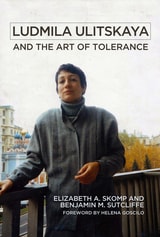
Ludmila Ulitskaya and the Art of Tolerance
Elizabeth Skomp and Benjamin M. Sutcliffe, Foreword by Helena Goscilo
University of Wisconsin Press, 2015
Novelist Ludmila Ulitskaya is a crucial cultural figure in contemporary Russia, garnering both literary awards and best-seller status. Engaging with the past to combat the creeping authoritarianism of the Putin era, she has become the latest in a long line of Russian dissident authors championing the values of liberalism and tolerance while critiquing the state. Ludmila Ulitskaya and the Art of Tolerance is the first English-language book about this influential writer, contextualizing her in the shifting landscape of post-Soviet society and culture.
Drawing on interviews with Ulitskaya and sources not readily available to Western scholars, Elizabeth A. Skomp and Benjamin M. Sutcliffe explore the ethical ideals that make Ulitskaya’s novels resonate in today’s Russia—tolerance, sincerity, and diversity—and examine how she uses innovative imagery to personalize history through a focus on body and kinship. This is essential reading for anyone interested in contemporary Russian literature and society.
Drawing on interviews with Ulitskaya and sources not readily available to Western scholars, Elizabeth A. Skomp and Benjamin M. Sutcliffe explore the ethical ideals that make Ulitskaya’s novels resonate in today’s Russia—tolerance, sincerity, and diversity—and examine how she uses innovative imagery to personalize history through a focus on body and kinship. This is essential reading for anyone interested in contemporary Russian literature and society.
[more]
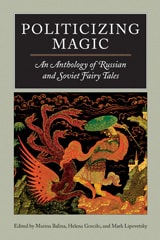
Politicizing Magic
An Anthology of Russian and Soviet Fairy TalesBalina/Goscilo/Lipovetsky
Northwestern University Press, 2005
A compendium of folkloric, literary, and critical texts that show how the Russian fairy tale acquired political and historical meanings during the Soviet era
We were born to make fairy tales come true. As one of Stalinism's more memorable slogans, this one suggests that the fairy tale figured in Soviet culture as far more than a category of children's literature. How much more-and how cannily Russian fairy tales reflect and interpret Soviet culture, especially in its utopian ambitions-becomes clear for the first time in Politicizing Magic, a compendium of folkloric, literary, and critical texts that demonstrate the degree to which ancient fairy-tale fantasies acquired political and historical meanings during the catastrophic twentieth century.
Introducing Western readers to the most representative texts of Russian folkloric and literary tales, this book documents a rich exploration of this colorful genre through all periods of Soviet literary production (1920-1985) by authors with varied political and aesthetic allegiances. Here are traditional Russian folkloric tales and transformations of these tales that, adopting the didacticism of Soviet ideology, proved significant for the official discourse of Socialist Realism. Here, too, are narratives produced during the same era that use the fairy-tale paradigm as a deconstructive device aimed at the very underpinnings of the Soviet system. The editors' introductory essays acquaint readers with the fairy-tale paradigm and the permutations it underwent within the utopian dream of Soviet culture, deftly placing each-from traditional folklore to fairy tales of Socialist Realism, to real-life events recast as fairy tales for ironic effect-in its literary, historical, and political context.
[more]
Shamara and Other Stories
Svetlana Vasilenko
Northwestern University Press, 1999
This collection features Svetlana Vasilenko's novel Little Fool, nominated for the Russian Booker Prize. Rich in folklore, legend, and history, the story follows the transformation of Ganna, a girl from the Volga shores, into a modern-day Madonna. Also included are the novella "Shamara" and several short stories, including the acclaimed "Going After Goat Antelopes."
[more]
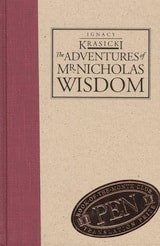
The Adventures of Mr. Nicholas Wisdom
Ignacy Krasicki
Northwestern University Press, 1992
Winner, 1997 National Book Award for Poetry
Winner, 1993 PEN Book-of-the-Month Club Translation Prize
Published in 1776 and considered the first Polish novel ever written, The Adventures of Mr. Nicholas Wisdom is a picaresque tale following the naïve title character's coming of age. Having conquered (and fled) sophisticated Warsaw, Nicholas enjoys many adventures across Europe, South America, and the high seas. He finally lands among the natives of an unknown isle who reject his allegedly superior European ways and instead tutor him for an "enlightened" existence. Resonant with Enlightenment ideas, The Adventures of Mr. Nicholas Wisdom provides a sly portrait of the era's Polish society and a fascinating perspective on the broader problems of eighteenth-century European culture.
[more]
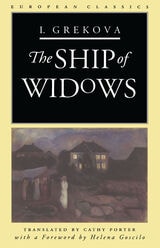
The Ship of Widows
I. Grekova
Northwestern University Press, 1994
"My husband was killed at the front right at the beginning of the war." Thus opens The Ship of Widows, the story of five women brought together in a large communal apartment by the vagaries of war in the year 1943. It spotlights the female experience of World War II: the fate of those not at the front, but still forced to fight as desperately to survive starvation, cold, and exhaustion, and to maintain homes and a country to which the soldiers can return. The Ship of Widows reveals an seldom-seen period of Russia's history and an understudied segment of its population—its women.
[more]