Results by title
7 books match the query 'Gossett, Philip'
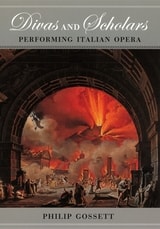
Divas and Scholars
Performing Italian OperaPhilip Gossett
University of Chicago Press, 2006
Winner of the 2007 Otto Kinkeldey Award from the American Musicological Society and the 2007 Deems Taylor Award from the American Society of Composers, Authors, and Publishers.
Divas and Scholars is a dazzling and beguiling account of how opera comes to the stage, filled with Philip Gossett’s personal experiences of triumphant—and even failed—performances and suffused with his towering and tonic passion for music. Writing as a fan, a musician, and a scholar, Gossett, the world's leading authority on the performance of Italian opera, brings colorfully to life the problems, and occasionally the scandals, that attend the production of some of our most favorite operas.
Gossett begins by tracing the social history of nineteenth-century Italian theaters in order to explain the nature of the musical scores from which performers have long worked. He then illuminates the often hidden but crucial negotiations opera scholars and opera conductors and performers: What does it mean to talk about performing from a critical edition? How does one determine what music to perform when multiple versions of an opera exist? What are the implications of omitting passages from an opera in a performance? In addition to vexing questions such as these, Gossett also tackles issues of ornamentation and transposition in vocal style, the matters of translation and adaptation, and even aspects of stage direction and set design.
Throughout this extensive and passionate work, Gossett enlivens his history with reports from his own experiences with major opera companies at venues ranging from the Metropolitan and Santa Fe operas to the Rossini Opera Festival at Pesaro. The result is a book that will enthrall both aficionados of Italian opera and newcomers seeking a reliable introduction to it—in all its incomparable grandeur and timeless allure.
Ermione
Dramma per musica in Two Acts by Andrea Leone TottolaGioachino Rossini
University of Chicago Press, 1996
This critical edition is the first publication of Ermione in full score.
The originality and power of Rossini's score lie in the musical realization of the four principal characters in Tottola's libretto—four survivors of the Trojan war—based on Racine's tragedy Andromaque. Rossini's Ermione was one of the most fully developed characters in nineteenth-century opera. The work's musical structure also was unconventional for its day. All the solo numbers involve other characters, and there is only one scene for a single protagonist.
L'occasione fa il ladro, ossia Il cambio della valigia
Burletta per musica in One Act by Luigi PrividaliGioachino Rossini
University of Chicago Press, 1995
La gazzetta
Dramma (giocoso) in Two Acts by Giuseppe Palomba, revised by Andrea Leone TottolaGioachino Rossini
University of Chicago Press, 2003
Semiramide
Melodramma tragico in Two Acts, Libretto by Gaetano RossiGioachino Rossini
University of Chicago Press, 2002
Tancredi
Melodramma eroico in Two Acts by Gaetano RossiGioachino Rossini
University of Chicago Press, 1984
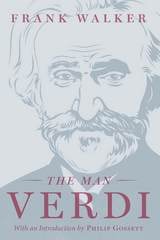
The Man Verdi
Frank Walker
University of Chicago Press, 1982
“Walker focuses on some of the more significant people in Verdi’s life and carefully scrutinizes his relationships with them. His wife, Giuseppina Strepponi; his student and amanuensis, Emanuele Muzio; the conductor who first fully understood Verdi’s mature art, Angelo Mariani; the great prima donna, Teresa Stolz; the incomparable librettist and friend of his old age, Arrigo Boito—each passes before our eyes in Walker’s meticulous reconstruction. As we learn more about them, we learn more about Verdi. We see him through the eyes of his closest friends, we watch his daily activities, his daily thoughts, his habits, his warmth, his domestic tyranny. The myth dissolves and a human being stands before us.”—Philip Gossett, from the introduction