Results by title
5 books match the query 'Gossip'

Andy Warhol, Poetry, and Gossip in the 1960s
Reva Wolf
University of Chicago Press, 1997
Wolf investigates the underground culture of poets, artists, and filmmakers who interacted with Warhol regularly. She claims that Warhol understood the literary imagination of his generation and that recognizing Warhol's literary activities is essential to understanding his art. Drawing on a wealth of unpublished material, including interviews, personal and public archives, tape recordings, documentary photographs, and works of art, Wolf offers dramatic evidence that Warhol's interactions with writers functioned like an extended conversation and details how this process impacted his work. This highly original and fascinating study gives us fresh insight into Warhol's art as practice and reformulates the myth that surrounds this popular American artist.

Between You and Me
Queer Disclosures in the New York Art World, 1948-1963Gavin Butt
Duke University Press, 2005
Focusing on the period from 1948 to 1963, Butt draws on the accusations and denials of homosexuality that appeared in the popular press, on early homophile publications such as One and the Mattachine Review, and on biographies, autobiographies, and interviews. In a stunning exposition of Larry Rivers’s work, he shows how Rivers incorporated gossip into his paintings, just as his friend and lover Frank O’Hara worked it into his poetry. He describes how the stories about Andy Warhol being too “swish” to be taken seriously as an artist changed following his breakthrough success, reconstructing him as an asexual dandy. Butt also speculates on the meanings surrounding a MoMA curator’s refusal in 1958 to buy Jasper Johns’s Target with Plaster Casts on the grounds that it was too scandalous for the museum to acquire. Between You and Me sheds new light on a pivotal moment in American cultural production as it signals new directions for art history.

Gossip & Metaphysics
Russian Modernist Poems & ProseEdited by Katie Farris, Ilya Kaminsky, and Valzhyna Mort
Tupelo Press, 2014
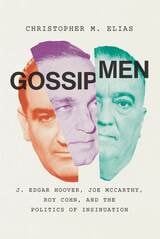
Gossip Men
J. Edgar Hoover, Joe McCarthy, Roy Cohn, and the Politics of InsinuationChristopher M. Elias
University of Chicago Press, 2021
By using gossip as a lens to examine profound issues of state security and institutional power, Elias thoroughly transforms our understanding of the development of modern American political culture.

Gossip, Markets, and Gender
How Dialogue Constructs Moral Value in Post-Socialist KilimanjaroTuulikki Pietilä
University of Wisconsin Press, 2007
"All traders are thieves, especially women traders," people often assured social anthropologist Tuulikki Pietilä during her field work in Kilimanjaro, Tanzania, in the mid-1990s. Equally common were stories about businessmen who had "bought a spirit" for their enrichment. Pietilä places these and similar comments in the context of the liberalization of the Tanzanian economy that began in the 1980s, when many men and women found themselves newly enmeshed in the burgeoning market economy. Even as emerging private markets strengthened the position of enterprising people, economic resources did not automatically lead to heightened social position. Instead, social recognition remained tied to a complex cultural negotiation through stories and gossip in markets, bars, and neighborhoods.
With its rich ethnographic detail, Gossip, Markets, and Gender shows how gossip and the responses to it form an ongoing dialogue through which the moral reputations of trading women and businessmen, and cultural ideas about moral value and gender, are constructed and rethought. By combining a sociolinguistic study of talk, storytelling, and conversation with analysis of gender, the political economy of trading, and the moral economy of personhood, Pietilä reveals a new perspective on the globalization of the market economy and its meaning and impact on the local level.
Winner, Aidoo-Snyder Prize, African Studies Association Women’s Caucus