Results by title
3 books match the query 'Gossy, Mary'
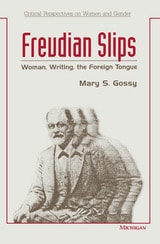
Freudian Slips
Woman, Writing, the Foreign TongueMary S. Gossy
University of Michigan Press, 1995
In Freudian Slips: Woman, Writing, the Foreign Tongue, Mary Gossy provides an original and provocative critique of language, sexuality, and the female body in Freud's The Psychopathology of Everyday Life.
Gossy believes that Freud's most popular statement of a theory of the unconscious is written over foreign and feminized texts, bodies, and places, by way of anecdotes that range from the Dora case to menstruation to travel phobias. Freudian Slips: Woman, Writing, the Foreign Tongue does a feminist psychoanalytic reading of Freud's book and shows how slippery- textually, erotically, and historically- the writing of theory can be, and also how much we can learn from our slips when we are willing to admit that we have made them.
Bringing together autobiography, psychoanalysis, close readings, pedagogy, and politics in provocative and innovative ways, Gossy discusses Freud's work from both textual and theoretical perspectives and asks what his writing can teach us about authority, theory, home, and the foreign. Arguing that the dominant metaphor in the Psychopathology is that of the female body as foreign text, and that this body, writing, and the foreign tongue are identified with a feminized unconscious that threatens authoritative discourse, Freudian Slips moves toward fashioning a feminist theory that is both "slippery and (para)practical" and constantly searches for ways of writing theory that free, rather than sacrifice, the bodies of women.
"The readings of individual slips are often highly productive; the argument is both hardworking and playful. Freudian Slips is a book that people will enjoy reading and from which they will learn a great deal."-- Helena Michie, Rice University
Mary S. Gossy is Associate Professor of Spanish and Comparative Literature, Rutgers University. She is the author of The Untold Story: Women and Theory in Golden Age Texts.
[more]

Freudian Slips
Woman, Writing, the Foreign TongueMary S. Gossy
University of Michigan Press, 1995
In Freudian Slips: Woman, Writing, the Foreign Tongue, Mary Gossy provides an original and provocative critique of language, sexuality, and the female body in Freud's The Psychopathology of Everyday Life.
Gossy believes that Freud's most popular statement of a theory of the unconscious is written over foreign and feminized texts, bodies, and places, by way of anecdotes that range from the Dora case to menstruation to travel phobias. Freudian Slips: Woman, Writing, the Foreign Tongue does a feminist psychoanalytic reading of Freud's book and shows how slippery- textually, erotically, and historically- the writing of theory can be, and also how much we can learn from our slips when we are willing to admit that we have made them.
Bringing together autobiography, psychoanalysis, close readings, pedagogy, and politics in provocative and innovative ways, Gossy discusses Freud's work from both textual and theoretical perspectives and asks what his writing can teach us about authority, theory, home, and the foreign. Arguing that the dominant metaphor in the Psychopathology is that of the female body as foreign text, and that this body, writing, and the foreign tongue are identified with a feminized unconscious that threatens authoritative discourse, Freudian Slips moves toward fashioning a feminist theory that is both "slippery and (para)practical" and constantly searches for ways of writing theory that free, rather than sacrifice, the bodies of women.
"The readings of individual slips are often highly productive; the argument is both hardworking and playful. Freudian Slips is a book that people will enjoy reading and from which they will learn a great deal."-- Helena Michie, Rice University
Mary S. Gossy is Associate Professor of Spanish and Comparative Literature, Rutgers University. She is the author of The Untold Story: Women and Theory in Golden Age Texts.
[more]
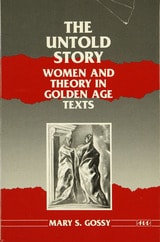
The Untold Story
Women and Theory in Golden Age TextsMary S. Gossy
University of Michigan Press, 1990
Choosing as her texts three works of the Spanish Golden Age, Mary Gossy uses feminist, reader-response, psychoanalytic, and narratological theory to examine gaps in narrative. The study surveys various critical approaches to such gaps, which, though intolerable to the reader, are necessary to the operations of desire that make reading possible. It then examines the ways in which the treatment of gaps by traditional reading strategies reflects the treatment of women and women’s bodies, making of the gap a fetishized feminine object.Gossy explores the ways in which these deviant women, the witches, prostitutes, and hymen-menders that inhabit these three works— La Celestina (Celestina), El casamiento engarioso/Coloquio de los perros (Deceitful Marriage/Colloquy of the Dogs), and La tia fingida (The Pretended Aunt) —can be seen to undermine the narrative expectations of the reader. In so doing, Gossy provides an important exploration of the heretofore neglected intersection of feminist theory and Spanish texts. The author concludes that the insights about reading, writing, and gender that they can help decode and reveal make contemporary literary theory and Spanish literature a dangerous and necessary couple.
[more]