Results by title
12 books match the query 'Governing'
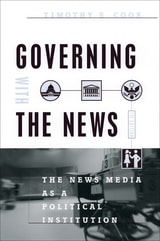
Governing With the News, Second Edition
The News Media as a Political InstitutionTimothy E. Cook
University of Chicago Press, 2005
"Provocative and often wise. . . . Cook, who has a complex understanding of the relationship between governing and the news, provides a fascinating account of the origins of this complicity."—James Bennet, Washington Monthly
"[Governing with the News] addresses central issues of media impact and power in fresh, illuminating ways. . . . Cook mines a wealth of historical and organizational literature to assert that the news media are a distinct political institution in our democratic system."—Robert Schmuhl, Commonweal
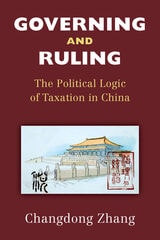
Governing and Ruling
The Political Logic of Taxation in ChinaChangdong Zhang
University of Michigan Press, 2021
Rapid social economic changes, the transition from a planned economy to a market economy, or even economic liberalization can lead to political instability and the collapse of authoritarian regimes. Despite experiencing all of these unprecedented changes in the past forty years, China under the Chinese Communist Party’s leadership has so far successfully transformed and improved both its governance capacity and its ruling capacity. Governing and Ruling: The Political Logic of Taxation in China addresses this regime resilience puzzle by examining the political logic of its taxation system, especially the ways in which taxation helps China handle three governance problems: maneuvering social control, improving agent discipline, and eliciting cooperation. Changdong Zhang argues that a taxation system plays an important role in sustaining authoritarian rule, in China and elsewhere, by combining co-optation and repression functions. The book collects valuable firsthand and secondhand data; studies China’s taxation system, intergovernmental fiscal relationships, composition of fiscal revenue sources, and tax administration; and discusses how each dimension influences the three governance problems.
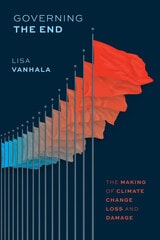
Governing the End
The Making of Climate Change Loss and DamageLisa Vanhala
University of Chicago Press, 2025
A searing account of how the international community is trying—and failing—to address the worst effects of climate change and the differential burdens borne by rich and poor countries.
Climate change is increasingly accepted as a global emergency creating irrevocable losses for the planet. Yet, each country experiences these losses differently, and reaching even inadequate political agreements is fraught with contestation. Governing the End untangles the complex relationship between deteriorating environmental conditions, high politics, and everyday diplomatic practices, focusing on the United Nations’ agreement to address “loss and damage” and subsequent battles over implementation.
Lisa Vanhala looks at the differing assumptions and strategic framings that poor and rich countries bring to bear and asks why some norms emerge and diffuse while others fail to do so. Governing the End is based on ethnographic observation of eight years of UN meetings and negotiations and more than one hundred and fifty interviews with diplomats, policymakers, UN secretariat staff, experts, and activists. It explores explicit political contestation, as well as the more clandestine politics that have stymied implementation and substantially reduced the scope of compensation to poor countries. In doing so, Governing the End elucidates the successes and failures of international climate governance, revealing the importance of how ideas are constructed and then institutionally embodied.
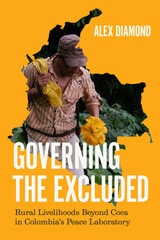
Governing the Excluded
Rural Livelihoods Beyond Coca in Colombia's Peace LaboratoryAlex Diamond
University of Chicago Press, 2026
The Colombian village of Briceño might, at first glimpse, look like many communities in the rural Global South. Many of the people living there rely on small-scale farming, even as a newly constructed hydroelectric dam threatens traditional livelihoods. Yet after decades where Briceño suffered from a bloody conflict, the village has more recently become central to the nation’s hopes for peace. In Governing the Excluded, sociologist Alex Diamond shares a closer look at Briceño and offers unique insight not only into the contemporary Colombian state but to how people across the Global South are struggling to maintain rural livelihoods amid economic dispossession.
Governing the Excluded describes a landmark peace process between the Colombian government and the radical FARC guerrillas from the perspective of Colombian farmers, drawing links between economic transformation, drug economies, and armed conflict. Exclusion from global markets for traditional crops like coffee first pushed farmers to grow coca, the raw material for cocaine. This ushered in an era of violent conflict for control of the illicit economy, while farmers continued to be priced out of legal markets. In exchange for peace and state protection, farmers ultimately agreed to sacrifice profitable coca. But with its disappearance, they now find themselves dependent on the state: for machinery to maintain the roads they need to get legal harvests to market, municipal jobs that are the only decent work available, and for public resources to subsidize food crops with razor-thin profit margins. Ongoing economic struggles in the legal sector make the state’s newfound authority tenuous, as some villagers replant coca, abandon the village for uncertain urban futures, or join a rearmed guerrilla group.
Informed by deep ethnographic research and firsthand stories from Briceño residents, Governing the Excluded shows that when it comes to the forces driving dispossession—be they international corporate megaprojects, global food prices, or national initiatives to replace coca cultivation—state authority goes only so far as its ability to sustain local livelihoods.
Governing the Global Clinic
HIV and the Legal Transformation of MedicineCarol A. Heimer
University of Chicago Press, 2025
A deep examination of how new, legalistic norms affected the trajectory of global HIV care and altered the practice of medicine.
HIV emerged in the world at a time when medicine and healthcare were undergoing two major transformations: globalization and a turn toward legally inflected, rule-based ways of doing things. It accelerated both trends. While pestilence and disease are generally considered the domain of biological sciences and medicine, social arrangements—and law in particular—are also crucial.
Drawing on years of research in HIV clinics in the United States, Thailand, South Africa, and Uganda, Governing the Global Clinic examines how growing norms of legalized accountability have altered the work of healthcare systems and how the effects of legalization vary across different national contexts. A key feature of legalism is universalistic language, but, in practice, rules are usually imported from richer countries (especially the United States) to poorer ones that have less adequate infrastructure and fewer resources with which to implement them. Challenging readers to reconsider the impulse to use law to organize and govern social life, Governing the Global Clinic poses difficult questions: When do rules solve problems, and when do they create new problems? When do rules become decoupled from ethics, and when do they lead to deeper moral commitments? When do rules reduce inequality? And when do they reflect, reproduce, and even amplify inequality?
Governing the Global Polity
Practice, Mentality, RationalityIver B. Neumann and Ole Jacob Sending
University of Michigan Press, 2010
"There have been many attempts to adapt Foucault's arguments to the study of international relations, but this powerful and provocative book is the most sustained, and arguably the most successful in showing how the governmentality approach can be adapted to the analysis of global politics."
---Barry Hindess, Research School of Social Sciences, The Australian National University
A highly welcome and original contribution to contemporary debates on the shape and future of the international system and on the possibility of reconfiguring IR theory as social theory."
---Mathias Albert, Bielefeld University, Germany
"Iver Neumann and Ole Jacob Sending have put meat on the bones of Michel Foucault's notion of governmentality, fulfilling the hopes of long-famished students and scholars of global governance. Through their focus on specific case studies, the authors have provided a much-needed contribution to the international relations literature, one that is sure to become a staple of courses and seminars throughout the world."
---Ronnie D. Lipschutz, University of California, Santa Cruz
What does globalization mean for the principle of state sovereignty and for the power and functioning of states? Whereas realists assert the continued importance of states, constructivists contend that various political entities as well as the logic of globalization itself undermine state sovereignty.
Drawing on the state formation literature and on social theory, particularly the works of Weber and Foucault, Iver B. Neumann and Ole Jacob Sending question the terms of the realist-constructionist debate. Through detailed case studies, they demonstrate that states use nongovernmental organizations and international organizations indirectly to enforce social order and, ultimately, to increase their own power. At the same time, global politics is dominated by a liberal political rationality that states ignore at their peril. While states remain as strong as ever, they operate within a global polity of new hierarchies among states and between states and other actors.
Iver B. Neumann is Director of Research at the Norwegian Institute of International Affairs and Professor of Russian Studies at the University of Oslo.
Ole Jacob Sending is Senior Researcher at the Norwegian Institute of International Affairs, where he heads the Research Programme on Global Governance and International Organizations.
Cover art credit: © iStockphoto.com/Will Evans
Also available as an e-book.

Governing the New Europe
Jack Hayward and Edward C. Page, eds.
Duke University Press, 1995
Beginning with a discussion of the political, economic, and cultural development of Europe from a historical perspective, the focus of the book shifts to an examination of the changing forms of European democracy and the move from public ownership and planning to privatization and deregulated competition. Further essays analyze the challenge to national party systems and electoral performance from emerging social movements and organized interest groups. Political and bureaucratic structures are also examined as is the new European constitutionalism reflected in the increasingly significant role of the judiciary. Lastly, attention is turned to several major themes in European politics: the changing foundations of foreign and security policy, the function of industrial champion firms, and the retreat from the welfare state. Primarily comparative in its scope, Governing the New Europe does devote particular attention to specific major states as well as to the importance of the European Union to the political life of member and non-member countries.
Neither exaggerating the common features of the patterns that have emerged in contemporary Europe nor capitulating to the complexity of enduring differences and instabilities between states, Governing the New Europe will become one of the standard texts in its field.
Contributors. Jack Hayward, Jolyon Howorth, Herbert Kitschelt, Marie Lavigne, Tom Mackie, Michael Mezey, Edward C. Page, Richard Parry, Richard Rose, Anthony Smith, Alec Stone
Governing the Twin Cities Region
The Metropolitan Council in Comparative PerspectiveJohn Harrigan
University of Minnesota Press, 1978
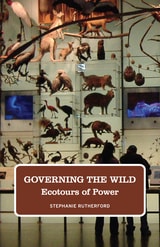
Governing the Wild
Ecotours of PowerStephanie Rutherford
University of Minnesota Press, 2011
Take four emblematic American scenes: the Hall of Biodiversity at the American Museum of Natural History in New York; Disney’s Animal Kingdom theme park in Orlando; an ecotour of Yellowstone and Grand Teton National Parks; the film An Inconvenient Truth. Other than expressing a common interest in the environment, they seem quite dissimilar.
And yet, as Governing the Wild makes clear, these sites are all manifestations of green governmentality, each seeking to define and regulate our understanding, experience, and treatment of nature. Stephanie Rutherford shows how the museum presents a scientized assessment of global nature under threat; the Animal Kingdom demonstrates that a corporation can successfully organize a biopolitical project; the ecotour, operating as a school for a natural aesthetic sensibility, provides a visual grammar of pristine national nature; and the film offers a toehold on a moral way of encountering nature. But one very powerful force unites the disparate “truths” of nature produced through these sites, and that, Rutherford tells us, is their debt to nature’s commodification.
Rutherford’s analysis reveals how each site integrates nature, power, and profit to make the buying and selling of nature critical to our understanding and rescuing of it. The combination, she argues, renders other ways of encountering nature—particularly more radically environmental ways—unthinkable.
Governing the Wind Energy Commons
Renewable Energy and Community DevelopmentKeith A. Taylor
West Virginia University Press, 2019
Wind energy is often framed as a factor in rural economic development, an element of the emerging “green economy” destined to upset the dominant greenhouse- gas-emitting energy industry and deliver conscious capitalism to host communities. The bulk of wind energy firms, however, are subsidiaries of the same fossil fuel companies that wrought havoc in shale-gas and coal-mining towns from rural Appalachia to the Great Plains. On its own, wind energy development does not automatically translate into community development.
In Governing the Wind Energy Commons, Keith Taylor asks whether revenue generated by wind power can be put to community well-being rather than corporate profit. He looks to the promising example of rural electric cooperatives, owned and governed by the 42 million Americans they serve, which generate $40 billion in annual revenue. Through case studies of a North Dakota wind energy cooperative and an investor-owned wind farm in Illinois, Taylor examines how regulatory and social forces are shaping this emerging energy sector. He draws on interviews with local residents to assess strategies for tipping the balance of power away from absentee-owned utilities.

Governing with the News
The News Media as a Political InstitutionTimothy E. Cook
University of Chicago Press, 1998
The formation of the press as a political institution began in the early days of the republic when newspapers were sponsored by political parties; the relationship is now so central that press offices are found wherever one turns. Cook demonstrates not only how the media are structured as an institution that exercises collective power but also how the role of the media has become institutionalized within the political process, affecting policy and instigating, rather than merely reflecting, political actions. Cook's analysis is a powerful and fascinating guide to our age when newsmaking and governing are inseparable.
"This is a wonderful analysis of a highly important topic. Tim Cook is resoundingly right that we need to look at the media as political institutions and their operatives as political actors."—David R. Mayhew, author of Divided We Govern
"This meticulously researched and well reasoned work proposes to take seriously a thesis which flies in the face of both journalistic lore and political myth. Governing with the News is an innovative contribution to our understanding of media."—W. Lance Bennett, author of News: The Politics of Illusion
"This book should be read by journalists . . . by mass communication faculty teaching courses in media structure or effects and journalism faculty as a supplemental text to courses in media history and media management."—Benjamin J. Burns, Journalism & Mass Communication Quarterly
Smart Governance
Governing the Global Knowledge SocietyHelmut Willke
Campus Verlag, 2007
In the wake of globalization, national governments are becoming increasingly interdependent, and knowledge is arguably becoming the most valuable form of capital. Helmut Willke’s Smart Governance offers a new perspective on global governance from the vantage point of a global knowledge society.
Employing a case study of the global financial system and an analysis of several governance regimes, Willke contends that markets, legal systems, and morality must evolve to cope with uncertainty, build capacities, and achieve resilience. Smart Governance will change the way economists, historians, and political scientists view international cooperation.