Results by title
5 books match the query 'Government spending policy'
An Empire of Indifference
American War and the Financial Logic of Risk ManagementRandy Martin
Duke University Press, 2007
Drawing on theorists including Michel Foucault, Giorgio Agamben, Michael Hardt, Antonio Negri, and Achille Mbembe, Martin illuminates a frightening financial logic that must be understood in order to be countered. Martin maintains that finance divides the world between those able to avail themselves of wealth opportunities through risk taking (investors) and those who cannot do so, who are considered “at risk.” He contends that modern-day American imperialism differs from previous models of imperialism, in which the occupiers engaged with the occupied to “civilize” them, siphon off wealth, or both. American imperialism, by contrast, is an empire of indifference: a massive flight from engagement. The United States urges an embrace of risk and self-management on the occupied and then ignores or dispossesses those who cannot make the grade.
Do Deficits Matter?
Daniel Shaviro
University of Chicago Press, 1997
"[An] excellent, comprehensive, and illuminating book. Its analysis, deftly integrating considerations of economics, law, politics, and philosophy, brings the issues of 'balanced budgets,' national saving, and intergenerational equity out of the area of religious crusades and into an arena of reason. . . . A magnificent, judicious, and balanced treatment. It should be read and studied not just by specialists in fiscal policy but by all those in the economic and political community."—Robert Eisner, Journal of Economic Literature
"Shaviro's history, economics, and political analysis are right on the mark. For all readers."—Library Journal
Economic Analysis and Infrastructure Investment
Edited by Edward L. Glaeser and James M. Poterba
University of Chicago Press, 2021
Economic Analysis and Infrastructure Investment explores the links between infrastructure investment and economic outcomes, analyzing key economic issues in the funding and management of infrastructure projects. It includes new research on the short-run stimulus effects of infrastructure spending, develops new estimates of the stock of US infrastructure capital, and explores incentive aspects of public-private partnerships with particular attention to their allocation of risk. The volume provides a reference for researchers seeking to study infrastructure issues and for policymakers tasked with determining the appropriate level and allocation of infrastructure spending.
Political Participation and Government Regulation
Sam Peltzman
University of Chicago Press, 1998
This collection reflects Peltzman's long career studying the interface between the private economy and the public sector. It will be essential to anyone who wishes to study government activity and voting behavior from an economic perspective.
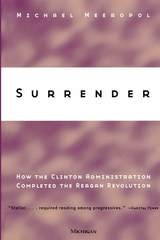
Surrender
How the Clinton Administration Completed the Reagan RevolutionMichael Meeropol
University of Michigan Press, 2000
Meeropol provides compelling evidence of the failure of the U.S. economy between 1990 and 1994 to generate rising incomes for most of the population or improvements in productivity. This caused, first, the electoral repudiation of President Bush in 1992, followed by a repudiation of President Clinton in the 1994 Congressional elections. The Clinton administration made a half-hearted attempt to reverse the Reagan Revolution in economic policy, but ultimately surrendered to the Republican Congressional majority in 1996 when Clinton promised to balance the budget by 2000 and signed the welfare reform bill. The rapid growth of the economy in 1997 caused surprisingly high government revenues, a dramatic fall in the federal budget deficit, and a brief euphoria evident in an almost uncontrollable stock market boom. Finally, Meeropol argues powerfully that the next recession, certain to come before the end of 1999, will turn the predicted path to budget balance and millennial prosperity into a painful joke on the hubris of public policymakers.
Accessibly written as a work of recent history and public policy as much as economics, this book is intended for all Americans interested in issues of economic policy, especially the budget deficit and the Clinton versus Congress debates. No specialized training in economics is needed.
"A wonderfully accessible discussion of contemporary American economic policy. Meeropol demonstrates that the Reagan-era policies of tax cuts and shredded safety nets, coupled with strident talk of balanced budgets, have been continued and even brought to fruition by the neo-liberal Clinton regime." --Frances Fox Piven, Graduate School, City University of New York
Michael Meeropol is Chair and Professor of Economics, Western New England College.