Results by title
3 books match the query 'Governmental'

Brazil and South Korea
Economic Crisis and RestructuringEdited by Edmund Amann and Ha-Joon Chang
University of London Press, 2003
The 1990s saw lower- and middle-income countries throughout the world come under pressure to open their domestic markets to international trade and investment. Despite the progressive implementation of market-friendly policies, many emerging market countries experienced financial market volatility, exchange rate collapse, and slumps in output. These problems profoundly affected two of the world's largest middle-income industrialized countries - Brazil and South Korea. Despite superficial similarities, prior to the onset of crisis both countries had very different models of industrialization and had adopted contrasting approaches to trade and market reform. This collection analyzes the factors underlying the economic crises in South Korea and Brazil, pointing out areas of similarity and divergence. It also reviews the paths of recovery taken by both economies, examining the role of policy and variations in structural characteristics.
Contributors include Andre Averburg (United Nations Development Programme/ Banco Nacional de Desenvolvimento Economico e Social, Brazil), Fabio Giambiagi (Banco Nacional de Desenvolvimento Economico e Social), Andrea Goldstein (OECD Development Centre), Louise Haagh (Department of Politics, University of York, USA), Tat Yan Kong (School of Oriental and African Studies, University of London, UK), Jose Ricardo Ramalho (Federal University of Rio de Janeiro, Brazil), Ben Ross Schneider (Center for International and Comparative Studies, Northwestern University, USA), and Jaang-Sup Shin (Department of Economics, National University of Singapore).
Contributors include Andre Averburg (United Nations Development Programme/ Banco Nacional de Desenvolvimento Economico e Social, Brazil), Fabio Giambiagi (Banco Nacional de Desenvolvimento Economico e Social), Andrea Goldstein (OECD Development Centre), Louise Haagh (Department of Politics, University of York, USA), Tat Yan Kong (School of Oriental and African Studies, University of London, UK), Jose Ricardo Ramalho (Federal University of Rio de Janeiro, Brazil), Ben Ross Schneider (Center for International and Comparative Studies, Northwestern University, USA), and Jaang-Sup Shin (Department of Economics, National University of Singapore).
[more]
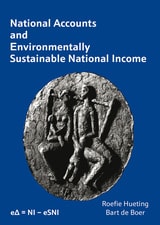
National Accounts and Environmentally Sustainable National Income
Roefie Hueting and Bart de Boer
Eburon Academic Publishers, 2019
Our planet is threatened by a mistaken confidence in erroneously calculated growth. The term “economic growth” can only mean an increase in human welfare, but it is often wrongly identified with production growth that may in fact be destructive to the environment. Thus, while the measures of standard National Income (NI) or Gross Domestic Product (GDP) are useful for many purposes, they are inadequate in guiding environmental policy making. This book develops the corrective concept of an environmentally Sustainable National Income (eSNI). eSNI is defined as the maximally attainable level of production, using the technology of the year under review, whereby the vital environmental functions (possible uses) of the not-human-made physical surroundings remain available for future generations. In order to accurately judge environmental sustainability, the authors show, NI and eSNI must be addressed jointly. Drawing on data from the Netherlands from 1990 to 2015, the authors demonstrate the effectiveness of eSNI and argue that national statistical bureaus around the world should provide this measure to their own policymakers, so that policymaking across the globe might be informed by sound information about both national economies and the global environment.
[more]
Studies in the Formation of the Nation-state in Latin America
Edited by James Dunkerley
University of London Press, 2002
This book adopts a variety of disciplinary, thematic, and country-based approaches to the complex and contested issues around the character of the nation-state in Latin America. In recent years there has been a great deal of scholarly interest in this topic from the viewpoint of cultural and literary studies, but Latin America remains under-represented in general historical and sociological theories of nationhood. The authors seek to develop debate and research on the topic through case-studies (including Argentina, Bolivia, Brazil, Chile, Mexico, Peru and Spain), historiographical review, and themes such as the role of violence, military conscription and pensions, money and the role of finance, early notions of development, the ambiguous role of liberalism, and how to evaluate the reach and qualities of the nation-state.
Contributors include Miguel Angel Centeno (Princeton University), Malcolm Deas (St Antony's College, Oxford), James Dunkerley (Institute of Latin American Studies, University of London), Paul Gootenberg (State University of New York at Stony Brook), Alan Knight (St Antony's College, Oxford), Colin Lewis (London School of Economics), Fernando Lopez Alves (University of California, Santa Barbara), David McCreery (Georgia State University), Florencia Mallon (University of Wisconsin), Seemin Qayum (Goldsmiths College, University of London), Guy Thomson (University of Warwick), and Steven Topik (University of California, Irvine). James Dunkerley is director of the Institute of Latin American Studies, University of London, and also professor of politics at Queen Mary, University of London. He is coeditor of the Journal of Latin American Studies. His most recent books are Americana:The Americas in the World, around 1850 (or 'Seeing the Elephant' as the Theme for an Imaginary Western) (2000) and Warriors and Scribes: Essays in the History and Politics of Latin America (2000).
Contributors include Miguel Angel Centeno (Princeton University), Malcolm Deas (St Antony's College, Oxford), James Dunkerley (Institute of Latin American Studies, University of London), Paul Gootenberg (State University of New York at Stony Brook), Alan Knight (St Antony's College, Oxford), Colin Lewis (London School of Economics), Fernando Lopez Alves (University of California, Santa Barbara), David McCreery (Georgia State University), Florencia Mallon (University of Wisconsin), Seemin Qayum (Goldsmiths College, University of London), Guy Thomson (University of Warwick), and Steven Topik (University of California, Irvine). James Dunkerley is director of the Institute of Latin American Studies, University of London, and also professor of politics at Queen Mary, University of London. He is coeditor of the Journal of Latin American Studies. His most recent books are Americana:The Americas in the World, around 1850 (or 'Seeing the Elephant' as the Theme for an Imaginary Western) (2000) and Warriors and Scribes: Essays in the History and Politics of Latin America (2000).
[more]