Results by title
3 books match the query 'Graboyes, Melissa'
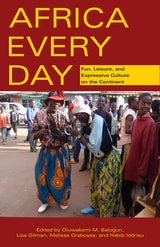
Africa Every Day
Fun, Leisure, and Expressive Culture on the ContinentOluwakemi M. Balogun
Ohio University Press, 2019
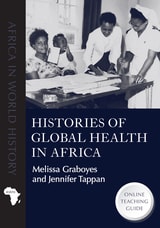
Histories of Global Health in Africa
Melissa Graboyes and Jennifer Tappan
Ohio University Press, 0
Histories of Global Health in Africa offers a concise and compelling introduction to the development and practice of global health on the African continent over the past century. Rather than centering institutions, the book foregrounds the people whose lives and labor have shaped global health—including African communities receiving care and the practitioners and experts who have long driven biomedical work across the region.
Drawing on cutting-edge scholarship, the book traces the colonial roots of global health and examines how these legacies continue to influence contemporary interventions, from vaccination campaigns and disease eradication efforts to epidemic responses. Its accessible thematic chapters explore key topics, including data collection, demography, ethics, and equity.
Designed for classroom use and ideal for nonspecialists, Histories of Global Health in Africa provides a flexible structure and a rich suite of teaching materials, including online multimedia components. It is an essential resource for students and readers seeking to understand how global health has evolved—and why its future depends on confronting its past.

The Experiment Must Continue
Medical Research and Ethics in East Africa, 1940–2014Melissa Graboyes
Ohio University Press, 2015
The Experiment Must Continue is a beautifully articulated ethnographic history of medical experimentation in East Africa from 1940 through 2014. In it, Melissa Graboyes combines her training in public health and in history to treat her subject with the dual sensitivities of a medical ethicist and a fine historian. She breathes life into the fascinating histories of research on human subjects, elucidating the hopes of the interventionists and the experiences of the putative beneficiaries.
Historical case studies highlight failed attempts to eliminate tropical diseases, while modern examples delve into ongoing malaria and HIV/AIDS research. Collectively, these show how East Africans have perceived research differently than researchers do and that the active participation of subjects led to the creation of a hybrid ethical form.
By writing an ethnography of the past and a history of the present, Graboyes casts medical experimentation in a new light, and makes the resounding case that we must readjust our dominant ideas of consent, participation, and exploitation. With global implications, this lively book is as relevant for scholars as it is for anyone invested in the place of medicine in society.