Results by title
6 books match the query 'Graduate work'
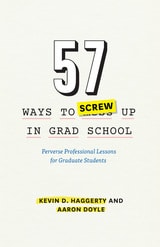
57 Ways to Screw Up in Grad School
Perverse Professional Lessons for Graduate StudentsKevin D. Haggerty and Aaron Doyle
University of Chicago Press, 2015
When it comes to a masters or PhD program, most graduate students don’t deliberately set out to fail. Yet, of the nearly 500,000 people who start a graduate program each year, up to half will never complete their degree. Books abound on acing the admissions process, but there is little on what to do once the acceptance letter arrives. Veteran graduate directors Kevin D. Haggerty and Aaron Doyle have set out to demystify the world of advanced education. Taking a wry, frank approach, they explain the common mistakes that can trip up a new graduate student and lay out practical advice about how to avoid the pitfalls. Along the way they relate stories from their decades of mentorship and even share some slip-ups from their own grad experiences.
The litany of foul-ups is organized by theme and covers the grad school experience from beginning to end: selecting the university and program, interacting with advisors and fellow students, balancing personal and scholarly lives, navigating a thesis, and creating a life after academia. Although the tone is engagingly tongue-in-cheek, the lessons are crucial to anyone attending or contemplating grad school. 57 Ways to Screw Up in Grad School allows you to learn from others’ mistakes rather than making them yourself.
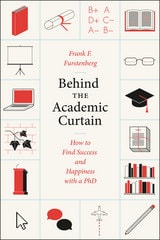
Behind the Academic Curtain
How to Find Success and Happiness with a PhDFrank F. Furstenberg
University of Chicago Press, 2013
While the greatest anxieties for PhD candidates and postgrads are often centered on getting that tenure-track dream job, each stage of an academic career poses a series of distinctive problems. Furstenberg divides these stages into five chapters that cover the entire trajectory of an academic life, including how to make use of a PhD outside of academia. From finding the right job to earning tenure, from managing teaching loads to conducting research, from working on committees to easing into retirement, he illuminates all the challenges and opportunities an academic can expect to encounter. Each chapter is designed for easy consultation, with copious signposts, helpful suggestions, and a bevy of questions that all academics should ask themselves throughout their career, whether at a major university, junior college, or a nonacademic organization. An honest and up-to-date portrayal of how this life really works, Behind the Academic Curtain is an essential companion for any scholar, at any stage of his or her career.
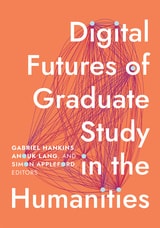
Digital Futures of Graduate Study in the Humanities
Gabriel Hankins
University of Minnesota Press, 2024
A resource for planning, reimagining, and participating in the digital transformation of graduate study in the humanities
How are the humanities adapting to the rise of digital technologies, and what are some of the tried and tested ways that postsecondary institutions are proving the importance of humanities training at the graduate level? Bringing together a diverse group of scholars and students, Digital Futures of Graduate Study in the Humanities invites a reimagining of current models of graduate education to address ongoing challenges to the humanities and to create sustainable and humane pedagogies, classes, and institutions.
The essays cover a wide range of topics, including the skills required to learn and practice digital methods, the resources needed to support students and faculty in this enterprise, the lack of meaningful credit for undertaking this time-intensive work, and the diminished employment possibilities within academia for graduate students who emerge with these skills. Mapping the broad terrain through which to address and intervene in these particular issues and beyond, this book offers deep insights into the digital futures of graduate studies in the humanities.
Contributors: Maria José Afanador-Llach, U de los Andes, Bogotá; Maria K. Alberto, U of Utah; Agnieszka Backman; Travis M. Bartley, CUNY Graduate Center; Peggy Bockwinkel, U Stuttgart; Alison Booth, U of Virginia; Donna Alfano Bussell, U of Illinois Springfield; Joshua Casmir Catalano, Clemson U; Laura Crossley, George Mason U; Quinn Dombrowski, Stanford U; Stuart Dunn, King’s College London; Jennifer Edmond, Trinity College Dublin; Natalia Ermolaev, Princeton U; Laura Estill, St. Francis Xavier U; Malte Gäckle-Heckelen; Vicky Garnett, Trinity College Dublin; Daniel Gorman Jr., U of Rochester; Sabrina T. Grimberg, Stanford U; Tena L. Helton, U of Illinois Springfield; Jeanelle Horcasitas; Melissa A. Hosek, Stanford U; Hoyeol Kim; Brady Krien, U of Iowa; Benjamin Charles Germain Lee, U of Washington; Pamela E. Mack, Clemson U; Meredith Martin, Princeton U; Germán Camilo Martínez Peñaloza, U de los Andes, Bogotá; E. L. Meszaros, Brown U; Sara Mohr, Hamilton College; Sethunya Mokoko, U of Virginia; Rebecca Munson; Erin Francisco Opalich; Olivia Quintanilla, MiraCosta College; Cecily Raynor, McGill U; Amanda E. Regan, Clemson U; Heather Richards-Rissetto, U of Nebraska–Lincoln; Jacob D. Richter, George Washington U; Stephen Robertson, George Mason U; Katina L. Rogers; Claus-Michael Schlesinger, Humboldt U Berlin; Douglas Seefeldt, Clemson U; Kayla Shipp, Yale Digital Humanities Lab; Serenity Sutherland, SUNY Oswego; Toma Tasovac, Belgrade Center for Digital Humanities; Hannah Taylor, Duke U; Manfred Thaller, U of Cologne; Madeline Ullrich, U of Rochester; Ted Underwood, U of Illinois Urbana-Champaign; Gabriel Viehhauser, U Stuttgart; Brandon Walsh, U of Virginia Library; Sean Weidman, Lycoming College; Alex Wermer-Colan, Temple U; Adrian S. Wisnicki, U of Nebraska–Lincoln; Alexander J. Zawacki, U Göttingen.
Retail e-book files for this title are screen-reader friendly with images accompanied by short alt text and/or extended descriptions.
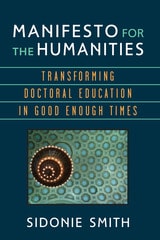
Manifesto for the Humanities
Transforming Doctoral Education in Good Enough TimesSidonie Smith
University of Michigan Press, 2015
Grounding this manifesto in background factors contributing to current “crises” in the humanities, Smith advocates for a 21st century doctoral education responsive to the changing ecology of humanistic scholarship and teaching. She elaborates a more expansive conceptualization of coursework and dissertation, a more robust, engaged public humanities, and a more diverse, collaborative, and networked sociality.
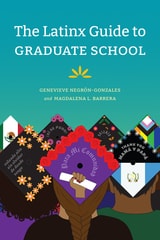
The Latinx Guide to Graduate School
Genevieve Negrón-Gonzales and Magdalena L. Barrera
Duke University Press, 2023
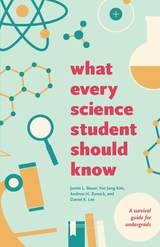
What Every Science Student Should Know
Justin L. Bauer, Yoo Jung Kim, Andrew H. Zureick, and Daniel K. Lee
University of Chicago Press, 2016
In 2012, the White House put out a call to increase the number of STEM graduates by one million. Since then, hundreds of thousands of science students have started down the path toward a STEM career. Yet, of these budding scientists, more than half of all college students planning to study science or medicine leave the field during their academic careers.
What Every Science Student Should Know is the perfect personal mentor for any aspiring scientist. Like an experienced lab partner or frank advisor, the book points out the pitfalls while providing encouragement. Chapters cover the entire college experience, including choosing a major, mastering study skills, doing scientific research, finding a job, and, most important, how to foster and keep a love of science.
This guide is a distillation of the authors’ own experiences as recent science graduates, bolstered by years of research and interviews with successful scientists and other science students. The authorial team includes former editors-in-chief of the prestigious Dartmouth Undergraduate Journal of Science. All have weathered the ups and downs of undergrad life—and all are still pursuing STEM careers. Forthright and empowering, What Every Science Student Should Know is brimming with insider advice on how to excel as both a student and a scientist.