Results by title
3 books match the query 'Gramm, Kent'
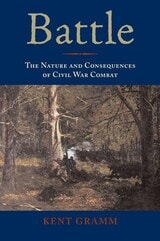
Battle
The Nature and Consequences of Civil War CombatEdited by Kent Gramm
University of Alabama Press, 2008
A critical, multidisciplinary examination of Civil War combat that interrogates the technological, medical, psychological, and cultural forces shaping battlefield experience and its enduring national legacy.
“In our youth, our hearts were touched with fire,” wrote Oliver Wendell Holmes of his generation’s Civil War days. Through the ages, war stories have gleamed with romantic glory, and American memories of the cataclysmic Civil War inspire pageantry and poetry even today.
The essays in Battle form a corrective to such celebratory histories by examining the lethal realities of Civil War combat—Enlightenment science applied to the creation of weapons that maimed and killed, which far outpaced advances in diet, sanitation, and medical treatment. The book reveals that behind the drums and trumpets, sashes and swords, the armies of the Union and Confederacy alike were haunted by fear, pain, and death.
The collection includes an introduction and afterword by editor Kent Gramm, who also contributes an essay titled “Numbers” that reveals the war in statistics. Paul Fussell contributes a powerful essay titled “The Culture of War.” D. Scott Hartwig examines the face of battle at Gettysburg. Bruce A. Evans discusses medical technology in “Wounds, Death, and Medical Care in the Civil War.” Eric T. Dean challenges the meanings and consequences of combat in “The Awful Shock and Rage of Battle.” The collection is rounded out by Alan T. Nolan’s masterful review of the national consequences of battle and the resultant myth of the Confederacy’s Lost Cause.
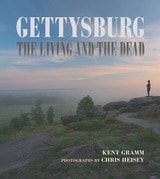
Gettysburg
The Living and the DeadKent Gramm. Photographs by Chris Heisey
Southern Illinois University Press, 2019
Creative nonfiction, fiction, dramatic dialogue, and poetry combine with full-color photographs to convey the essential reality of the famous battlefield as a place both terrible and beautiful. The living and the dead contained here include Confederates and Yankees, soldiers and civilians, male and female, young and old. Visitors to the battlefield after 1863, both well known and obscure, provide the voices of the living. They include a female admiral in the U.S. Navy and a man from rural Virginia who visits the battlefield as a way of working through the death of his son in Iraq. The ghostly voices of the dead include actual participants in the battle, like a fiery colonel and a girl in Confederate uniform, as well as their representatives, such as a grieving widow who has come to seek her husband.
Utilizing light as a central motif and fourscore and seven voices to evoke how Gettysburg continues to draw visitors and resound throughout history, alternately wounding and stitching the lives it touches, Gramm’s words and Heisey’s photographs meld for a historical experience unlike any other. Gettysburg: The Living and the Dead offers a panoramic view wherein the battle and battlefield of Gettysburg are seen through the eyes of those who lived through it and died on it as well as those who have sought meaning at the site ever since.
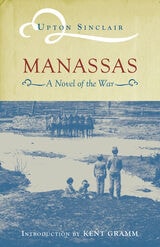
Manassas
A Novel of the WarUpton Sinclair
University of Alabama Press, 2000
Centers on the moral dimension of the conflict as it traces a young Mississippi boy’s conversion from pro-slavery Southerner to abolitionist Union soldier
Allan Montague, born on a Mississippi plantation about twenty years before the Civil War, has grown up with slavery and considers it natural. When his father moves to Boston for business and takes the boy with him, young Allan carries a knife given to him by his cousin to use in killing abolitionists.
The first abolitionist young Allan meets in Boston is Levi Coffin, the reputed founder of the Underground Railroad. In this first of many meetings with historical figures, Allan forms a friendship with Coffin, who eventually takes him to hear a speech by former slave Frederick Douglass. Douglass's powerful words cement Allan's transformation into an abolitionist—a transformation that will lead him back to his Deep South home with the hope of freeing slaves and eventually back to the North and the fateful Battle of Manassas.
Kent Gramm, author of the introduction for this new edition of Manassas, calls the novel “a modern version of the morality play,” with the United States as the central character. “The real story, he writes, is the moral phenomenon of the Civil War.” It is a powerful book that deserves to be revived, read, and studied.