Results by title

10 books match the query 'Grammar, Generative'
cover of Analyzing Syntax & Semantics Textbook

Analyzing Syntax & Semantics Textbook

Virginia Heidinger

Gallaudet University Press, 1984

This 22-chapter text explores the structure of language and the meaning of words within a given structure. The text/workbook combination gives students both the theory and practice they need to understand this complex topic.

       Analyzing Syntax and Semantics features the Personalized System of Instruction (PSI) approach. This method uses student performance objectives, practice, feedback, individualization of pace, and repeatable testing as instructional strategies.
[more]
cover of Aspects of English Sentence Stress

Aspects of English Sentence Stress

By Susan F. Schmerling

University of Texas Press, 1976

Aspects of English Sentence Stress is written within the conceptual framework of generative-transformational grammar. However, it is atheoretical in the sense that the proposals made cannot be formulated in this theory and are a challenge to many other theories. The author's concern is not with the phonetic nature of stress; rather, using a working definition of stress as subjective impression of prominence, she attempts to formulate general principles that will predict the relative prominence of different words in particular utterances—what might be called the syntax of stress. She supports her arguments with a large amount of original data and provides the basis for new ways of thinking about this area of linguistic research.

Schmerling begins with a detailed review and critique of Noam Chomsky and Morris Halle's approach to sentence stress; she shows that their cyclic analysis cannot be considered valid, even for quite simple phrases and sentences. Next, she reviews discussions of sentence stress by Joan Bresnan, George Lakoff, and Dwight Bolinger, agreeing with Bolinger's contention that there is no intimate connection between sentence stress and syntactic structure but showing that his counterproposal to the standard approach is inadequate as well. She also examines the concept of "normal stress" and demonstrates that no linguistically significant distinction can be drawn between "normal" and "special" stress contours.

In generating her own proposals concerning sentence stress, Schmerling takes the view that certain items which are stressable are taken for granted by the speaker and are eliminated from consideration by the principles governing relative prominence of words in a sentence. Then she examines the pragmatic and phonological principles pertaining to items that are not eliminated from consideration. Finally, the author contends that the standard views, which she shows to be untenable, are a result of the assumption that linguistic entities should be studied apart from questions concerning their use, in that it was adoption of this methodological assumption that forced linguists to deny the essentially pragmatic nature of sentence stress.

Accessible to anyone who is familiar with the basic concepts of generative-transformational grammar, Aspects of English Sentence Stress presents provocative ideas in the field.
[more]
cover of Configuring Topic and Focus in Russian

Configuring Topic and Focus in Russian

Tracy Holloway King

CSLI, 1995
This work examines word order. More accurately, it is the ordering of constituents that is discussed since prepositional phrases and most noun phrases form syntactic constituents and the encoding of topic and focus in Russian. As has long been observed, word order in Russian encodes specific discourse information: with neutral intonation, topics precede discourse-neutral constituents which precede foci. King extends this idea to show that word order encodes different types of topic and focus in a principled manner.
[more]
cover of German in Head-Driven Phrase Structure Grammar

German in Head-Driven Phrase Structure Grammar

Edited by John Nerbonne, Carl Pollard, and Klaus Netter

CSLI, 1993

These essays apply the syntactic theory of Carl Pollard and Ivan Sag—Head-driven Phrase Structure Grammar (HPSG)—to a formal study and analysis of German grammar. A wide variety of fundamental and well-known phenomena in German grammar are addressed, including the German passive and impersonal passive, various Mittelfeld and Vorfeld word-order phenomena (including auxiliary stacking and the distribution of adjuncts), and the structure of phrasal constituents. Linguistic issues include the treatment of idioms, word-order variation and phrase structure constituency, subcategorization, complementation, argument structure, case assignment, lexical rules, and syntactic ambiguity.

The theoretical background for these essays can be found in Information-Based Syntax and Semantics and Head-Driven Phrase Structure Grammar, both by Pollard and Sag and both available from the University of Chicago Press.

[more]
cover of Jacy: An Implemented Grammar of Japanese

Jacy

An Implemented Grammar of Japanese

Melanie Siegel, Emily M. Bender, and Francis Bond

CSLI, 2017

This book describes the fundamentals of Jacy, an implementation of a Japanese head-driven phrase structure grammar with many useful linguistic implications. Jacy presents sound information about the Japanese language (syntax, semantics, and pragmatics) based on implementation and tested on large quantities of data. As the grammar development was done in a multilingual environment, Jacy also showcases both multilingual concepts and differences among the languages and demonstrates the usefulness of semantic analysis in language technology applications.
[more]
cover of Romance in HPSG

Romance in HPSG

Edited by Sergio Balari and Luca Dini

CSLI, 1997

This book describes several aspects of syntax and semantics of romance languages assuming the point of view of a constraint-based, non-transformational linguistic theory, i.e. Head-driven Phrase Structure Grammar (HPSG). Besides the widening of the empirical coverage of HPSG the theory, its main significance consists in a refinement of the theory itself, on the basis of data from romance languages. It contains essays discussing phenomena from Catalan, French, Italian and Spanish.
[more]
cover of The Syntactic Phenomena of English

The Syntactic Phenomena of English

James D. McCawley

University of Chicago Press, 1998

This second edition of James D. McCawley's classic textbook offers in one volume a complete course in the syntactic structure of English. New to this edition are sections on appositive constructions, parasitic gaps, contrastive negation, and comparative conditional sentences, as well as expanded coverage of cleft sentences and free relatives. The presentation is coherent, comprehensive, and systematically organized, beginning with an overview of McCawley's approach to syntactic analysis and progressing through the major constructions and processes of English grammar. No prior special knowledge of syntax is presupposed, and the number and variety of exercises after each chapter have been increased.

And now available from the author! Answers to Selected Exercises.

Instructors using James D. McCawley's The Syntactic Phenomena of English, Second Edition may request a complimentary copy of Answers to Selected Exercises in The Syntactic Phenomena of English by writing on their department's letterhead to the author, James D. McCawley, Department of Linguistics, 1010 E. 59th Street, Chicago, IL 60637. [Note: This material is available only from the author and is not available from the University of Chicago Press.]
[more]
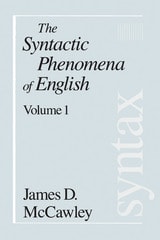
cover of The Syntactic Phenomena of English, Volume 1

The Syntactic Phenomena of English, Volume 1

James D. McCawley

University of Chicago Press, 1988

This second edition of James D. McCawley's classic textbook offers in one volume a complete course in the syntactic structure of English. New to this edition are sections on appositive constructions, parasitic gaps, contrastive negation, and comparative conditional sentences, as well as expanded coverage of cleft sentences and free relatives. The presentation is coherent, comprehensive, and systematically organized, beginning with an overview of McCawley's approach to syntactic analysis and progressing through the major constructions and processes of English grammar. No prior special knowledge of syntax is presupposed, and the number and variety of exercises after each chapter have been increased.

And now available from the author! Answers to Selected Exercises.

Instructors using James D. McCawley's The Syntactic Phenomena of English, Second Edition may request a complimentary copy of Answers to Selected Exercises in The Syntactic Phenomena of English by writing on their department's letterhead to the author, James D. McCawley, Department of Linguistics, 1010 E. 59th Street, Chicago, IL 60637. [Note: This material is available only from the author and is not available from the University of Chicago Press.]

[more]
cover of The Syntactic Phenomena of English, Volume 2

The Syntactic Phenomena of English, Volume 2

James D. McCawley

University of Chicago Press, 1988

This second edition of James D. McCawley's classic textbook offers in one volume a complete course in the syntactic structure of English. New to this edition are sections on appositive constructions, parasitic gaps, contrastive negation, and comparative conditional sentences, as well as expanded coverage of cleft sentences and free relatives. The presentation is coherent, comprehensive, and systematically organized, beginning with an overview of McCawley's approach to syntactic analysis and progressing through the major constructions and processes of English grammar. No prior special knowledge of syntax is presupposed, and the number and variety of exercises after each chapter have been increased.

And now available from the author! Answers to Selected Exercises.

Instructors using James D. McCawley's The Syntactic Phenomena of English, Second Edition may request a complimentary copy of Answers to Selected Exercises in The Syntactic Phenomena of English by writing on their department's letterhead to the author, James D. McCawley, Department of Linguistics, 1010 E. 59th Street, Chicago, IL 60637. [Note: This material is available only from the author and is not available from the University of Chicago Press.]
[more]
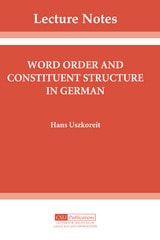
cover of Word Order and Constituent Structure in German

Word Order and Constituent Structure in German

Hans Uszkoreit

CSLI, 1987

This book applies the highly constrained grammatical framework of Generalized Phrase Structure Grammar of the syntax of German, focusing on the complex interaction of word order phenomena and constituent structure. Uszkoreit modifies and extends this framework to permit the adequate treatment of partially free word order as it occurs in German and probably to some degree in all natural languages. Through Uszkoreit's redefined notion of linear precedence rules, it has become possible for the first time to present a formalized analysis of the interaction of the competing syntactic, semantic, pragmatic, and stylistic principles that determine the order of arguments and adjuncts. Most of the book is dedicated to the proof that a phrase-structure-grammar model can offer an adequate description of a language with much freer word order than English and at the same time provide new insights in the structure of this language. A highly concentrated and elegant grammar fragment is given, which offers intuitive analyses for such notoriously problematic phenomena as (1) word order differences between main clauses and subordinate clauses, (2) the second position of the finite verb in assertion main clauses, (3) the order among main, auxiliary, and modal verbs, (4) the derivation and distribution of separable prefix verbs, and (5) the partially free order among verb complements and adjuncts.
[more]