Results by title
4 books match the query 'Grand Staircase-Escalante National Monument (Utah)'
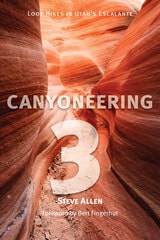
Canyoneering 3
Loop Hikes in Utah’s EscalanteSteve Allen
University of Utah Press, 1997
Utah’s Escalante country: a vast jigsaw puzzle of desert canyons, draws, defiles, gorges, slots, and washes demarcating upland expanses of slickrock, benches, and ridges, above which stand towers, pinnacles, and peaks. Inhabited for centuries by the ancient Puebloans and now managed primarily by various federal agencies, it is a land of stark contrasts and unforgettable beauty.
This guide features 37 major hikes designed to satisfy any canyoneer from novice to expert, including 20 in the new Grand Staircase-Escalante National Monument. All hikes are designed as loops, eliminating the need to backtrack or car shuttle for those inclined to do the full routes. Dayhikers can choose routes from an hour to all day, backpackers will find multi-day hikes, and those who prefer charting their own course will also profit from the information here.
Aside from the detailed route descriptions, Canyoneering 3 describes 14 road sections plus side roads to ensure time will not be lost finding a trailhead in this often confusing country. Also included are sections on geology, history, equipment, and technical canyoneering. Thoroughly researched, this is now the most comprehensive guide to the wonderland of the Escalante.
Hikes include: Death Hollow; Sand Creek; Boulder Mail Trail; Big Flat Wash, the Escalante River, and the Bowington Road; Middle Boulder Creek; Upper Boulder Creek and Dry Hollow; Phipps Wash; Big Horn Canyon; The Escalante River and the Sand Slides; Red Breaks Canyon; Harris Wash; Egypt 3-The Slot; Lower Harris Wash; Fence Canyon, the Escalante River, and Twenty-five Mile Wash; Twenty-five Mile Wash, the Escalante River, and Scorpion Gulch; Spooky and Peek-a-Book Gulches-The Long Loop; Upper Brimstone Gulch-The Slot; Scorpion Gulch and the Scorpion Horse Trail; Peek-a-Boo and Spooky Gulches-The Standard Loop; Coyote Gulch; Stevens Canyon and the Waterpocket Fold; Stevens and Fold Canyons; The Pollywog Bench Area; Forty-mile Creek and Willow Gulch Everett Russ; Fifty-mile Creek; Sixty Point and Twilight Canyon; Llewellyn and Cottonwood Gulches; Davis Gulch; Clear Creek and the Cathedral in the Desert; Deer Creek; Steep Creek and Horse Canyon; The Gulch and Horse Canyon; Little Death Hollow and Wolverine Creek; Egg Canyon and Lamanite Arch; Silver Falls Creek and Choprock Canyon; Deer Point-An Ascent; Moody Creek Canyons
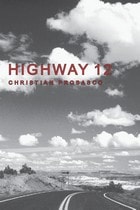
Highway 12
Christian Probasco
Utah State University Press, 2005
Highway 12 is undoubtedly one of not only America's but the world's most scenic highways. From its intersection on the west with Highway 89 south of Panguitch, Utah, it runs up through Red Canyon onto the Paunsagunt Plateau and across Bryce Canyon National Park. It then drops into the Paria River Valley, passes through several tiny villages, crosses some extraordinary (for anywhere but this region) badlands, and descends the Escalante River into Potato Valley. While a driver may justifiably feel she has seen some scenery by that point, the highway is just getting started, for in the next stretch, it crosses a labyrinth of multicolored sandstone humps and corridors, climaxed by a narrow hogback with steep slickrock drops to each side, all within Grand Staircase-Escalante National Monument. Reaching the oasis of Boulder within this desert of rock, the road then climbs across the flank of the Aquarius Plateau, providing spectacular vistas and terminating at the gateway to Capitol Reef National Park. Along the way side roads and trails access the vast wilderness of the Paria and Escalante Rivers and the high plateaus they drain. Congress acknowledged the unequaled splendor of Highway 12 by designating it one of a handful of All-American Roads.
To travel with Christian Probasco this road and its spurs, which lead deep into some of the wildest, most broken-up and stunning landscapes anywhere, can put a unique twist on an already singular experience. He knows the region as well as anyone and brings an original, edgy, youthful view to it. His opinions and his language may challenge you. His approaches to and perspectives on the land may sometimes surprise you. His understanding of the area's history and its people will likely teach you a thing or two.
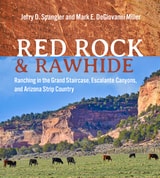
Red Rock and Rawhide
Ranching in the Grand Staircase, Escalante Canyons, and Arizona Strip CountryJerry D. Spangler and Mark E. DeGiovanni Miller
University of Utah Press, 2024
Today, the relatively few cattle ranchers who continue to operate in southern Utah are part of a complex political and social mix of peoples and interests, as Indigenous nations, environmentalists, politicians, and tourists all have differing positions on land use in the region. In Red Rock and Rawhide, Jerry D. Spangler and Mark E. DeGiovanni Miller provide the first comprehensive examination of the history of livestock grazing in the Grand Staircase-Escalante National Monument and surrounding areas, drawing on years of research to show how the culture and industry have changed and continue to evolve.
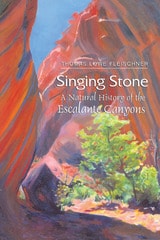
Singing Stone
Thomas L Fleischner
University of Utah Press, 1999
Integrating personal narrative and natural history, Fleischner presents what he calls a "guide to understanding" the relatively unknown landscape of the Grand Staircase-Escalante National Monument.
Like a bright blue seam incised deep in solid rock, the Escalante River binds the fir forests of Utah’s High Plateau with the barren deserts of the canyonlands region in the newly designed Grand Staircase-Escalante National Monument. To this wild landscape, naturalist Thomas Fleischner brings both emotional engagement and a wealth of knowledge. With unabashed passion and patient and learned observations Fleischner presents this relatively unknown landscape.
Singing Stone is ideal for curious visitors to the national monument as well as students of environmental studies. Fleischner’s background as a conservation biologist and former park ranger, a professor of environmental studies, and a naturalist in the Escalante Region for almost twenty years has provided him with a deep reservoir of experience and knowledge.
The book’s first three chapters survey the unique geology, flora and fauna, and human history of the region. Chapters four and five trace the more recent impacts of human activities—grazing and wilderness recreation—and explore the shifts in cultural values and public policy that have occurred as a result. Examining these topics in the context of a specific landscape offers a lens through which these changes, now the topic of examination and controversy throughout the New West, can be clearly seen and, hopefully, re-evaluated.