Results by title
6 books match the query 'Grass'
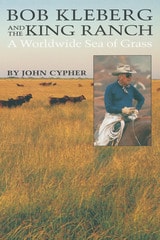
Bob Kleberg and the King Ranch
A Worldwide Sea of GrassBy John Cypher
University of Texas Press, 1996
Ranching on the vast scale that Texas is famous for actually happened at King Ranch, a sea of grass that ultimately spread its pastures to countries around the globe under the fifty-year leadership of Bob Kleberg. This absorbing biography, written by Kleberg's top assistant of many years, captures both the life of the man and the spirit of the kingdom he ruled, offering a rare, insider's view of life on a fabled Texas ranch.
John Cypher spent forty years (1948-1988) on King Ranch. In these pages, he melds highlights of Kleberg's life with memories of his own experiences as the "right hand" who implemented many of Kleberg's grand designs. In a lively story laced with fascinating anecdotes he both recounts his worldwide travels with Kleberg as the ranch expanded its holdings to Latin America, Cuba, Australia, the Philippines, Europe, and Africa, and describes timeless, traditional tasks such as roundup at the home ranch in Kingsville.
Kleberg's accomplishments as the founder of the Santa Gertrudis cattle breed and a breeder of Thoroughbred racing horses receive full attention, as does his fabled lifestyle, which included friendships not merely with the rich and famous but also with Queen Elizabeth the Queen Mother, who shared his love of horse racing. For everyone interested in ranching and one of its most famous practitioners, this book will be essential reading.
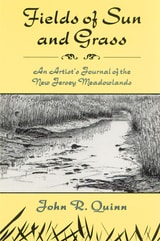
Fields of Sun and Grass
An Artist's Journal of the New Jersey MeadowlandsQuinn, John R
Rutgers University Press, 1997
The setting is the New Jersey Meadowlands, a wild and reedy tract located a mere six miles west of New York's Times Square. It is considered by many as nothing more than a "toxic wasteland," but is in fact home to a dazzling array of often overlooked plants and animals. While there is little doubt that many of the life forms that once thrived here are long gone, many others remain, and these are the primary focus of this book. Many, many species are discussed; far too many to list here. Suffice it to say Quinn leaves no stones unturned.
The book has three central parts, respectively called "Yesterday," "Today," and "Tomorrow." Each covers a different time period in the ecological life of the Meadowlands. There also is an "Introduction," a "Starting Point," an "Epilogue," a bibliography, an index, and an interesting sort of "hands-on" chapter called "Exploring the Meadowlands." This will be of particular interest to anyone who lives within traveling distance of the region. It gives helpful and experienced advice on enjoyed the Meadowlands firsthand through boating, fishing, hiking, and the visiting of local parks.

Island of Grass
Ellen E. Wohl
University Press of Colorado, 2009
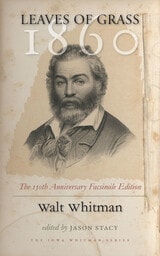
Leaves of Grass, 1860
The 150th Anniversary Facsimile EditionWhitman, Walt
University of Iowa Press, 2009
In May 1860, Walt Whitman published a third edition of Leaves of Grass. His timing was compelling. Printed during a period of regional, ideological, and political divisions, written by a poet intimately concerned with the idea of a United States as “essentially the greatest poem,” this new edition was Whitman’s last best hope for national salvation. Now available in a facsimile edition, Leaves of Grass, 1860 faithfully reproduces Whitman’s attempt to create a “Great construction of the New Bible” to save the nation on the eve of civil war and, for the first time, frames the book in historical rather than literary terms.
In his third edition, Whitman added 146 new poems to the 32 that comprised the second edition, reorganized the book into a bible of American civic religion that could be cited chapter and verse, and included erotic poetry intended to bind the nation in organic harmony. This 150th anniversary edition includes a facsimile reproduction of the original 1860 volume, a thought-provoking introduction by antebellum historian and Whitman scholar Jason Stacy that situates Whitman in nineteenth-century America, and annotations that provide detailed historical context for Whitman’s poems.
A profoundly rich product of a period when America faced its greatest peril, this third edition finds the poet transforming himself into a prophet of spiritual democracy and the Whitman we celebrate today—boisterous, barbaric, and benevolent. Reprinting it now continues the poet’s goal of proclaiming for “the whole of America for each / individual, without exception . . . uncompromising liberty and equality.”
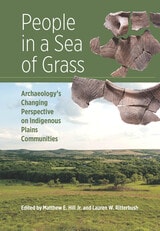
People in a Sea of Grass
Archaeology's Changing Perspective on Indigenous Plains CommunitiesEdited by Matthew E. Hill and Lauren W. Ritterbush
University of Utah Press, 2021
Contributors highlight how Indigenous Plains groups participated in large-scale social networks in which ideas, symbols, artifacts, and people moved across North America over the last 2,000 years. They also discuss cultural transformation, focusing on key demographic, economic, social, and ceremonial factors associated with change, including colonization and integration into the social and political economies of transatlantic societies. Cultural traditions covered include Woodland-era Kansas City Hopewell, late prehistoric Central Plains tradition, and ancestral and early historic Wichita, Pawnee and Arikara, Kanza, Plains Apache, and Puebloan migrants. As the first review of Plains archaeology in more than a decade, this book brings studies of early Indigenous
peoples of the central and southern Plains into a new era.

Sea Of Grass
Conrad Richter
Ohio University Press, 1992