Results by title
3 books match the query 'Grassland ecology'
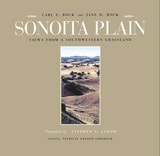
Sonoita Plain
Views from a Southwestern GrasslandCarl E. Bock and Jane H. Bock; Photographs by Stephen E. Strom; Foreword by Patricia Nelson Limerick
University of Arizona Press, 2005
Far to the south of Arizona’s sprawling metropolises, a rolling savanna of grass, oak, and mesquite rises above the surrounding deserts. The Sonoita Plain is a basin of a thousand square miles bracketed by mountains, a land once the domain of cowboys that is now more and more the focus of exurban development. These southwestern grasslands are both typical of and distinct from those of the Great Plains—similarly shaped by drought, grazing, and fire, but with a different flora and fauna, and the product of a different human history.
The Appleton-Whittell Research Ranch is a tract of 8,000 acres on the Sonoita Plain that was established in 1968 by the Appleton family and that is now part of the sanctuary system of the National Audubon Society. To all appearances, it is an ordinary piece of land, but for the last 35 years it has been treated in an extraordinary way—by leaving it alone. No grazing to influence grass production. No dam building to hold back flash floods. No pest control. No fire-fighting. By employing such non-action, might we gain a glimpse of what this land was like hundreds, even thousands, of years ago?
Through essays and photographs focusing on the Sanctuary and surrounding area, this book reveals the complex ecology and unique aesthetics of its grasslands and savannas. Carl and Jane Bock and Stephen Strom share a passion for the remarkable beauty found here, and in their book they describe its environment, biodiversity, and human history. People have dominated the world’s grasslands and savannas for so long that today we have no clear idea what these lands might be like without us. By understanding the lessons of the Sonoita Plain, we might gain such insight—and, more important, discover approaches to protecting the very things that attract us to such lands in the first place.
[more]
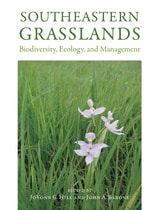
Southeastern Grasslands
Biodiversity, Ecology, and ManagementJoVonn G. Hill and John A. Barone, eds.
University of Alabama Press, 2019
A holistic approach to analyzing distinct grassland habitats that integrates ecological, historical, and archaeological data
Today the southeastern United States is a largely rural, forested, and agricultural landscape interspersed with urban areas of development. However, two centuries ago it contained hundreds of thousands of acres of natural grasslands that stretched from Florida to Texas. Now more than 99 percent of these prairies, glades, and savannas have been plowed up or paved over, lost to agriculture, urban growth, and cattle ranching. The few remaining grassland sites are complex ecosystems, home to hundreds of distinct plant and animal species, and worthy of study.
Southeastern Grasslands: Biodiversity, Ecology, and Management brings together the latest research on southeastern prairie systems and species, provides a complete picture of an increasingly rare biome, and offers solutions to many conservation biology queries. Editors JoVonn G. Hill and John A. Barone have gathered renowned experts in their fields from across the region who address questions related to the diversity, ecology, and management of southeastern grasslands, along with discussions of how to restore sites that have been damaged by human activity.
Over the last twenty years, both researchers and the public have become more interested in the grasslands of the Southeast. This volume builds on the growing knowledge base of these remarkable ecosystems with the goal of increasing appreciation for them and stimulating further study of their biota and ecology. Topics such as the historical distribution of grasslands in the South, the plants and animals that inhabit them, as well as assessments of several techniques used in their conservation and management are covered in-depth. Written with a broad audience in mind, this book will serve as a valuable introduction and reference for nature enthusiasts, scientists, and land managers.
[more]
The Desert Grassland
Edited by Mitchel P. McClaran and Thomas R. Van Devender
University of Arizona Press, 1995
The mixed grass and shrub vegetation known to scientists as desert grassland is common to the basins and valleys that skirt the mountain ranges throughout southwestern North America, extending from Arizona, New Mexico and Texas down through thirteen Mexican states. This variegated ground cover is crucial to life in an arid environment. The Desert Grassland offers the most comprehensive study to date of these flora and the rich biotic communities they support.
Leading experts in geography, biology, botany, zoology, and geoscience present new research on the desert grassland and review a vast amount of earlier work. They reveal that present-day grasses once grew in the ice-age forests that existed in these areas before the climate dried and the trees vanished and how the intensity and frequency of fire can influence the plant and animal species of the grassland. They also document how the influence of humans—from Amerindians to contemporary ranchers, public land managers, and real estate developers—has changed the relative abundance of woody and herbaceous species and how the introduction of new plants and domesticated animals to the area has also affected biodiversity. The book concludes with a review of the attempts, both failed and successful, to reestablish plants in desert grasslands affected by overgrazing, drought, and farm abandonment.
Meticulously researched and copiously illustrated, The Desert Grassland is a major contribution to ecological literature. For advanced lay readers as well as students and scholars of history, geography, and ecology, it will be a standard reference work for years to come.
[more]