Results by title
4 books match the query 'Great Britain. Parliament'
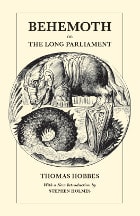
Behemoth or The Long Parliament
Thomas Hobbes
University of Chicago Press, 1990
Behemoth, or The Long Parliament is essential to any reader interested in the historical context of the thought of Thomas Hobbes (1588-1679). In De Cive (1642) and Leviathan (1651), the great political philosopher had developed an analytical framework for discussing sedition, rebellion, and the breakdown of authority. Behemoth, completed around 1668 and not published until after Hobbe's death, represents the systematic application of this framework to the English Civil War.
In his insightful and substantial Introduction, Stephen Holmes examines the major themes and implications of Behemoth in Hobbes's system of thought. Holmes notes that a fresh consideration of Behemoth dispels persistent misreadings of Hobbes, including the idea that man is motivated solely by a desire for self-preservation. Behemoth, which is cast as a series of dialogues between a teacher and his pupil, locates the principal cause of the Civil War less in economic interests than in the stubborn irrationality of key actors. It also shows more vividly than any of Hobbe's other works the importance of religion in his theories of human nature and behavior.
In his insightful and substantial Introduction, Stephen Holmes examines the major themes and implications of Behemoth in Hobbes's system of thought. Holmes notes that a fresh consideration of Behemoth dispels persistent misreadings of Hobbes, including the idea that man is motivated solely by a desire for self-preservation. Behemoth, which is cast as a series of dialogues between a teacher and his pupil, locates the principal cause of the Civil War less in economic interests than in the stubborn irrationality of key actors. It also shows more vividly than any of Hobbe's other works the importance of religion in his theories of human nature and behavior.
[more]
Commons and Lords
A Short Anthropology of ParliamentEmma Crewe
Haus Publishing, 2015
The British Parliament rewards close scrutiny not just for the sake of democracy, but also because the surprises it contains challenge our understanding of British politics. Commons and Lords pulls back the curtain on both the upper House of Lords and the lower House of Commons to examine their unexpected inner workings.
Based on fieldwork within both Houses, this volume in the Haus Curiosities series provides a surprising twist in how relationships in each play out. The high social status of peers in the House of Lords gives the impression of hierarchy and, more specifically, patriarchy. In contrast, the House of Commons conjures impressions of equality and fairness between members. But actual observation reveals the opposite: while the House of Lords has an egalitarian and cooperative ethos that is also supportive of female members, the competitive and aggressive House of Commons is a far less comfortable place for women. Offering many surprises and secrets, this book exposes the sheer oddity of the British parliament system.
Based on fieldwork within both Houses, this volume in the Haus Curiosities series provides a surprising twist in how relationships in each play out. The high social status of peers in the House of Lords gives the impression of hierarchy and, more specifically, patriarchy. In contrast, the House of Commons conjures impressions of equality and fairness between members. But actual observation reveals the opposite: while the House of Lords has an egalitarian and cooperative ethos that is also supportive of female members, the competitive and aggressive House of Commons is a far less comfortable place for women. Offering many surprises and secrets, this book exposes the sheer oddity of the British parliament system.
[more]
Confidence Regained
Economics, Mrs. Thatcher, and the British VoterHelmut Norpoth
University of Michigan Press, 1992
Elected to office at the end of a decade of economic decline, Prime Minister Margaret Thatcher set out to cure Britain's ills with daring new free-market policies. Putting financial stability first on the agenda of macroeconomic priorities, the Thatcher government pursued this goal with rare tenacity. In Confidence Regained, Helmut Norpoth examines the electoral risks and rewards of this economic strategy.Professor Norpoth paints a vivid picture of the fierce battle over the economic policies and record of the Thatcher government. Using electoral surveys, Norpoth reveals how British voters sorted out the competing claims of economists and politicians in their various partisan choices. Turning from election outcomes to government popularity between elections, Professor Norpoth charts the rise and decline of Margaret Thatcher's approval ratings and Conservative party support, showing how responsive these ratings were to economic performance. The statistical evidence presented shows that economic views significantly affected voter choices in the Thatcher elections. But the author reveals that the Conservatives under Mrs. Thatcher owed their ability to regain the confidence of the British electorate not only to the nation’s economic success, but also, in large measure, to the British victory in the Falkland Islands.Confidence Regained is an invaluable source to scholars of electoral politics, especially of British elections, but it will also interest historians of Thatcherism and scholars studying the role of macroeconomics in elections.
[more]

The Humours of Parliament
Harry Furniss's View of Late-Victorian Political CultureEdited and with an Introduction by Gareth Cordery and Joseph S. Meisel
The Ohio State University Press, 2014
Harry Furniss (1854–1925), a leading contributor to Punch and other important illustrated magazines, was arguably the most significant political caricaturist and illustrator of the late Victorian and Edwardian eras. He was widely celebrated in his time, and his cartoons helped to define the political world in the public mind. The Humours of Parliament was Furniss’s hugely successful illustrated lecture that he staged throughout the U.K., North America, and Australia during the 1890s. Entertaining his audiences with anecdotes, mimicry, and jokes—along with the spectacle of more than 100 magic lantern slides—Furniss gave his audiences an insider’s view of the mysterious workings of Parliament and the leading political personalities of the day, such as Gladstone, Balfour, and Chamberlain.
Reproducing some 150 images drawn from Furniss’s extensive graphic work, The Humours of Parliament: Harry Furniss’s View of Late-Victorian Political Culture, edited and with an introduction by Gareth Cordery and Joseph S. Meisel, presents Furniss’s unpublished lecture text for the first time. The extensive introduction places the show in its biographical, political, and performative contexts. Cordery and Meisel’s volume therefore both documents a pivotal moment in British political and social history and provides a rare case study of an important yet little studied nineteenth-century performance genre: the illustrated platform lecture.
Reproducing some 150 images drawn from Furniss’s extensive graphic work, The Humours of Parliament: Harry Furniss’s View of Late-Victorian Political Culture, edited and with an introduction by Gareth Cordery and Joseph S. Meisel, presents Furniss’s unpublished lecture text for the first time. The extensive introduction places the show in its biographical, political, and performative contexts. Cordery and Meisel’s volume therefore both documents a pivotal moment in British political and social history and provides a rare case study of an important yet little studied nineteenth-century performance genre: the illustrated platform lecture.
[more]