Results by title
21 books match the query 'Great Lakes'
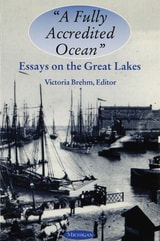
"A Fully Accredited Ocean"
Essays on the Great LakesVictoria Brehm, Editor
University of Michigan Press, 1998
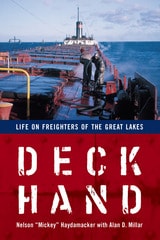
Deckhand
Life on Freighters of the Great LakesNelson "Mickey" Haydamacker with Alan D. Millar
University of Michigan Press, 2009
Long before popular television shows such as Dirty Jobs and The Deadliest Catch, everyday men and women---the unsung heroes of the job world---toiled in important but mostly anonymous jobs. One of those jobs was deckhand on the ore boats.
With numerous photographs and engaging stories, Deckhand offers an insider's view of both the mundane and the intriguing duties performed by deckhands on these gritty cargo vessels. Boisterous port saloons, monster ice jams, near drownings, and the daily drudgery of soogeying---cleaning dirt and grime off the ships---are just a few of the experiences Mickey Haydamacker had as a young deckhand working on freighters of the Great Lakes in the early 1960s. Haydamacker sailed five Interlake Steamship Company boats, from the modern Elton Hoyt 2nd to the ancient coal-powered Colonel James Pickands with its backbreaking tarp-covered hatches.
Deckhand will appeal to shipping buffs and to anyone interested in Great Lakes shipping and maritime history as it chronicles the adventures of living on the lakes from the seldom-seen view of a deckhand.
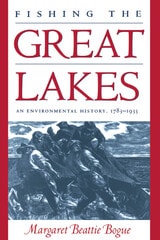
Fishing the Great Lakes
An Environmental History, 1783–1933Margaret Beattie Bogue
University of Wisconsin Press, 2000
Fishing the Great Lakes is a sweeping history of the destruction of the once-abundant fisheries of the great "inland seas" that lie between the United States and Canada. Though lake trout, whitefish, freshwater herring, and sturgeon were still teeming as late as 1850, Margaret Bogue documents here how overfishing, pollution, political squabbling, poor public policies, and commercial exploitation combined to damage the fish populations even before the voracious sea lamprey invaded the lakes and decimated the lake trout population in the 1940s.
From the earliest records of fishing by native peoples, through the era of European exploration and settlement, to the growth and collapse of the commercial fishing industry, Fishing the Great Lakes traces the changing relationships between the fish resources and the people of the Great Lakes region. Bogue focuses in particular on the period from 1783, when Great Britain and the United States first politically severed the geographic unity of the Great Lakes, through 1933, when the commercial fishing industry had passed from its heyday in the late nineteenth century into very serious decline. She shows how fishermen, entrepreneurial fish dealers, the monopolistic A. Booth and Company (which distributed and marketed much of the Great Lakes catch), and policy makers at all levels of government played their parts in the debacle. So, too, did underfunded scientists and early conservationists unable to spark the interest of an indifferent public. Concern with the quality of lake habitat and the abundance of fish increasingly took a backseat to the interests of agriculture, lumbering, mining, commerce, manufacturing, and urban development in the Great Lakes region. Offering more than a regional history, Bogue also places the problems of Great Lakes fishing in the context of past and current worldwide fishery concerns.
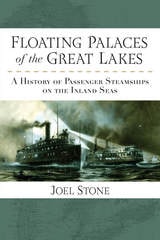
Floating Palaces of the Great Lakes
A History of Passenger Steamships on the Inland SeasJoel Stone
University of Michigan Press, 2015

Fresh Water
Women Writing on the Great LakesAlison Swan
Michigan State University Press, 2006
Fresh Water: Women Writing on the Great Lakes is a collection of nonfiction works by women writers. These works focus on the Midwest: living with the five interconnected freshwater seas that we know as the Great Lakes. Contributing to this collection are renowned poets, essayists, and fiction writers, all of whom write about their own creative streams of consciousness, the fresh waters of the Great Lakes, and the region's many rivers: Loraine Anderson, Judith Arcana, Rachel Azima, Mary Blocksma, Gayle Boss, Sharon Dilworth, Beth Ann Fennelly, Linda Nemec Foster, Gail Griffin, Rasma Haidri, Aleta Karstad, Laura Kasischke, Janet Kauffman, Jacqueline Kolosov, Susan Laidlaw, Lisa Lenzo, Linda Loomis, Anna Mills, Stephanie Mills, Judith Minty, Anne-Marie Oomen, Rachael Perry, Susan Power, Donna Seaman, Heather Sellers, Gail Louise Siegel, Sue William Silverman,Claudia Skutar, Annick Smith, Leslie Stainton, Kathleen Stocking, Judith Strasser, Alison Swan, Elizabeth A.Trembley, Jane Urquhart, Diane Wakoski, and Leigh Allison Wilson.
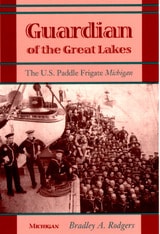
Guardian of the Great Lakes
The U.S. Paddle Frigate MichiganBradley A. Rodgers
University of Michigan Press, 1996
Guardian of the Great Lakes is the saga of the USS Michigan, an archetype iron-hulled war steamer launched in 1843. Its mission was to patrol the ofttimes volatile Great Lakes region, quelling port town civil disturbances, while at the same time rescuing both Canadian and American ships in distress.
The Michigan found itself unavoidably attracted to calamity, leaving in its wake a collection of eyewitness accounts to these momentous yet largely forgotten occurences. Incidents such as the timber rebellion of the 1850s, which occurred in Wisconsin, Illinois, and Michigan, are documented for the first time. Other episodes such as the assassination of "king" Strang on Beaver Island and the destruction of the community there are studied under the light of newly discovered sources. Still other chapters reveal the chaos created by the Civil War on the lakes, the destructive mining strikes of Michigan's Upper Peninsula, and the tragic, bloody, Fenian invasion of Canada.
Between major calamities lay the vagaries of maritime life on the Great Lakes detailed in the records of the Michigan's crew. From their social and community life in Erie, Pennsylvania to storms, shipwrecks, and sickness, the records kept by the men and officers of the USS Michigan have helped to produce in this book an accurate and detailed narrative of naval and maritime life on the Great Lakes during this important period.
Bradley A. Rodgers is Assistant Professor, Program in Maritime History and Nautical Archaeology, East Carolina University.

Long Ships Passing
The Story Of The Great LakesWalter Havighurst
University of Minnesota Press, 2002
A dramatic account of three centuries of people and ships that sailed the Great Lakes
A popular history of navigation on the Great Lakes and life on their shores, The Long Ships Passing brings us aboard the crafts that have plowed the waves of the treacherous "five sisters" carrying the grain, lumber, and minerals that fed and built the cities of America. Walter Havighurst paints vivid pictures of life—and death—on the lakes, mysterious accounts of wooden ships and iron men that sank to freshwater graves, especially along the immigrant route where the wrecks lie thick. In rich and marvelous detail, this classic history recounts the saga of an inland marine empire.
Nessie Visits the Great Lakes
Anna Urso
Michigan Publishing Services, 2022
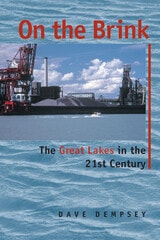
On the Brink
The Great Lakes in the 21st CenturyDave Dempsey
Michigan State University Press, 2004
As one of the world’s great natural treasures, the Great Lakes have also served in recent decades as an early warning system for many emerging environmental problems. In the early twenty-first century, as the Lakes face unprecedented challenges, we need to revisit both the wonder of the Lakes and the perils plaguing them, and to take action to protect this majestic ecosystem.
Dave Dempsey weaves the natural character and phenomena of the Great Lakes and stories of the schemes, calamities, and unusual human residents of the Basin with the history of their environmental exploitation and recovery. Contrasting the incomparable beauty and complexity of the Lakes, and the poetry, folklore, and citizen action they have inspired, with the disasters that short-sighted human folly has inflicted on the ecosystem, Dempsey makes this history both engaging and relevant to today’s debates and decisions.
Underlying the neglectful treatment of the Lakes are two irreconcilable and faulty human assumptions: that the Lakes are a system so big that human beings cannot do great harm to it, and that the Lakes are a resource that can be bent to the will of humankind. Dempsey finds evidence that, despite great changes in the laws governing the Lakes and public attitudes toward them in the last fifty years, government policy and institutions are still dominated by these dangerous attitudes.
A central theme of On the Brink is that citizens, who have displayed an increasing sense of commitment to the Lakes and a growing sense of place, must challenge their leaders to reform Great Lakes institutions. While everything from large-scale water exports to global climate change looms in the future of the Lakes, single-purpose solutions do not suffice—no more than a Band- aid would on a gaping wound. Dempsey shows that it is necessary to create a governing system that reflects the realities of life “on the ground” in communities and that taps into the passion and determination of citizens to protect these treasures.
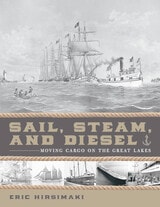
Sail, Steam, and Diesel
Moving Cargo on the Great LakesEric Hirsimaki
Michigan State University Press, 2024

Ship Captain's Daughter
Growing Up on the Great LakesAnn Michler Lewis
Wisconsin Historical Society Press, 2015
Ann Lewis's childhood was marked by an unusual rhythm. Each year the thawing and freezing of the Great Lakes signaled the beginning and end of the shipping season, months of waiting that were punctuated by brief trips to various ports to meet her father, the captain.
With lively storytelling and vivid details, Lewis captures the unusual life of shipping families whose days and weeks revolved around the shipping industry on the Great Lakes. She paints an intriguing and affectionate portrait of her father, a talented pianist whose summer job aboard an ore freighter led him to a life on the water. Working his way up from deckhand to ship captain, Willis Michler became the master of thirteen ships over a span of twenty-eight years. From the age of twelve, Ann accompanied the captain to the ports of Milwaukee, Chicago, Toledo, and Cleveland on the lower Great Lakes. She describes sailing through stormy weather and starry nights, visiting the engine room, dining at the captain's table, and wheeling the block-long ship with her father in the pilot house. Through her mother's stories and remarks, Lewis also reveals insights into the trials and rewards of being a ship captain's wife. The book is enhanced by the author's vintage snapshots, depicting this bygone lifestyle.
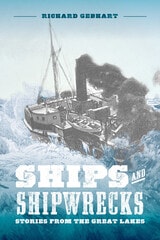
Ships and Shipwrecks
Stories from the Great LakesRichard Gebhart
Michigan State University Press, 2022
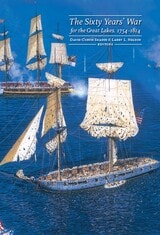
Sixty Years' War for the Great Lakes, 1754-1814
David Curtis Skaggs
Michigan State University Press, 2001
The Sixty Years' War for the Great Lakes contains twenty essays concerning not only military and naval operations, but also the political, economic, social, and cultural interactions of individuals and groups during the struggle to control the great freshwater lakes and rivers between the Ohio Valley and the Canadian Shield. Contributing scholars represent a wide variety of disciplines and institutional affiliations from the United States, Canada, and Great Britain.
Collectively, these important essays delineate the common thread, weaving together the series of wars for the North American heartland that stretched from 1754 to 1814. The war for the Great Lakes was not merely a sideshow in a broader, worldwide struggle for empire, independence, self-determination, and territory. Rather, it was a single war, a regional conflict waged to establish hegemony within the area, forcing interactions that divided the Great Lakes nationally and ethnically for the two centuries that followed.

Sport
Ship Dog of the Great LakesPamela Cameron
Wisconsin Historical Society Press, 2019
In this beautifully illustrated children’s book based on historical documents and photographs, readers share in Sport’s adventures while discovering the various ways lighthouse tender ships helped keep the lake safe for others. Helpful diagrams, a map, and a historical note supplement this engaging story for young readers.
2020 Wisconsin Library Association Outstanding Children’s Book of the Year
2020 Midwest Book Award Gold Medal
2020 Library of Michigan Notable Book Award
2019 Historical Society of Michigan State History Award
2019 Moonbeam Children’s Book Award
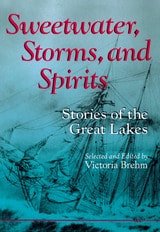
Sweetwater, Storms, and Spirits
Stories of the Great LakesSelected and Edited by Victoria Brehm
University of Michigan Press, 1991
Native American legends, shipping tales, folklore, and myths spanning the last 150 years are gathered together for the first time in this collection. The presence of Native American culture, the unpredictable climate, the dangerous closeness of the shoreline, and the bloody history of shipping on the Lakes contribute greatly to the uniqueness of maritime literature on the Lakes.
Sweetwater, Storms, and Spirits will appeal to those interested in both Native American literature and history and Great Lakes maritime history, and to those who simply enjoy a good maritime tale. The collection is a seabag of different kinds of stories, myths, and tales that together create a picture of life as it has been lived on the Great Lakes.
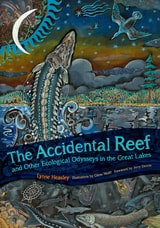
The Accidental Reef and Other Ecological Odysseys in the Great Lakes
Lynne Heasley
Michigan State University Press, 2022
The Archaeology of Native-Lived Colonialism
Challenging History in the Great LakesNeal Ferris
University of Arizona Press, 2009
In reconsidering Native adaptation and resistance to colonial British rule, Ferris reviews five centuries of interaction that are usually read as a single event viewed through the lens of historical bias. He first examines patterns of traditional lifeway continuity among the Ojibwa, demonstrating their ability to maintain seasonal mobility up to the mid-nineteenth century and their adaptive response to its loss. He then looks at the experience of refugee Delawares, who settled among the Ojibwa as a missionary-sponsored community yet managed to maintain an identity distinct from missionary influences. And he shows how the archaeological history of the Six Nations Iroquois reflected patterns of negotiating emergent colonialism when they returned to the region in the 1780s, exploring how families managed tradition and the contemporary colonial world to develop innovative ways of revising and maintaining identity.
The Archaeology of Native-Lived Colonialism convincingly utilizes historical archaeology to link the Native experience of the eighteenth and nineteenth centuries to the deeper history of sixteenth- and seventeenth-century interactions and with pre-European times. It shows how these Native communities succeeded in retaining cohesiveness through centuries of foreign influence and material innovations by maintaining ancient, adaptive social processes that both incorporated European ideas and reinforced historically understood notions of self and community.

The Salvager
The Life of Captain Tom Reid on the Great LakesMary Frances Doner
University of Minnesota Press, 2017
First published in 1958, The Salvager is both a narrative history of Great Lakes shipping disasters of 1880–1950 and the life story of Captain Thomas Reid, who operated one of the region’s largest salvaging companies during that era.
The treacherous shoals, unpredictable storms, and sub-zero temperatures of the Great Lakes have always posed special hazards to mariners—particularly before the advent of modern navigational technologies—and offered ample opportunity for an enterprising sailor to build a salvage business up from nothing. Designing much of his equipment himself and honing a keen eye for the risks and rewards of various catastrophes, Captain Reid rose from humble beginnings and developed salvaging into a science. Using the actual records of the Reid Wrecking and Towing Company as well as Reid’s personal logs and letters, Mary Frances Doner deftly tells the stories not only of the maritime disasters and the wrecking adventures that followed, but also of those waiting back on shore for their loved ones to return.

The Windward Shore
A Winter on the Great LakesJerry Dennis
University of Michigan Press, 2012
If you have been enchanted by Jerry Dennis’s earlier work on sailing the Great Lakes, canoeing, angling, and the natural wonders of water and sky—or you have not yet been lucky enough to enjoy his engaging prose—you will want to immerse yourself in his powerful and insightful new book on winter in Great Lakes country.
Grounded by a knee injury, Dennis learns to live at a slower pace while staying in houses ranging from a log cabin on Lake Superior’s Keweenaw Peninsula to a $20 million mansion on the northern shore of Lake Michigan. While walking on beaches and exploring nearby woods and villages, he muses on the nature of time, weather, waves, agates, books, words for snow and ice, our complex relationship with nature, and much more.
From the introduction: “I wanted to present a true picture of a complex region, part of my continuing project to learn at least one place on earth reasonably well, and trusted that it would appear gradually and accumulatively—and not as a conventional portrait, but as a mosaic that included the sounds and scents and textures of the place and some of the plants, animals, and its inhabitants. Bolstered by the notion that a book is a journey that author and reader walk together, I would search for promising trails and follow them as far as my reconstructed knee would allow.”

Tragedy and Triumph on the Great Lakes
Richard Gebhart
Michigan State University Press, 2024

Zooplankton of the Great Lakes
A Guide to the Identification and Ecology of the Common Crustacean SpeciesMary D. Balcer, Nancy L. Korda, and Stanely I. Dodson
University of Wisconsin Press, 1984
Researchers, instructors, and students will appreciate this compilation of detailed information on the crustacean zooplankton of the Great Lakes. The authors have gathered data from more than three hundred sources and organized into a useful laboratory manual. The taxonomic keys are easy to use, suitable for both classroom and laboratory identifications. Detailed line drawings are provided to help confirm the identification of the major species. Zoologists, limnologists, hydrobiologists, fish ecologists, and those who study or monitor water quality will welcome this dependable new identification tool.
A concise summary of pertinent information on the ecology of these zooplankton is provided in the main body of the text. A check-list of all species reported from each of the Great Lakes and notes on the distribution and abundance of more than a hundred species were compiled from an extensive search of existing literature. In addition, the authors collected samples from several locations on Lake Superior, in order to provide information on the abundance and life histories of the major crustacean species.