Results by title
6 books match the query 'Great powers'
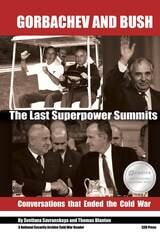
Gorbachev and Bush
The Last Superpower Summits. Conversations that Ended the Cold WarThe National Security Archive Savranskaya
Central European University Press, 2020
This book presents and interprets archival records of the meetings between Mikhail Gorbachev and George W. Bush between 1989 and 1991, including transcripts of conversations between top leaders on the rapid and monumental events of the final days of the Cold War. Particularly effective interlocutors were the foreign ministers Eduard Shevardnadze and James Baker, especially interesting when they interacted directly with Bush or Gorbachev. The documents were obtained from the Gorbachev Foundation and the Russian State Archives and from the United States government through requests under the Freedom of Information Act. Taking place at a time of revolutionary change in Eastern Europe, stimulated in part by Gorbachev and by Eastern Europeans (the Solidarity movement, dissidents, reform communists), the Malta Summit of 1989 and subsequent meetings helped defuse any potential for superpower conflict. Each of the five summits is covered in a separate chapter, introduced by an essay that places the transcripts in historical context. The anthology offers a fascinating glimpse into the relationship that defined the last, waning years of the Cold War—a unique record of these historic, highest-level conversations that effectively brought it to a close. The quality and scope of the dialogue between these world leaders was unprecedented and is likely never to be repeated.
[more]
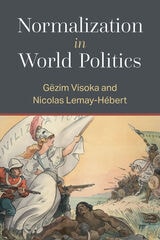
Normalization in World Politics
Gëzim Visoka and Nicolas Lemay-Hébert
University of Michigan Press, 2022
As we face new challenges from climate change and the rise of populism in Western politics and beyond, there is little doubt that we are entering a new configuration of world politics. Driven by nostalgia for past certainties or fear of what is coming next, references to normalcy have been creeping into political discourse, with people either vying for a return to a past normalcy or coping with the new normal.
This book traces main discourses and practices associated with normalcy in world politics. Visoka and Lemay-Hébert mostly focus on how dominant states and international organizations try to manage global affairs through imposing normalcy over fragile states, restoring normalcy over disaster-affected states, and accepting normalcy over suppressive states. They show how discourses and practices come together in constituting normalization interventions and how in turn they play in shaping the dynamics of continuity and change in world politics.
This book traces main discourses and practices associated with normalcy in world politics. Visoka and Lemay-Hébert mostly focus on how dominant states and international organizations try to manage global affairs through imposing normalcy over fragile states, restoring normalcy over disaster-affected states, and accepting normalcy over suppressive states. They show how discourses and practices come together in constituting normalization interventions and how in turn they play in shaping the dynamics of continuity and change in world politics.
[more]
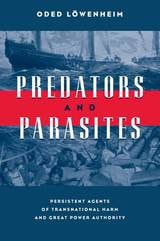
Predators and Parasites
Persistent Agents of Transnational Harm and Great Power AuthorityOded Löwenheim
University of Michigan Press, 2007
What explains variance in the policy of Great Powers toward drug traffickers, pirates, and terrorists? Does counterharm policy depend just on the degree of material harm caused to a powerful state by such nonstate actors, or do normative, moral, and emotional factors also play a role? Why did the U.S., for example, harshly punish al Qaeda after 9/11 but avoid taking similar forceful measures against foreign drug traffickers who enable the deaths of thousands of Americans each year by selling highly illegal and harmful narcotics? Oded Löwenheim argues that the answers to these questions lie in the social construction of agents of harm.
"Predators and Parasites shows, with impressive scholarship, that world politics is characterized by a cartel-like structure that gives states monopolies of legitimate violence. Sovereignty and a global structure of authority are not mutually exclusive. In a sense, anarchy is in the eye of the beholder."
—Robert O. Keohane, Princeton University
—Robert O. Keohane, Princeton University
"An invaluable contribution to the growing body of constructivist literature in international relations and should be read by anyone interested in the use of force in contemporary global politics . . . Goes a long way toward explaining America's War on Terror against al Qaeda and the Taliban and the widespread global support for this policy, as well as the highly negative global reaction to America's own intervention in Iraq and its norm-threatening doctrine of preemption."
—Richard W. Mansbach, Iowa State University
"Prepare to be boarded! Löwenheim delivers an essential constructivist tutorial on Great Power sovereignty and authority. An intellectual swashbuckler!"
—Rodney Bruce Hall, Oxford University
—Rodney Bruce Hall, Oxford University
"Rejecting preventive war for moral consistency and just conduct, a fascinating discussion of pirates, terrorists, and revenge."
—Jon Mercer, University of Washington
Oded Löwenheim is Lecturer in the Department of International Relations at the Hebrew University of Jerusalem.
[more]
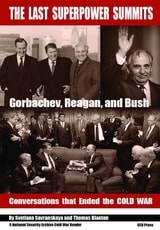
The Last Superpower Summits
Reagan, Gorbachev and Bush. Conversations that Ended the Cold War.The National Security Archive Savranskaya
Central European University Press, 2017
This book publishes for the first time in print every word the American and Soviet leaders – Ronald Reagan, Mikhail Gorbachev, and George H.W. Bush – said to each other in their superpower summits from 1985 to 1991. Obtained by the authors through the Freedom of Information Act in the U.S., from the Gorbachev Foundation and the State Archive of the Russian Federation in Moscow, and from the personal donation of Anatoly Chernyaev, these previously Top Secret verbatim transcripts combine with key declassified preparatory and after-action documents from both sides to create a unique interactive documentary record of these historic highest-level talks – the conversations that ended the Cold War. The summits fueled a process of learning on both sides, as the authors argue in contextual essays on each summit and detailed headnotes on each document. Geneva 1985 and Reykjavik 1986 reduced Moscow's sense of threat and unleashed Reagan's inner abolitionist. Malta 1989 and Washington 1990 helped dampen any superpower sparks that might have flown in a time of revolutionary change in Eastern Europe, set off by Gorbachev and by Eastern Europeans (Solidarity, dissidents, reform Communists). The high level and scope of the dialogue between these world leaders was unprecedented, and is likely never to be repeated.
[more]
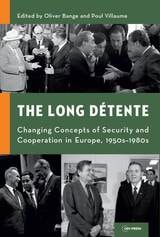
The Long Détente
Changing Concepts of Security and Cooperation in Europe, 1950s–1980sPoul Villaume
Central European University Press, 2017
This book presents pieces of evidence, which – taken together – lead to an argument that goes against the grain of the established Cold War narrative. The argument is that a “long détente” existed between East and West from the 1950s to the 1980s, that it existed and lasted for good (economic, national security, societal) reasons, and that it had a profound impact on the outcome of the conflict between East and West and the quintessentially peaceful framework in which this “endgame” was played. New, Euro-centered narratives are offered, including both West and East European perspectives. These contributions point to critical inconsistencies and inherent problems in the traditional U.S. dominated narrative of the “Victory in the Cold War.” The argument of a “long détente” does not need to replace the ruling American narrative. Rather, it can and needs to be augmented with European experiences and perceptions. After all, it was Europe – its peoples, societies, and states – that stood both at the ideological and military frontline of the conflict between East and West, and it was here that the struggle between liberalism and communism was eventually decided.
[more]
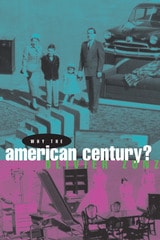
Why the American Century?
Olivier Zunz
University of Chicago Press, 1998
Reinterpreting our country's rise to world power, Olivier Zunz shows how American elites appropriated the twentieth century. Policymakers, corporate managers, engineers, scientists, and social scientists promoted a social contract of abundance and a controversial theory of pluralism. Their efforts created a model of middle class behavior for America and for the rest of the world.
"It should certainly be the task of historians to explain the nation's triumphs as effectively as they have explained its failures, and Zunz in this intelligent, learned and ambitious book suggests a valuable new model for doing so."—Alan Brinkley, Times Literary Supplement
"Zunz is evenhanded in his judgments. . . . His thesis is both imaginative and well grounded in the appropriate sources."—David M. Oshinsky, New York Times Book Review
"Zunz is an innovative and perceptive social critic. He crosses disciplinary boundaries with ease and felicity, and is particularly adept at illustrating large themes with unusual but telling details."—Kent Blaser, American Studies
"An eye-opening introduction to the shaping of modern America."—Foreign Affairs
[more]