Results by title

3 books match the query 'Greatness'
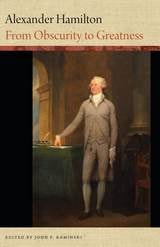
cover of Alexander Hamilton: From Obscurity to Greatness

Alexander Hamilton

From Obscurity to Greatness

John P. Kaminski

Wisconsin Historical Society Press, 2016

Born in 1755 on a small Caribbean island to unmarried parents, Alexander Hamilton did not enjoy the privileges of wealth or heredity by which so many of his contemporaries advanced to the highest levels of power. Yet Hamilton's natural ability and ambition earned him prevailing influence in the American Revolution and the government created thereafter, eventually securing his place in the pantheon of America's founders.

Editor John P. Kaminski has gathered a remarkable collection of quotations by and about Alexander Hamilton that paint for us a nuanced portrait of a complex man. Through his own words and the words of his contemporaries -- including the man who killed him in a duel, Aaron Burr -- we can gain a better understanding of this fascinating man who rose from anonymity on a small Caribbean island to the corridors of power.
[more]
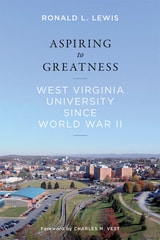
cover of Aspiring to Greatness: West Virginia University Since World War II

Aspiring to Greatness

West Virginia University Since World War II

RONALD L. LEWIS

West Virginia University Press, 2013

 Aspiring to Greatness: West Virginia University since World War II chronicles the emergence of WVU as a major land-grant institution. As a continuation of the work of Doherty and Summers in West Virginia University: Symbol of Unity in a Sectionalized State, this book focuses on the modern historical developments that elevated WVU from a small regional institution to one of national prominence.
 
West Virginia University’s growth mirrors the developmental eras that have shaped American higher education since World War II. The University’s history as an innovative, pioneering force within higher education is explored through its major postwar stages of expansion, diversification, and commercialization.
 
Institutions of higher education nationwide experienced a dramatic increase in enrollments between 1945 and 1975 as millions of returning World War II and Korean War veterans took advantage of the GI Bill of Rights. Their children, the “baby boom” generation, continued to supply the growth in college enrollment and the corresponding increase in institutional complexity until the mid-1970s. During this period WVU followed the national trend by growing from a few thousand students to nearly fifteen thousand.
 
From 1975 to the early 1990s, expansion gave way to diversification. The traditional student population stopped growing by 1975, and  “boomers” were replaced by students from nontraditional backgrounds. An unprecedented gender, racial, and ethnic diversification took place on college campuses, a trend encouraged by federal civil rights legislation. To a lesser degree WVU was no exception, although its location in a rural state with a small minority population forced the University to work harder to attract minorities than institutions in proximity to urban areas.
 
The commercialization of higher education became a full-fledged movement by the 1990s. Major changes, such as globalization, demographic shifts, a weak economy, and the triumph of the “market society,” all accelerated the penetration of business values and practices into university life.  Like other public universities, WVU was called upon to generate more of its own revenues. The University’s strategic responses to these pressures reconstructed the state’s leading land grant into the large complex institution of today.
 
As the only modern history of West Virginia University, this text reaches into the archives of the President’s Office and makes exhaustive use of press accounts and interviews with key individuals to produce a detailed resource for alumni, friends, and supporters of WVU, as well as administrators and specialists in higher education. 
[more]
cover of John Steinbeck: The Years of Greatness, 1936-1939

John Steinbeck

The Years of Greatness, 1936-1939

Tetsumaro Hayashi

University of Alabama Press, 1993

Revisiting the remarkable years that produced Steinbeck's greatest literary achievements.

John Steinbeck: The Years of Greatness, 1936–1939, edited by Tetsumaro Hayashi, offers a compelling scholarly exploration of the brief but extraordinary period during which John Steinbeck produced some of the most influential works in American literary history. Drawn from papers presented at the Third International Steinbeck Congress, this collection of essays examines the creative, intellectual, and social forces that shaped Steinbeck's remarkable achievements during the late 1930s.

The contributors investigate Steinbeck's major works of the period, including In Dubious Battle, Of Mice and Men, and The Grapes of Wrath, situating them within the social and economic realities of the Great Depression and the evolving landscape of twentieth-century American literature. Particular attention is given to Steinbeck's portrayal of labor, migration, community, social justice, and the experiences of working-class Americans. The volume also presents innovative studies of female characters and relationships in Steinbeck's fiction, drawing on newly available research materials and correspondence to illuminate previously overlooked dimensions of his work.

By combining historical context, literary analysis, and fresh critical perspectives, this collection deepens appreciation for Steinbeck's artistry and enduring cultural significance. An essential resource for scholars and students alike, it offers valuable insights into the years that established Steinbeck as one of America's most important and widely studied authors.

[more]