Results by title
16 books match the query 'Greek language'
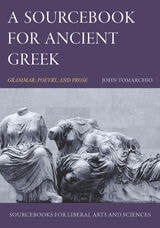
A Sourcebook for Ancient Greek
Grammar, Poetry, and ProseJohn Tomarchio
Catholic University of America Press, 2022
A Student Commentary on Pausanias Book 1
Patrick Paul Hogan
University of Michigan Press, 2014
A Student Commentary on Pausanias Book 2
Patrick Paul Hogan
University of Michigan Press, 2018
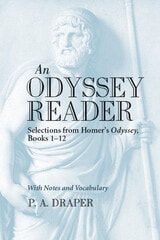
An Odyssey Reader
Selections from Homer's Odyssey, Books 1-12P. A. Draper
University of Michigan Press, 2012
Homer's Odyssey has captivated readers and influenced writers and artists for more than 2,000 years. Reading the poem in its original language provides an experience as challenging as it is rewarding. Most students encountering Homeric Greek for the first time need considerable help, especially with vocabulary and constructions that differ from the more familiar Attic forms. For anyone who has completed studies in elementary Greek, this edition provides the assistance necessary to read, understand, and appreciate the first book of the Odyssey in its original language.
Structured to maximize reading ease, P. A. Draper's volume stands out among introductions to the Greek Odyssey. Readers of this edition will appreciate the positioning of all notes facing the Greek text; the frequent vocabulary entries; the complete glossary; the appendix on basic Homeric forms and grammar; and the copious annotations on vocabulary, grammar, meter, historical and mythological allusions, and literary interpretation.
Primarily designed as a textbook, this volume will be an effective classroom tool and a useful acquisition for any library supporting a classics program. The book will find readers among high school and college Greek students, advanced students in Homer or epic poetry classes, graduate students working on reading-list requirements, and anyone interested in maintaining Greek reading skills.
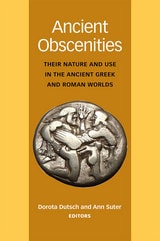
Ancient Obscenities
Their Nature and Use in the Ancient Greek and Roman WorldsDorota Dutsch and Ann Suter, editors
University of Michigan Press, 2015
English Words from Latin and Greek Elements
Donald M. Ayers; Revised by Thomas D. Worthen
University of Arizona Press, 1986
Since its first publication in 1965, English Words from Latin and Greek Elements by Donald M. Ayers has empowered thousands of students to expand their vocabulary by uncovering the classical roots embedded in modern English. Now in its enduring second edition, this trusted resource proves that vocabulary is most effectively learned through understanding—not memorization.
Why dedicate an entire book to this approach? Because Ayers goes beyond the basics. Students are introduced to a broad spectrum of Latin and Greek roots, encounter new vocabulary in meaningful context, and reinforce their learning through targeted exercises. This method equips learners with lifelong tools to decode unfamiliar words and deepen their command of English.
Written for English learners—not classical language scholars—this book requires no prior knowledge of Latin or Greek. It’s proven effective across high school and college classrooms, and adaptable for both remedial and accelerated programs.
Homer's Text and Language
Gregory Nagy
University of Illinois Press, 2004
In Homeric studies, there has been an ongoing debate centering on different ways to establish the text of Homer and the different ways to appreciate the poetry created in the language of Homer. Gregory Nagy, a lifelong Homer scholar, takes a stand in the midst of this debate. He presents an overview of millennia of scholarly engagement with Homer's poetry, shows the different editorial principles that have been applied to the texts, and evaluates their impact.
Iliad, Book 1
Homer
University of Michigan Press, 2002
Nomodeiktes
Greek Studies in Honor of Martin OstwaldRalph M. Rosen and Joseph Farrell, Editors
University of Michigan Press, 1994
Nomodeiktes: Greek Studies in Honor of Martin Ostwald offers fascinating discussions of many of these areas, and it helps illuminate ways in which modern perceptions of this complex period are right and are wrong. Important observations are made on Greek historians and historiography, on politics and society, and on Greek philosophy and literature. The analyses of these major areas of investigation will be very useful for all interested in this centrally important period and for those who know the lure of that vivid and compelling city, Athens.
Quantifying Mentalities
The Use of Numbers by Ancient Greek HistoriansCatherine Rubincam
University of Michigan Press, 2021
As 21st-century citizens of developed countries, we are constantly bombarded by numbers in every aspect of our lives. Almost automatically, we learn to interpret how numbers are used in our language, what magnitude of numbers we expect to hear in particular contexts, how people in our community express degrees of confidence in the reliability of any particular number, etc. Context of this kind is lacking when we read a historical narrative composed in an ancient language, from a world vastly different from ours. In Quantifying Mentalities, Catherine Rubincam helps overcome this barrier to our accurate understanding of the numbers in the works of five major ancient Greek historians by providing a standard against which their credibility can be more accurately judged.
This systematic, quantified study is based on the compilation of statistics concerning a standard constellation of aspects of all the numbers in the historical works of the five earliest wholly or at least substantially surviving ancient Greek historians: Herodotus, Thucydides, Xenophon (Anabasis and Hellenica), Polybius, and Diodorus Siculus. Such a comprehensive study has not been attempted before. For scholars reading and writing about the history of ancient Greece the volume offers a tool for interpreting the numbers in these ancient texts with more sensitivity to the world in which they were written. Standard aspects of number use captured by the coding system are: the different types of number (cardinals, ordinals, compounds, and non-explicit but definite numbers); the subject category to which each number belongs (Time, Distance-Size, Military, Population, Money, and Miscellaneous); and the types of any qualifications attached to it (Approximating, Comparative, Alternative, and Emphatic). The statistics also facilitate comparisons of every aspect of number use between authors and texts, enabling the delineation of a numeric profile for each one. This allows us to read these texts with a greater sensitivity to how they might have sounded to the author and his original readers, thus providing a firmer foundation for reconstructing or interpreting ancient Greek history.
The Artistry of the Homeric Simile
William C. Scott
Dartmouth College Press, 2009

The Cast of Character
Style in Greek LiteratureBy Nancy Worman
University of Texas Press, 2003
Well before Aristotle's Rhetoric elucidated the elements of verbal style that give writing its persuasive power, Greek poets and prose authors understood the importance of style in creating compelling characters to engage an audience. And because their works were composed in predominantly oral settings, their sense of style included not only the characters' manner of speaking, but also their appearance and deportment. From Homeric epic to classical tragedy and oratory, verbal and visual cues work hand-in-hand to create distinctive styles for literary characters.
In this book, Nancy Worman investigates the development and evolution of ideas about style in archaic and classical literature through a study of representations of Odysseus and Helen. She demonstrates that, as liars and imitators, pleasing storytellers, and adept users of costume, these two figures are especially skillful manipulators of style. In tracing the way literary representations of them changed through time—from Homer's positive portrayal of their subtle self-presentations to the sharply polarized portrayals of these same subtleties in classical tragedy and oratory—Worman also uncovers a nascent awareness among the Greek writers that style may be used not only to persuade but also to distract and deceive.
The Rhetoric of Faith
Irenaeus and the Structure of the Adversus HaeresesScott D. Moringiello
Catholic University of America Press, 2019
The argument focuses on the Adversus Haereses, although it does begin with some discussion to put Irenaeus in the context of second century Christian literature. Moringiello concludes with a discussion of Irenaeus’s Demonstration of the Apostolic Preaching.Other scholars have provided introductions to Irenaeus’s work, and other scholars have argued for the structural unity of the Adversus Haereses. No other scholar, though, has argued that the faith of the Church is the basis of Irenaeus’s argument. This argument, then, presents an important contribution to the field of Irenaeus studies.
The Syntax and Semantics of the Verb in Classical Greek
An Introduction: Third EditionAlbert Rijksbaron
University of Chicago Press, 2007
The verb is, in any language, the motor of all communication: no verb, no action. In Greek, verb forms change not only with person, number, tense, and voice, but in four possible moods as well. Available now in a special reprint for the North American market, The Syntax and Semantics of the Verb in Classical Greek is an incomparable resource to students and scholars charged with the considerable task of untangling the Greek language’s many complexities. With clear, concise instruction, Albert Rijksbaron shows how the various verb forms contribute to the richness of the Greek literature as we know it, in this essential guide for both novices and experienced practitioners.
“[This study] belongs in the library of any Hellenist and any linguist interested in ancient Greek.”—Classics Newsletter (Anzeiger für die Altertumswissenschaft)
“Every use is described with concision and clarity.”—Kratylos
“The book offers an example of how the empirical thoroughness of traditional Classical scholarship can be brought into contact with general linguistic theory.”—Language
Thucydides Book I
A Students' Grammatical CommentaryH. D. Cameron
University of Michigan Press, 2003
Because Book I is not primarily historical narrative, it inevitably proves difficult for inexperienced readers. Despite the convolutions and density of Thucydides' prose style, no authoritative commentary has been published since the early days of the last century. H. D. Cameron is a renowned expert in Greek and comparative grammar and has written this handbook for all levels of classical students and scholars. His commentary authoritatively accounts for the last one hundred years of evolving grammatical and linguistic theory as they apply to the seminal work of Thucydides.
H. D. Cameron is Professor of Greek and Latin and Director of the Great Books Program at the University of Michigan.
Understanding Language
A Guide for Beginning Students of Greek and LatinDonald Fairbairn
Catholic University of America Press, 2011