Results by title
2 books match the query 'Griffith, Lucille'
Letters from Alabama, 1817–1822
Anne Newport Royall
University of Alabama Press, 1969
Anne Royall was a prominent woman journalist for more than a quarter of a century before her death in 1854, publishing some ten books of travel accounts, one novel, and two successive weekly newspapers in Washington, and sponsoring causes, often unpopular, in the manner of latter-day "muckrakers." She was a well-known habitue of the halls of Congress, looking for news and subscribers, sniffing out irregularities in governmental departments, and pressing claims for a pension which she believed should have been hers from her Revolutionary War husband. For those who helped her she had high, often inordinate, praise; for those who refused her or crossed her path she was a "holy terror," lashing out against them often in intemperate language. Through the columns of her paper she debated such public issues as the Bank, antiMasonry, Nullification, and the franking privilege; she was forever attacking what she considered a very diabolical plot to unite church and state. There was never a doubt where she stood on any of the issues on which she spoke out; she was no compromiser or "fence-straddler." She has the distinction of being the only woman in our national history who was tried (and convicted) for being a "common scold." She was, in short, an aggressive, intolerant, outspoken, suspicious, meddlesome, nonconforming but patriotic, and fascinating woman.
Anne Royall, we might say, began her journalistic career in Alabama. Although the letters were not published until 1830, some four years after Sketches of History, Life and Manners in the United States, they were her :first literary effort. Ostensibly written to a young lawyer friend “Matt” in Virginia, the letters are dated from November 28, 1817 to June 8, 1822.. The letters include, in addition to personal matters and comments on the inconveniences of travel, a considerable amount of description of the country through which she traveled and discussions -often lengthy-of religion, literature, education, social injustices, crops, and important personages she met in her travels. While she is often outspoken, her comments in these letters are more temperate than those in her later works.
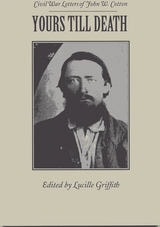
Yours Till Death
Civil War Letters of John W. CottonJohn Cotton
University of Alabama Press, 1951
Letters from a Confederate soldier to his wife during the Civil War.
Yours Till Death: Civil War Letters of John W. Cotton offers a rare and deeply personal window into the lived experience of the American Civil War through the words of an ordinary Confederate soldier. Composed of letters written by John W. Cotton to his wife in Coosa County, Alabama, this collection preserves an unfiltered, intimate record of wartime life from 1862 to 1865, revealing both the hardships of military service and the enduring ties of family and home.
Cotton, a yeoman farmer who enlisted in the Confederate Army in the spring of 1862, writes with directness and honesty about his daily experiences as he moves through the major campaigns of the war, including service in Tennessee, Kentucky, Georgia, and South Carolina. His correspondence captures not only the movements and conditions of military life—guard duty, illness, shortages, and shifting morale—but also the emotional landscape of a soldier separated from his family. His letters are filled with concern for his wife, children, and farm, illustrating the constant tension between duty to country and responsibility to home.
More than a military chronicle, Yours Till Death is also a valuable portrait of rural Southern life during wartime. Cotton’s references to crops, weather, labor, and household concerns provide insight into how families on the home front coped with absence, uncertainty, and economic strain. These details illuminate the broader social and agricultural context of the Confederacy, offering readers a richer understanding of how war reshaped everyday life for civilians as well as soldiers.
The letters, preserved and edited by historian Lucille Griffith, retain the immediacy and authenticity of Cotton’s voice. Written without the benefit of hindsight, they convey the evolving attitudes, anxieties, and hopes of a man living through one of the most turbulent periods in American history. As such, they serve as an important primary source for scholars and students, complementing official histories with the perspective of an individual whose experiences reflect those of countless others who lived and fought during the Civil War.
Yours Till Death will appeal to readers interested in Civil War studies, Southern history, and personal narratives of wartime experience. By bringing together themes of conflict, family, survival, and resilience, this collection transforms historical events into a deeply human story—one that reminds us that the past is best understood not only through battles and politics, but through the voices of those who lived it.