Results by title
2 books match the query 'Griggs, William C.'
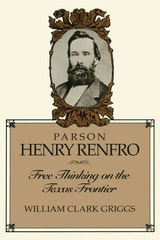
Parson Henry Renfro
Free Thinking on the Texas FrontierBy William C. Griggs
University of Texas Press, 1994
The years following the Texas Revolution held even more turbulent events as diverse droves of pioneers crossed the Sabine and Red Rivers to start new lives in Texas. Early Texas society contended with religious issues, family life in a rugged environment, and the Civil War. This cultural history was clearly reflected in the life of frontier preacher Henry C. Renfro.
Migrating to Texas in 1851, Renfro enrolled in the fledgling Baylor University and became a Baptist preacher. Eventually disillusioned with Baptist orthodoxy, Renfro was disenfranchised on charges of infidelity as he embraced the ideals of the Free Thought Movement, inspired by the writings of men such as Thomas Paine, Spinoza, and Robert Ingersoll.
Renfro's Civil War experience was no less unusual. Serving as both soldier and chaplain, Renfro left a valuable legacy of insight into the conflict, captured in a wealth of correspondence that is in itself significant.
Drawing on a vast body of letters, speeches, sermons, and oral histories that had never before been available, this chronological narrative of "The Parson's" life describes significant changes in Texas from 1850 to 1900, especially the volatile formation and growth of Baptist churches in North Central Texas. William Griggs' study yields numerous new details about the Free Thought Movement and depicts public reaction to sectarian leaders in nineteenth-century Texas.
The author also describes the developing Central Texas region known as the Cross Timbers, including the personal dynamics between a frontier family and its patriarch and encompassing such issues as property conflicts, divorce, and family reconciliation. This work unlocks an enlightening, engaging scene from Texas history.
The Confederados
Old South Immigrants in BrazilCyrus B. Dawsey
University of Alabama Press, 1998
The story of exiles from the Confederate South who fled to Brazil after the US Civil War. The collection includes a previously unpublished narrative by an original settler
In the wake of the American Civil War, thousands of disillusioned Southerners sought refuge far from Reconstruction’s reach—many found it in Brazil. The Confederados is a compelling exploration of this little-known migration, tracing the journey of Confederate exiles who forged new lives in the sugarcane fields of São Paulo. Through vivid personal narratives, scholarly essays, and rare archival insights, this volume uncovers the cultural, agricultural, and religious legacy these settlers left behind.
From the harrowing voyage of Sarah Bellona Smith Ferguson to the enduring traditions of the Campo chapel, the book reveals how these Americans shaped—and were shaped by—their Brazilian surroundings. It examines their impact on education, Protestantism, and farming, and how their descendants maintain a distinct identity more than a century later.
Richly illustrated and deeply researched, The Confederados is essential reading for anyone interested in Southern history, diaspora studies, or the global echoes of the Civil War. This is not just a story of exile—it’s a testament to resilience, adaptation, and the enduring ties between two nations.