Results by title
2 books match the query 'Ground Zero'
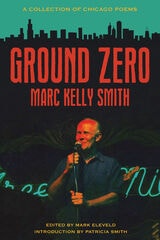
Ground Zero
A Collection of Chicago PoemsMarc Kelly Smith; Edited by Mark Eleveld; With an introduction by Patricia Smith
Northwestern University Press, 2021
Inception and implosion, Chicago’s grit and grandiosity all come together in the finite poetic power of the original Slam igniter, renowned poet Marc Kelly Smith and his retrospect denotation, Ground Zero.
A cultural, community, and adversarial figure, Smith has challenged the status quo and raised new questions about an environment in a state of continuous calamity. Smith’s power and influence have inspired celebrated figures who cut their teeth on both the stage and the page under his watchful eye—always speaking in the traditions of Carl Sandburg and Gwendolyn Brooks. Ground Zero challenges but pays homage to the thousand underbellies of Chicago with Smith’s wicked, cigarette-in-the-beer language: “I ain’t diggin’ no concrete coffin, / No backyard mausoleum / To keep me a pickle sweet aplenty / Plied with sardines and pork sausage wieners / Livin’ out the chance that some bubble-flesh victim / Will come puckered up and scabby lipped / To kiss me in the name of a new mankind.”
Ground Zero leaves no doubt. The Slampapi / instigator / visionary / you-may-love-me-or-hate-me-but-my-history-will-always-be-chiseled-in-everything-the-poetry-world-does-next collects a survey of his land and his experience, no matter how beautiful or flawed. This book lets the landmines of imagery and Chicago’s slow and uneasy drawl showcase one of our most original voices.
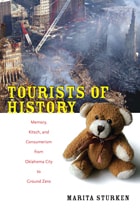
Tourists of History
Memory, Kitsch, and Consumerism from Oklahoma City to Ground ZeroMarita Sturken
Duke University Press, 2007
Sturken contends that a consumer culture of comfort objects such as World Trade Center snow globes, FDNY teddy bears, and Oklahoma City Memorial t-shirts and branded water, as well as reenactments of traumatic events in memorial and architectural designs, enables a national tendency to see U.S. culture as distant from both history and world politics. A kitsch comfort culture contributes to a “tourist” relationship to history: Americans can feel good about visiting and buying souvenirs at sites of national mourning without having to engage with the economic, social, and political causes of the violent events. While arguing for the importance of remembering tragic losses of life, Sturken is urging attention to a dangerous confluence—of memory, tourism, consumerism, paranoia, security, and kitsch—that promulgates fear to sell safety, offers prepackaged emotion at the expense of critical thought, contains alternative politics, and facilitates public acquiescence in the federal government’s repressive measures at home and its aggressive political and military policies abroad.