Results by title
2 books match the query 'Group identity in the performing arts'
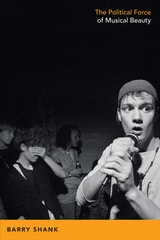
The Political Force of Musical Beauty
Barry Shank
Duke University Press, 2014
In The Political Force of Musical Beauty, Barry Shank shows how musical acts and performances generate their own aesthetic and political force, creating, however fleetingly, a shared sense of the world among otherwise diverse listeners. Rather than focusing on the ways in which music enables the circulation of political messages, he argues that communities grounded in the act and experience of listening can give rise to new political ideas and expression. Analyzing a wide range of "beautiful music" within popular and avant-garde genres—including the Japanese traditions in the music of Takemitsu Toru and Yoko Ono, the drone of the Velvet Underground, and the insistence of hardcore punk and Riot grrrl post-punk—Shank finds that when it fulfills the promise of combining sonic and lyrical differences into a cohesive whole, musical beauty has the power to reorganize the basis of social relations and produce communities that recognize meaningful difference.
[more]
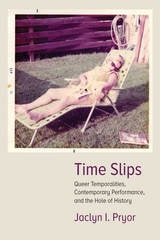
Time Slips
Queer Temporalities, Contemporary Performance, and the Hole of HistoryJaclyn I. Pryor
Northwestern University Press, 2017
This bold book investigates how performance can transform the way people perceive trauma and memory, time and history. Jaclyn I. Pryor introduces the concept of "time slips," moments in which past, present, and future coincide, moments that challenge American narratives of racial and sexual citizenship.
Framing performance as a site of resistance, Pryor analyzes their own work and that of four other queer artists—Ann Carlson, Mary Ellen Strom, Peggy Shaw, and Lisa Kron—between 2001 and 2016. Pryor illuminates how each artist deploys performance as a tool to render history visible, trauma recognizable, and transformation possible by laying bare the histories and ongoing systems of violence woven deep into our society. Pryor also includes a case study that examines the challenges of teaching queer time and queer performance within the academy in what Pryor calls a post-9/11 “homeland” security state.
Masterfully synthesizing a wealth of research and experiences, Time Slips will interest scholars and readers in the fields of theater and performance studies, queer studies, and American studies.
Masterfully synthesizing a wealth of research and experiences, Time Slips will interest scholars and readers in the fields of theater and performance studies, queer studies, and American studies.
[more]