Results by title
2 books match the query 'Guangdong Sheng'
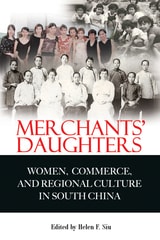
Merchants' Daughters
Women, Commerce, and Regional Culture in South ChinaEdited by Helen F. Siu
Hong Kong University Press, 2010
Historians and anthropologists have long been interested in South China where powerful lineages and gendered hierarchies are juxtaposed with unorthodox trading cultures, multi-ethnic colonial encounters, and market-driven consumption. The divergent paths taken by women in Hong Kong and Guangdong during thirty years of Maoist closure, and the post-reform cross-border fluidities have also gained analytical attention. This collection provides further theoretical application of a “regional construct” that appreciates process, transcends definitive powers of administrative borders, and brings out nuanced gender notions. An interdisciplinary team uses fine-grained historical and ethnographic materials to map out three crucial historical junctures in the evolution of South China, from late imperial to contemporary periods, that have significantly shaped the construction of gendered space. Stressing process and human agency, the volume uses women’s experiences to challenge dichotomous analytical perspectives on lineage patriarchy, colonial institutions, power, and social activism. For scholars of modern Hong Kong society, Merchants’ Daughters refocuses attention to cultural dynamics in the South China region of which Hong Kong is an integral part. For audiences generally interested in gender issues, this book illuminates the analytical importance of long historical periods in which layers of social, political, and economic activities intersected to constitute the complicated positioning of women.
[more]
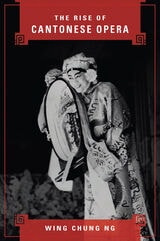
The Rise of Cantonese Opera
Wing Chung Ng
University of Illinois Press, 2015
Defined by its distinct performance style, stage practices, and regional and dialect based identities, Cantonese opera originated as a traditional art form performed by itinerant companies in temple courtyards and rural market fairs.
In the early 1900s, however, Cantonese opera began to capture mass audiences in the commercial theaters of Hong Kong and Guangzhou--a transformation that changed it forever. Wing Chung Ng charts Cantonese opera's confrontations with state power, nationalist discourses, and its challenge to the ascendancy of Peking opera as the country's preeminent "national theatre." Mining vivid oral histories and heretofore untapped archival sources, Ng relates how Cantonese opera evolved from a fundamentally rural tradition into urbanized entertainment distinguished by a reliance on capitalization and celebrity performers. He also expands his analysis to the transnational level, showing how waves of Chinese emigration to Southeast Asia and North America further re-shaped Cantonese opera into a vibrant part of the ethnic Chinese social life and cultural landscape in the many corners of a sprawling diaspora.
In the early 1900s, however, Cantonese opera began to capture mass audiences in the commercial theaters of Hong Kong and Guangzhou--a transformation that changed it forever. Wing Chung Ng charts Cantonese opera's confrontations with state power, nationalist discourses, and its challenge to the ascendancy of Peking opera as the country's preeminent "national theatre." Mining vivid oral histories and heretofore untapped archival sources, Ng relates how Cantonese opera evolved from a fundamentally rural tradition into urbanized entertainment distinguished by a reliance on capitalization and celebrity performers. He also expands his analysis to the transnational level, showing how waves of Chinese emigration to Southeast Asia and North America further re-shaped Cantonese opera into a vibrant part of the ethnic Chinese social life and cultural landscape in the many corners of a sprawling diaspora.
[more]