Results by title
6 books match the query 'Guangzhou'
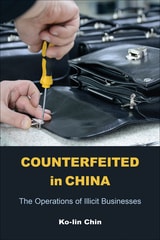
Counterfeited in China
The Operations of Illicit BusinessesKo-lin Chin
Temple University Press, 2025
Counterfeiting tops the list of organized crimes committed worldwide, raking in nearly half a trillion dollars in 2019. The impact of this illicit business is felt by consumers, brand owners, state authorities, and workers, and it impacts the economy. Moreover, its proliferation has fueled the advancement of organized crime groups.
In his illuminating study, Counterfeited in China, Ko-lin Chin investigates this lucrative industry and its emergence in China. His face-to-face interviews with counterfeiters — business owners, workers, facilitators, and key informants — in the hub of Guangzhou, China reveal how businesses that design, produce, and distribute fake and unauthorized luxury goods manage the risks inherent in their business.
Counterfeited in China examines the individual and group characteristics of counterfeiters and their relationships with organized crime; analyzes the economic aspects of counterfeiting; assesses the relationships among counterfeiting, violence, and corruption; and seeks to understand the demand for counterfeit goods. Chin also discusses the role of Chinese authorities and other parties in the war against counterfeiting.
Assessing the state of the industry and its future, Chin provides fascinating new insights into the modus operandi of counterfeiters.
[more]
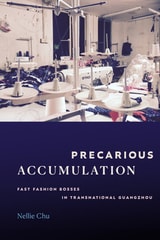
Precarious Accumulation
Fast Fashion Bosses in Transnational GuangzhouNellie Chu
Duke University Press, 2026
In Precarious Accumulation, Nellie Chu tells the story of the migrant entrepreneurs at the heart of Guangzhou’s fast fashion industry—one of the world’s most dynamic hubs of transnational commodity production. Chu shows how rural Chinese migrants, West African traders, and South Korean jobbers navigate the high-speed, low-margin world of just-in-time garment production that fuels the constant accumulation of wealth via global supply chains. Drawing on fieldwork in Guangzhou’s urban villages and household workshops, Chu outlines how these entrepreneurs’ dreams of economic freedom clash with the reality of precarity and the exclusions of emigre status. Migrant bosses operate within a highly competitive, informal economy where they are both agents and target of exploitation, as they must evade rent collectors, endure racialized policing, and mitigate extortion from security officers and competitors. Chu crucially demonstrates how their efforts generate novel forms of migratory labor, commodity production, and cross-cultural exchange in postsocialist China.
[more]
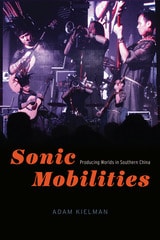
Sonic Mobilities
Producing Worlds in Southern ChinaAdam Kielman
University of Chicago Press, 2022
A fascinating look at how the popular musical culture of Guangzhou expresses the city’s unique cosmopolitanism.
Guangzhou is a large Chinese city like many others. With a booming economy and abundant job opportunities, it has become a magnet for rural citizens seeking better job prospects as well as global corporations hoping to gain a foothold in one of the world’s largest economies. This openness and energy have led to a thriving popular music scene that is every bit the equal of Beijing’s. But the musical culture of Guangzhou expresses the city’s unique cosmopolitanism. A port city that once played a key role in China’s maritime Silk Road, Guangzhou has long been an international hub. Now, new migrants to the city are incorporating diverse Chinese folk traditions into the musical tapestry.
In Sonic Mobilities, ethnomusicologist Adam Kielman takes a deep dive into Guangzhou's music scene through two bands, Wanju Chuanzhang (Toy Captain) and Mabang (Caravan), that express ties to their rural homelands and small-town roots while forging new cosmopolitan musical connections. These bands make music that captures the intersection of the global and local that has come to define Guangzhou, for example by writing songs with a popular Jamaican reggae beat and lyrics in their distinct regional dialects mostly incomprehensible to their audiences. These bands create a sound both instantly recognizable and totally foreign, international and hyper-local. This juxtaposition, Kielman argues, is an apt expression of the demographic, geographic, and political shifts underway in Guangzhou and across the country. Bridging ethnomusicology, popular music studies, cultural geography, and media studies, Kielman examines the cultural dimensions of shifts in conceptualizations of self, space, publics, and state in a rapidly transforming the People’s Republic of China.
[more]
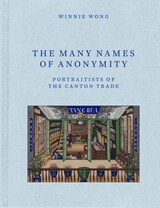
The Many Names of Anonymity
Portraitists of the Canton TradeWinnie Wong
University of Chicago Press, 2025
Explores how the function, norms, and meaning of artists’ names in Chinese modernity have been misunderstood.
Challenging contemporary procedures for establishing attribution, chronology, and authenticity in Chinese art, Winnie Wong explores the means, methods, and stakes of recovering the names of an anonymous community of artists. To examine how Western art history has misconstrued and miscategorized names and identities in Chinese art, she looks to conflicting features of modernity: the European attachment of singular names to individuals and their works, and the Chinese use of socially contingent names that often are not attached to material labor and sometimes operate against it. Wong charts the genealogy of this naming problem by bringing to life the artists of the Qing Empire’s trade with Europeans at the port of Guangzhou, centering on a group of portraitists known by names that were recorded in a pidgin language: Chin Qua, Chit Qua, Spoilum, Lam Qua, and Ting Qua.
Many of these paintings survive today, yet scholars have identified only a handful of the painters’ identities. Pushing against Western norms that have shaped our understanding of authorship, Wong reveals that these artists shared names, created works in multiples, and signed their pieces with different names or none at all. This lavishly illustrated volume explores portraiture across media, including unfired clay, reverse painting on glass, watercolor on paper, oil on canvas, and the daguerreotype, to propose new ways of studying anonymity, copying, and the emergence of author names in the Sino-European visual culture of the long eighteenth century.
[more]
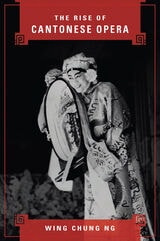
The Rise of Cantonese Opera
Wing Chung Ng
University of Illinois Press, 2015
Defined by its distinct performance style, stage practices, and regional and dialect based identities, Cantonese opera originated as a traditional art form performed by itinerant companies in temple courtyards and rural market fairs.
In the early 1900s, however, Cantonese opera began to capture mass audiences in the commercial theaters of Hong Kong and Guangzhou--a transformation that changed it forever. Wing Chung Ng charts Cantonese opera's confrontations with state power, nationalist discourses, and its challenge to the ascendancy of Peking opera as the country's preeminent "national theatre." Mining vivid oral histories and heretofore untapped archival sources, Ng relates how Cantonese opera evolved from a fundamentally rural tradition into urbanized entertainment distinguished by a reliance on capitalization and celebrity performers. He also expands his analysis to the transnational level, showing how waves of Chinese emigration to Southeast Asia and North America further re-shaped Cantonese opera into a vibrant part of the ethnic Chinese social life and cultural landscape in the many corners of a sprawling diaspora.
In the early 1900s, however, Cantonese opera began to capture mass audiences in the commercial theaters of Hong Kong and Guangzhou--a transformation that changed it forever. Wing Chung Ng charts Cantonese opera's confrontations with state power, nationalist discourses, and its challenge to the ascendancy of Peking opera as the country's preeminent "national theatre." Mining vivid oral histories and heretofore untapped archival sources, Ng relates how Cantonese opera evolved from a fundamentally rural tradition into urbanized entertainment distinguished by a reliance on capitalization and celebrity performers. He also expands his analysis to the transnational level, showing how waves of Chinese emigration to Southeast Asia and North America further re-shaped Cantonese opera into a vibrant part of the ethnic Chinese social life and cultural landscape in the many corners of a sprawling diaspora.
[more]
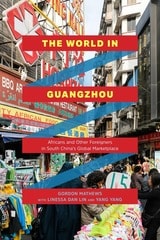
The World in Guangzhou
Africans and Other Foreigners in South China’s Global MarketplaceGordon Mathews, Linessa Dan Lin, and Yang Yang
University of Chicago Press, 2017
Only decades ago, the population of Guangzhou was almost wholly Chinese. Today, it is a truly global city, a place where people from around the world go to make new lives, find themselves, or further their careers. A large number of these migrants are small-scale traders from Africa who deal in Chinese goods—often knockoffs or copies of high-end branded items—to send back to their home countries. In The World in Guangzhou, Gordon Mathews explores the question of how the city became a center of “low-end globalization” and shows what we can learn from that experience about similar transformations elsewhere in the world.
Through detailed ethnographic portraits, Mathews reveals a world of globalization based on informality, reputation, and trust rather than on formal contracts. How, he asks, can such informal relationships emerge between two groups—Chinese and sub-Saharan Africans—that don't share a common language, culture, or religion? And what happens when Africans move beyond their status as temporary residents and begin to put down roots and establish families?
Full of unforgettable characters, The World in Guangzhou presents a compelling account of globalization at ground level and offers a look into the future of urban life as transnational connections continue to remake cities around the world.
[more]