Results by title
4 books match the query 'Guardian'
Atlanta Life Insurance
Guardian of Black Economic DignityAlexa Benson Henderson
University of Alabama Press, 1990
Efforts to develop an economic base within the Black community began even before the Civil War. These efforts gained new meaning in the post-Reconstruction period as Blacks strove to adapt to radically changing economic circumstances and the emergence of the Jim Crow South. In Atlanta, shortly after the turn of the century, Alonzo Franklin Herndon, a former slave, joined a long line of Black entrepreneurs by creating Atlanta Life Insurance Company. More than three-quarters of a century later, it remains an important enterprise that is the nation’s largest Black-controlled shareholder insurance company. The firm is today a significant example of the efforts of Black Americans to achieve economic independence and dignity in America.
Capitalism's Conscience
200 Years of the GuardianDes Freedman
Pluto Press, 2021
Since its inception in Manchester in 1821 as a response to the 1819 Peterloo Massacre, the Guardian has been a key institution in the definition and development of liberalism. The stereotype of the 'Guardianista', an environmentally-conscious, Labour-voting, progressively-minded public sector worker endures in the popular mythology of British press history.
Yet the title has a complex lineage and occupies an equivocal position between capital and its opponents. It has both fiercely defended the need for fearless, independent journalism and handed over documents to the authorities; it has carved out a niche for itself in the UK media as a progressive voice but has also consistently diminished more radical projects on the left.
Published to coincide with its 200th anniversary, Capitalism's Conscience brings together historians, journalists and activists in an appraisal of the Guardian's contribution to British politics, society and culture - and its distinctive brand of centrism. Contextualising some of the main controversies in which the title has been implicated, the book offers timely insights into the publication's history, loyalties and political values.
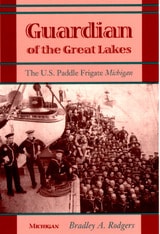
Guardian of the Great Lakes
The U.S. Paddle Frigate MichiganBradley A. Rodgers
University of Michigan Press, 1996
Guardian of the Great Lakes is the saga of the USS Michigan, an archetype iron-hulled war steamer launched in 1843. Its mission was to patrol the ofttimes volatile Great Lakes region, quelling port town civil disturbances, while at the same time rescuing both Canadian and American ships in distress.
The Michigan found itself unavoidably attracted to calamity, leaving in its wake a collection of eyewitness accounts to these momentous yet largely forgotten occurences. Incidents such as the timber rebellion of the 1850s, which occurred in Wisconsin, Illinois, and Michigan, are documented for the first time. Other episodes such as the assassination of "king" Strang on Beaver Island and the destruction of the community there are studied under the light of newly discovered sources. Still other chapters reveal the chaos created by the Civil War on the lakes, the destructive mining strikes of Michigan's Upper Peninsula, and the tragic, bloody, Fenian invasion of Canada.
Between major calamities lay the vagaries of maritime life on the Great Lakes detailed in the records of the Michigan's crew. From their social and community life in Erie, Pennsylvania to storms, shipwrecks, and sickness, the records kept by the men and officers of the USS Michigan have helped to produce in this book an accurate and detailed narrative of naval and maritime life on the Great Lakes during this important period.
Bradley A. Rodgers is Assistant Professor, Program in Maritime History and Nautical Archaeology, East Carolina University.
The Guardian
The History of South Africa's Extraordinary Anti-Apartheid NewspaperJames Zug
Michigan State University Press, 2007
In this fascinating history of the Guardian, South Africa’s famous anti-apartheid newspaper, James Zug tells the story of a political publication that not only reported events but also helped to shape them. Between 1937 and 1963, the Guardian was the sole voice of dissent in the South African media, and Zug shows us how it played an essential rolein the struggle to end apartheid.
Combining a scholar’s attention to facts with a journalist's sense of the dramatic, Zug recreates a tumultuous and dangerous era. The newspaper's telephones were tapped, articles were censored, and staff members were jailed and deported. The apartheid regime banned the paper three times, charged it with high treason, and could only silence it completely, in 1963, by placing the entire staff under house arrest. As Zug explains, the Guardian persisted through the harassment and torment because the paper's staff knew the significance of their work: "We not only record the struggle for freedom, we are actively participating in it." When wages were kept low, when workers went on strikes, and when fascism reared its head in South Africa, the Guardian spoke up. At its height, the paper sold more than 50,000 copies a week nationally, with four bureaus across the country.
As Nelson Mandela, head of the African National Congress (ANC), led the movement to end apartheid, he issued messages through the paper. Perhaps the newspaper's most significant accomplishment, Zug writes, was uniting the ANC and the South African Communist Party. The Guardian translated Marxism into an African idiom for the ANC, bringing together the two factions that propelled the liberation struggle into a mass movement.
This highly readable work is more than a perceptive look at an influential paper. It is a testament to the power of the printed word in ending injustice and changing the course of history.