Results by title
3 books match the query 'Guatemalan literature'
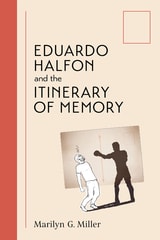
Eduardo Halfon and the Itinerary of Memory
Marilyn G. Miller
Vanderbilt University Press, 2024
Arguably, all of Guatemalan writer Eduardo Halfon’s fictional works deal with quandaries of translation, even in their original versions. The award-winning author of fifteen books claims to have lost his mother tongue when his family fled to the United States after his tenth birthday. This displacement, echoing the displacement of his four grandparents from different corners of the Jewish diaspora to Guatemala, gives Halfon, like his ancestors before him, good reason to consider translation a natural environment for his creative work and for life itself. Indeed, Halfon’s uncanny ability to translate his family’s history into “fictions” that resonate across the globe with readers in Spanish, English, and several other languages helps explain why he has received numerous prizes in the United States, Spain, Guatemala, and even France, some as a Latin American author, others as a Latino or Jewish author.
Marilyn G. Miller has written the first study to focus exclusively on this important voice in Jewish–Latin American letters. Only after returning to Guatemala and regaining his command of Spanish through reading literature did Halfon begin to build his life as a writer and translator. Nonetheless, the author admits that “one thing is stubbornly true, and it’s this: every sentence that I write, every verb or adjective that I painstakingly insert or remove, every literary thought that I have while writing, always . . . begins and ends in English.” Halfon’s translated works are never parallel texts, however. Thus, translation and its side effects (foreign words, linguistic lacunae, multilingual modes of perception) offer us crucial keys to understanding the author’s fictional world as a vehicle for retelling and surviving Jewish trauma and finding his own particular plurilingual voice.
Marilyn G. Miller has written the first study to focus exclusively on this important voice in Jewish–Latin American letters. Only after returning to Guatemala and regaining his command of Spanish through reading literature did Halfon begin to build his life as a writer and translator. Nonetheless, the author admits that “one thing is stubbornly true, and it’s this: every sentence that I write, every verb or adjective that I painstakingly insert or remove, every literary thought that I have while writing, always . . . begins and ends in English.” Halfon’s translated works are never parallel texts, however. Thus, translation and its side effects (foreign words, linguistic lacunae, multilingual modes of perception) offer us crucial keys to understanding the author’s fictional world as a vehicle for retelling and surviving Jewish trauma and finding his own particular plurilingual voice.
[more]
Literature and Resistance in Guatemala
Textual Modes and Cultural Politics from El Señor Presidente to Rigoberta MenchúMarc Zimmerman
Ohio University Press, 1994
What circumstances lead writers in a poor, multi-ethnic and largely illiterate country to produce a literature that both expresses and affects opposition to the regime? Who are these writers? This study examines these and other questions about the literature of resistance in Guatemala, from the days of Estrada Cabrera up to the events of May and June of 1993. Zimmerman provides the cultural context for the various modes of literary production and analysis, and identifies the currents of opposition in the nation’s fiction, poetry, and testimonial writing. He details the cultural politics involving Guatemalan writers and their organizations during their years of Cerezo and Serrano-Elías, paying particular attention to the role of women and indigenous groups, Rigoberta Menchú among them. These two volumes are companion texts to Guatemala: Voices from the Silence, an “epic-collage” of writings compiled by Zimmerman and Raúl Rojas.
[more]
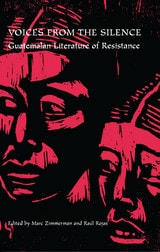
Voices from the Silence
Guatemalan Literature of ResistanceMarc Zimmerman
Ohio University Press, 1998
The conquest, colonization, independence, the liberal reforms, the regimes, revolution, and dictatorships, the insurrections and ongoing peace dialogues all are combined in a narrative projecting the most important forces in Guatemalan history from the Mayan period to our own times. Using excerpts from poems, novels, stories, essays, and interviews by writers ranging from Cardoza y Aragón and Nobel Prize winner Miguel Angel Asturias to the indigenous and testimonial voices of Rigoberta Menchú and Mario Payeras, this full sampling of a country’s literature is, in truth, a documentary of realism and magic. Voices from the Silence bears witness to a nation’s long journey toward some ideal community for which so many have fought and died. Texts translated by Marc Zimmerman with the collaboration of Robert Scott Curry, Linda Thelma Campos, Preston Browning, Brad Stull, and Anne Woerhle.
[more]